Understanding the Impact of Missing Your Daily Invisalign Wear
Not wearing Invisalign for a day can set back your treatment progress, but it won’t ruin everything. Here’s what happens:
Immediate Effects (Within 24 Hours):
- Minor tooth shifting back toward original positions due to flexible ligaments
- Tighter fit when you reinsert aligners, causing temporary discomfort
- Pause in bone remodeling that guides tooth movement
What You Should Do:
- Reinsert your aligners immediately
- Wear them for the full 22 hours for the next few days
- Do NOT skip ahead to the next tray
- Contact your orthodontist if aligners feel extremely tight or don’t fit
Long-Term Risk: Repeated missed days can extend treatment by weeks or months and may require additional aligners.
Life gets busy. Maybe you forgot your aligners at home during a weekend trip, or you removed them for a special event and lost track of time. If you’re wondering whether not wearing Invisalign for a day is a serious problem, you’re asking the right question.
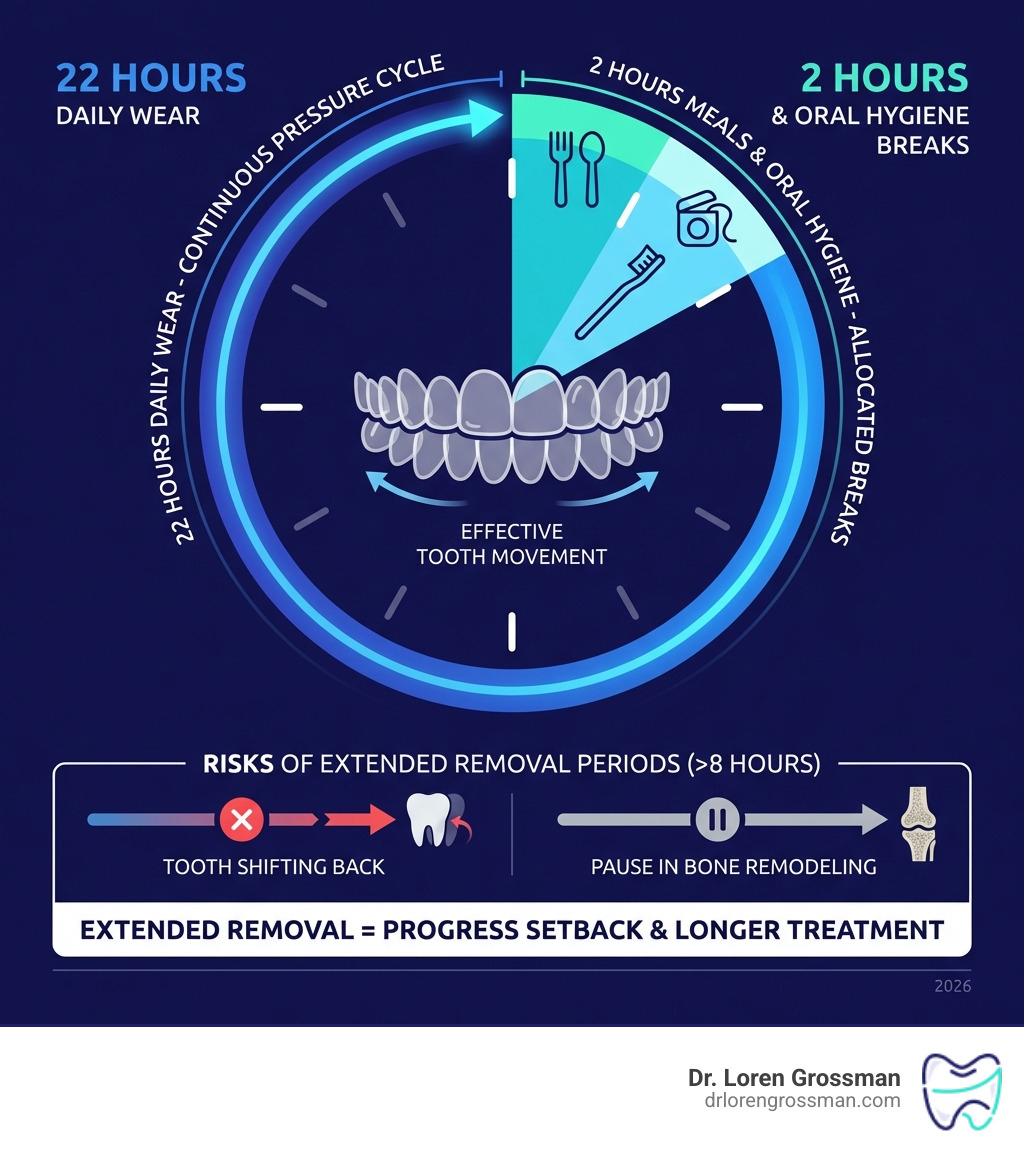
The truth is straightforward: consistency matters more than perfection. Invisalign aligners need to apply gentle, continuous pressure for at least 20 to 22 hours every day to move your teeth gradually. When you remove them for longer than recommended, your teeth can shift back slightly because of the flexible ligaments that connect them to your jawbone.
Missing a single day won’t destroy your treatment, but it can slow your progress and make your aligners feel uncomfortably tight when you put them back in. The longer you go without wearing them, the more your teeth may revert to their original positions.
As Dr. Loren Grossman, I’ve guided countless patients through Invisalign treatment in Northeastern Pennsylvania since 1984, and I’ve seen how even small lapses in wear time can affect results. Understanding what happens when you’re not wearing Invisalign for a day helps you make informed decisions and get back on track quickly.
What Happens If You Are Not Wearing Invisalign for a Day?
When you are not wearing Invisalign for a day, your mouth undergoes a biological “pause” that can quickly turn into a “rewind.” To understand why, we have to look at the biology of your smile. Your teeth are not fixed like nails in a board; they are held in place by a complex network of periodontal ligaments and bone tissue.
The Role of Flexible Ligaments
These ligaments are incredibly flexible. When you wear your aligners, they apply a precise, constant force (moving teeth about 0.25mm per tray) that signals your body to break down bone on one side of the tooth and build it on the other. This process is called bone remodeling. The moment that pressure is removed, those flexible ligaments act like tiny rubber bands, trying to pull your teeth back to where they used to be.
Immediate and Short-Term Effects
If you skip a full 24-hour period, you will likely notice immediate changes:
- Minor Shifting: While you might not see it in the mirror, your teeth can shift back toward their original positions in as little as a few hours.
- Immediate Discomfort: When you finally reinsert the trays, they will feel significantly tighter. This is because the tray is still at the “target” position while your teeth have drifted “backward.”
- Speech and Comfort: Some patients remove their aligners to avoid a slight lisp during presentations, but doing so for a full day means your tongue and mouth have to readjust all over again once the trays are back in.
The 24-hour limit is a critical threshold. Most orthodontists agree that after 24 hours without wear, the risk of “tracking” issues—where the aligner no longer fits the teeth perfectly—increases dramatically.
The Science of the 22-Hour Rule and the 8-Hour Limit
Why is 22 hours the magic number? It’s not a random guess; it’s based on the physiological requirements of tooth movement.
22-Hour Wear vs. 12-Hour Wear
Statistics show that patients who hit the 22-hour goal experience predictable, steady movement. If wear time drops to 12 hours or less, the teeth spend half the day moving forward and the other half drifting back. This “tug-of-war” prevents the bone from ever fully stabilizing around the new position.
| Wear Time | Resulting Tooth Movement | Risk of Relapse |
|---|---|---|
| 22-23 Hours | Optimal / On Schedule | Very Low |
| 20 Hours | Acceptable / Minor Delays | Low |
| 12-15 Hours | Stalled / Inconsistent | High |
| <8 Hours | Negative (Teeth Shifting Back) | Extremely High |
The 8-Hour Rule
A general rule of thumb in the orthodontic community is that you can safely leave your Invisalign out for up to 8 hours at a time (for example, during a long dinner or a wedding), provided you wear them for the remaining 16 hours of the day. However, skipping a full day—and especially leaving them out overnight—is much more detrimental.
When you sleep, your jaw often clenches or moves, and without the aligners to provide a barrier and constant pressure, the “drift” can be more pronounced. Continuous pressure is the only way to ensure that 0.25mm of movement per tray actually happens.
How to Recover and Get Back on Track
If you’ve realized you’ve spent the last 24 hours not wearing Invisalign for a day, don’t panic. The key is how you handle the next 48 hours.
Resuming Wear Immediately
The first step is to clean your aligners and put them back in immediately. Do not wait for a “convenient” time. Every hour counts when you are trying to stop the relapse. You can find more orthodontic care tips here to help maintain your trays.
If you are in our local area, we offer specialized support for Invisalign in Kingston, PA to help patients navigate these minor setbacks and ensure their trays are still tracking correctly.
Immediate Steps After Not Wearing Invisalign for a Day
- Assessment: When you put the tray in, does it seat all the way? If there are large gaps between the edge of your teeth and the bottom of the tray, you have a tracking issue.
- Wear Time Extension: If you were supposed to switch to a new tray tomorrow, but you missed today, we recommend wearing your current tray for an extra 24 to 48 hours to make up for the lost time.
- Consultation: If the tray simply won’t fit or causes excruciating pain, you must contact your provider. You can review our Invisalign services for more details on how we handle mid-course corrections.
Managing Discomfort After Not Wearing Invisalign for a Day
It is normal for the aligners to feel tight or for your teeth to feel sore after a lapse. This is because the tray is forcing the teeth back into the alignment they started to leave.
- Use Chewies: These are small, soft cylinders you bite down on to help “seat” the aligner fully against your teeth.
- Cold Water: Sips of cold water can help soothe the inflammation in the ligaments.
- Avoid Tray Skipping: Never try to “catch up” by moving to the next tray early. This can cause root damage if the teeth are moved too quickly without proper support.
Long-Term Consequences of Inconsistent Wear
While one day is a hiccup, a pattern of not wearing Invisalign for a day every week can lead to serious complications.
Treatment Delays and Costs
Each aligner is a step in a carefully choreographed dance. If one step is missed, the rest of the routine falls apart. Missing multiple days can extend your treatment by months. In some cases, your teeth may shift so far out of the planned path that your current trays no longer work. This requires a “mid-course correction”—a new scan and a new set of trays—which can add significant costs to your treatment.
Precision and Complex Movements
Invisalign isn’t just for simple straightening. We often use it for complex movements involving Invisalign and dental implants. These movements require extreme precision. If you have “attachments” (small tooth-colored bumps) on your teeth, the aligner must grip them perfectly. Inconsistent wear means the aligner loses its “grip” on these attachments, making complex rotations impossible.
Proactive Strategies to Prevent Missed Wear Time
The best way to handle a missed day is to make sure it never happens again. Here is how we recommend our patients stay compliant:
- Phone Alerts: Set a timer on your phone every time you take your trays out to eat. If the timer hits 30 minutes and you haven’t put them back in, it’s time to wrap up lunch!
- The “Case Always” Rule: Never wrap your aligners in a napkin (the #1 way they get thrown away). If they aren’t in your mouth, they should be in their case.
- Meal Planning: Try to consolidate your eating into three main blocks to maximize your “trays-in” time.
- Wear Indicators: If you have a teen in treatment, many Invisalign trays come with small blue dots that fade with wear. This helps parents and doctors monitor compliance.
Frequently Asked Questions about Invisalign Compliance
Will skipping one day ruin my Invisalign progress?
No, skipping one day won’t “ruin” your smile forever, but it will cause minor relapse and discomfort. It is a speed bump, not a brick wall. However, if you skip a day and then try to move to your next tray immediately, you might run into fit issues.
How long can I safely leave my aligners out?
The official recommendation is no more than 2 hours a day. However, a “safe” limit for a one-time event is about 8 hours. Anything beyond 24 hours is considered a significant lapse that requires professional advice.
What should I do if my aligners don’t fit after a break?
If you’ve been not wearing Invisalign for a day or more and the trays won’t seat, try going back to your previous set of trays if you still have them. This can act as a “bridge” to get your teeth back to where they need to be. Then, call our office to schedule an assessment.
Conclusion
At the practice of Dr. Loren Grossman, we believe that every patient deserves a smile they can be proud of. Whether you are in Kingston, Wilkes-Barre, Scranton, or Dallas, we provide the personalized, high-tech care needed to keep your Invisalign journey on track.
Don’t let a single missed day discourage you from reaching your goals. If you’ve had a lapse in wear time or are ready to start your journey toward a straighter smile, we are here to help. Our team focuses on the unique needs of patients throughout Northeastern Pennsylvania, ensuring that even when life gets in the way, your smile transformation doesn’t have to stop.
Schedule your Invisalign consultation today and let us help you achieve the perfect smile with the care and expertise you deserve.