Restoring Your Smile After Tooth Loss
Dental bridge vs implant — these are the two most common solutions when you’ve lost a tooth. Here’s what you need to know to make the right choice:
| Factor | Dental Bridge | Dental Implant |
|---|---|---|
| Timeline | 1-2 weeks | 3-9+ months |
| Lifespan | 5-15 years | 15+ years (post can last lifetime) |
| Cost | $500-$1,500 per unit | $3,000-$4,500 per tooth |
| Procedure | Non-surgical | Requires surgery |
| Bone Health | Allows bone loss | Preserves jawbone |
| Adjacent Teeth | Must be reshaped | Not affected |
Losing a tooth affects how you eat, speak, and feel about yourself. It’s a common issue; an estimated 69 percent of adults aged 35 to 44 have lost at least one adult tooth. By age 74, about a quarter of Americans have lost all their adult teeth.
When you lose a tooth, remaining teeth can shift, your jawbone can shrink, and your facial structure can change. The good news is that modern dentistry offers two excellent solutions: dental bridges and dental implants.
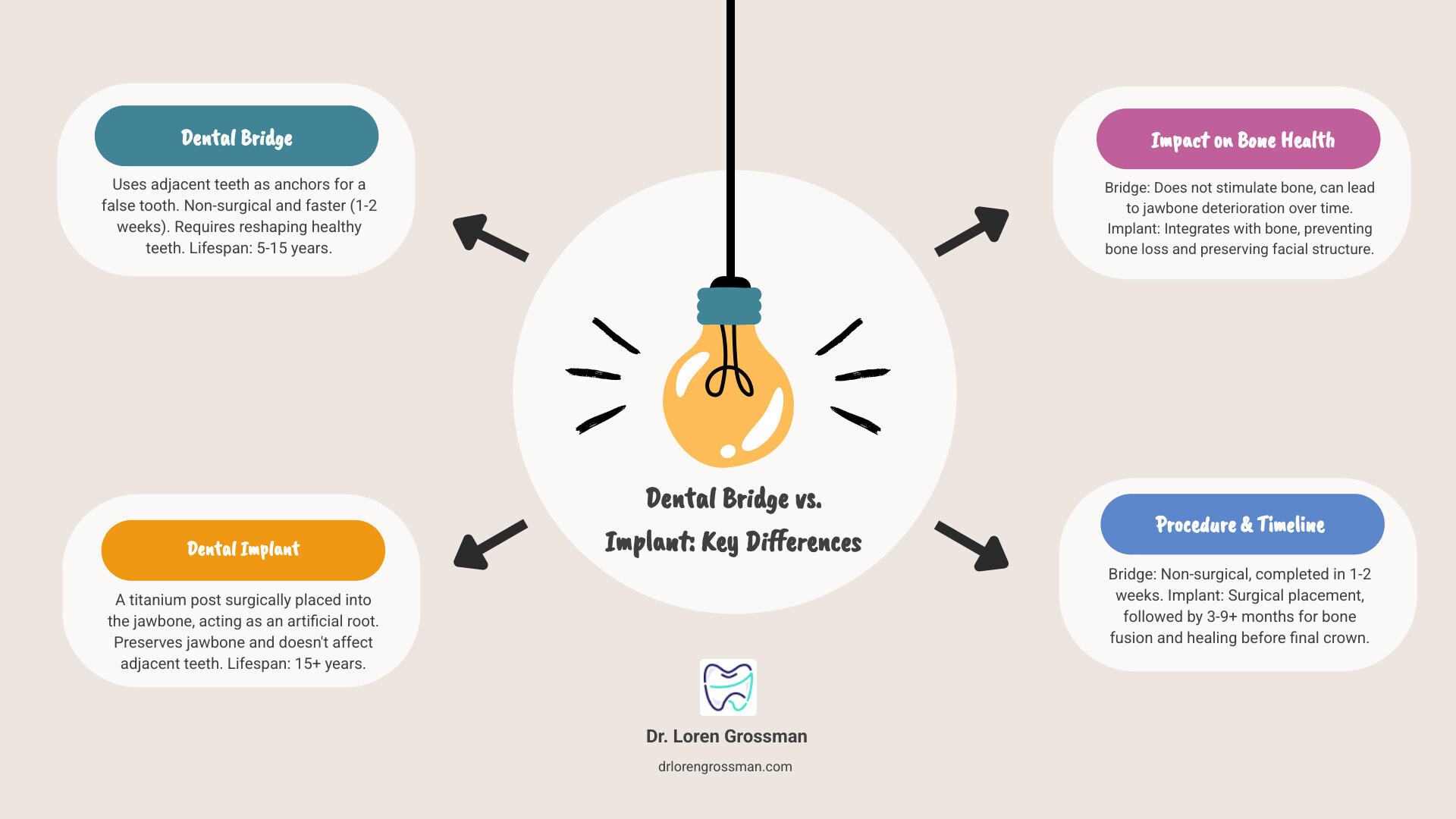
A dental bridge uses your neighboring teeth as anchors to hold a false tooth in place. It’s a faster fix that doesn’t require surgery.
A dental implant replaces your missing tooth at the root level with a titanium post surgically placed into your jawbone. It’s a standalone solution that preserves bone health.
Both options can look natural and restore your ability to chew comfortably, but they differ in cost, timeline, durability, and their effect on your oral health. The right choice depends on your specific situation—your bone health, budget, timeline, and long-term goals.
I’m Dr. Loren Grossman, and since 1984, I’ve helped patients in Northeastern Pennsylvania restore their smiles. With decades of experience placing dental implants and crafting bridges, I know that understanding the dental bridge vs implant comparison is key to making a confident decision about your oral health.
Understanding the Contenders: How Bridges and Implants Work
When a tooth goes missing, it leaves a void that needs to be addressed to prevent an impact on your appearance and long-term oral health. We offer two primary solutions: dental bridges and dental implants. Let’s explore what each of these restorative options entails.
What is a Dental Bridge?
A dental bridge, or fixed dental prosthesis, is a non-removable restoration that fills the space of one or more missing teeth. It’s a classic, time-tested solution in restorative dentistry that can quickly restore your smile.
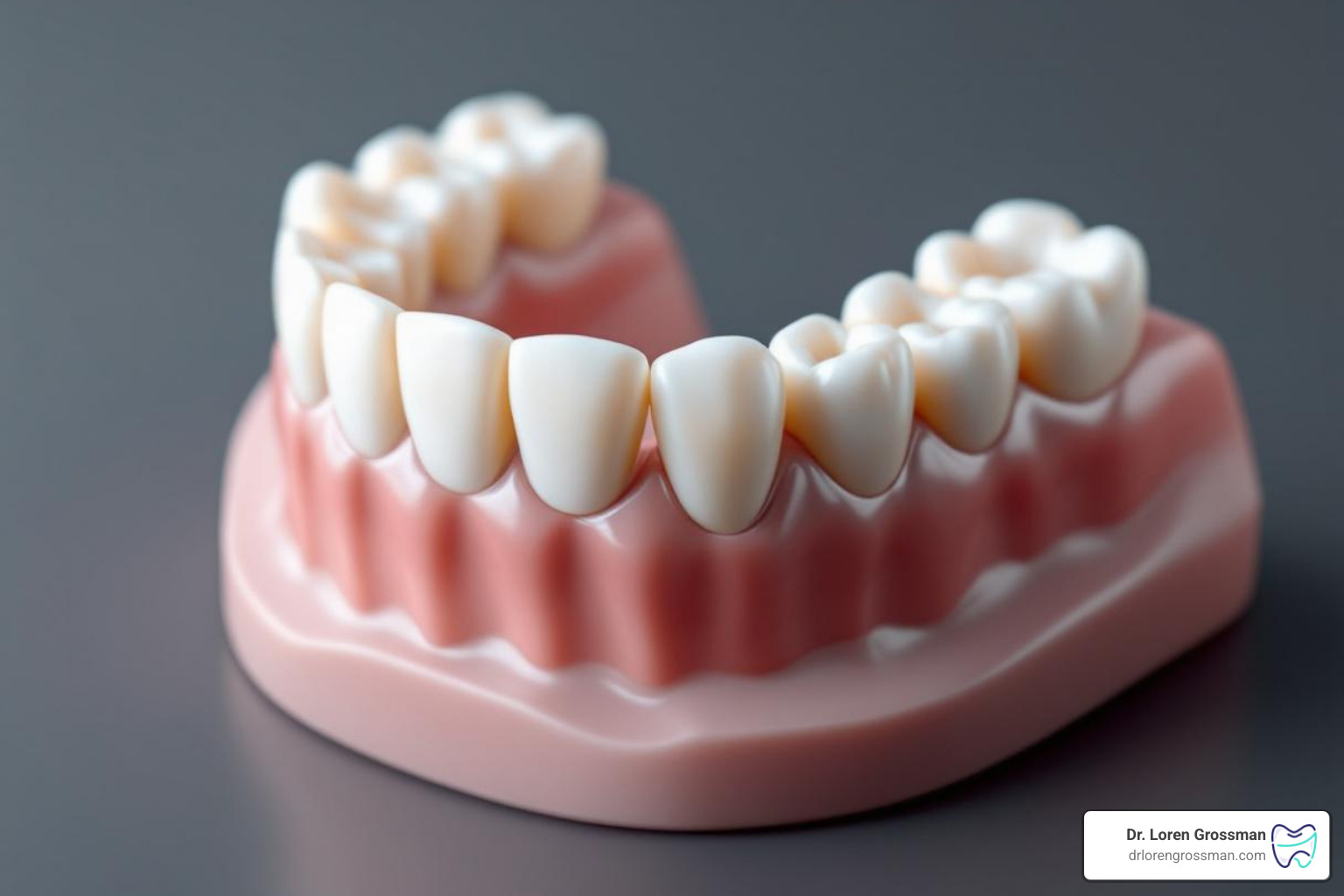
So, how does it work? A traditional dental bridge consists of three main parts:
- The Pontic (False Tooth): This is the artificial tooth that replaces the missing one. It’s custom-made from materials like porcelain or ceramic to match your natural teeth.
- Abutment Teeth (Anchors): These are the healthy natural teeth on either side of the gap that are strong enough to support the pontic.
- Crowns: To secure the pontic, crowns are placed over the abutment teeth. These crowns act as anchors, holding the pontic firmly in place and “bridging” the gap.
We can use a dental bridge to replace one to three teeth in a row, and sometimes up to four if there is enough support. The process is straightforward and non-surgical, making it an appealing option for many patients.
To learn more about how we can restore your smile with this option, visit our dedicated page on Crowns & Bridges.
What is a Dental Implant?
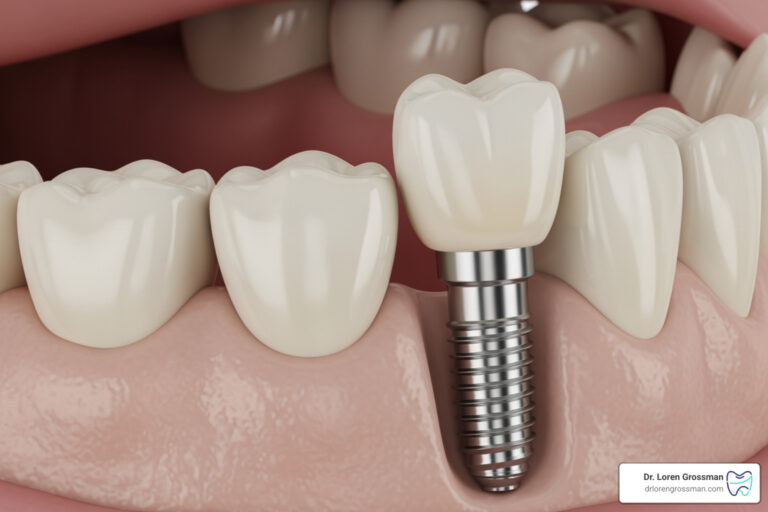
A dental implant is an artificial tooth root, typically made of titanium, that is surgically placed into the jawbone. It acts as a strong, permanent foundation for a replacement tooth, closely mimicking the natural tooth structure from root to crown.
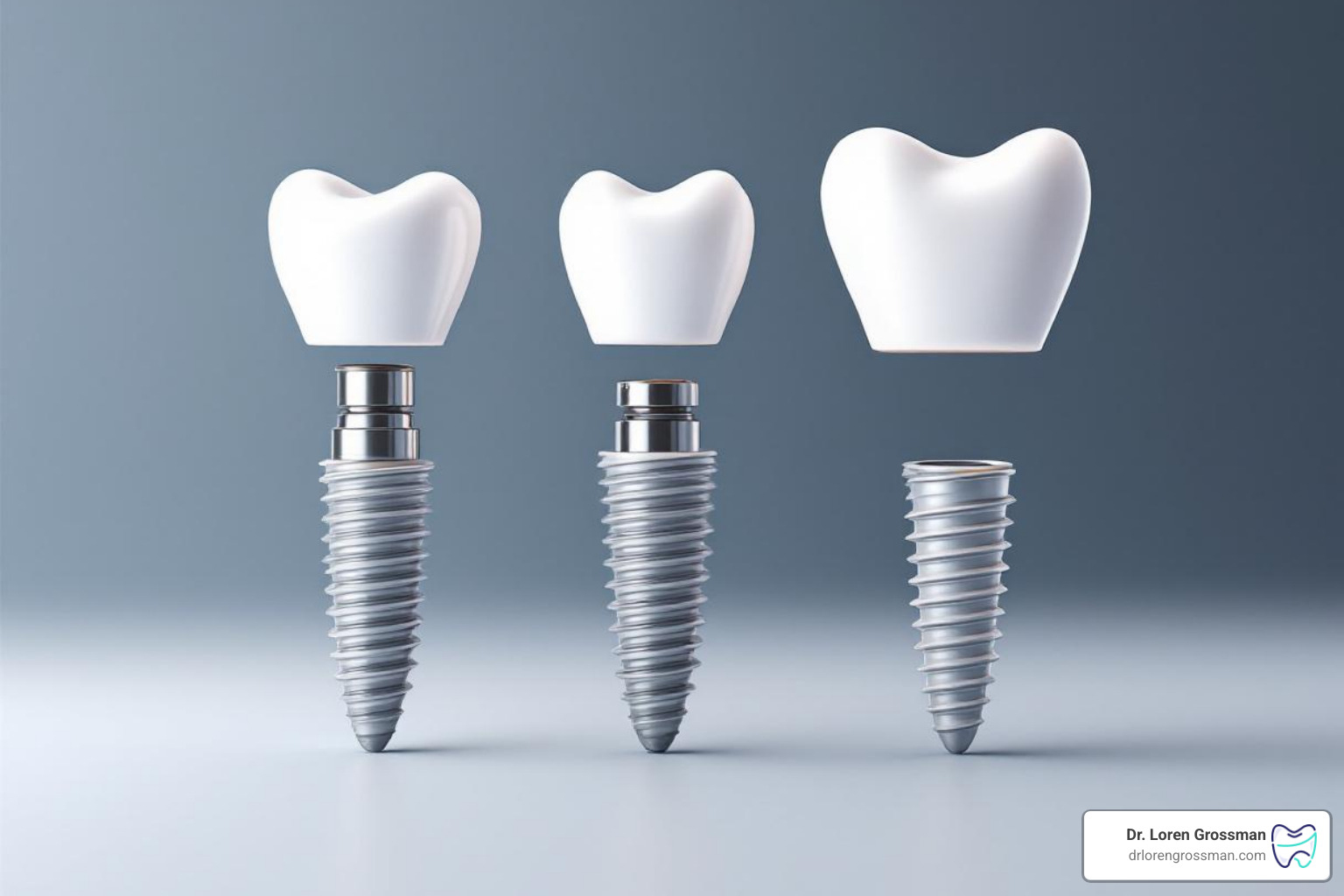
Here’s a closer look at its components:
- Titanium Post (The “Root”): This small, screw-shaped post is surgically inserted into your jawbone. Titanium is biocompatible, meaning it can fuse with bone tissue.
- Osseointegration (Bone Fusion): Over several months, your jawbone naturally grows around and fuses with the titanium post. This process creates an incredibly strong and stable foundation.
- Abutment: Once the implant has fused with the bone, a small connector piece called an abutment is attached to the post, protruding above the gum line.
- Crown: Finally, a custom-made crown, designed to match your natural teeth, is securely attached to the abutment.
A key advantage of an implant is that it’s a standalone structure, so it doesn’t rely on or require altering healthy adjacent teeth. Crucially, dental implants also preserve jawbone health. The post integrates with the bone, providing the stimulation needed to prevent the bone loss that typically occurs after a tooth is lost, which helps maintain your facial structure.
We believe in providing solutions that last a lifetime. Find more about our advanced dental implant services on our Dental Implants page.
The Procedure: A Step-by-Step Timeline Comparison
Knowing what to expect during treatment is key. The journey to a restored smile differs significantly for a dental bridge vs implant, especially in the timeline and surgical involvement.
The Dental Bridge Process: A Faster Fix
A major appeal of a dental bridge is its quick, non-surgical process. With no bone surgery required, the experience is faster and less invasive, typically completed in just two to three office visits over a couple of weeks.
Here’s what you can expect:
- Tooth Preparation: During your first visit, we prepare the abutment teeth (on either side of the gap) by reshaping them to make room for the crowns that will hold the bridge.
- Impressions: We then take precise impressions of your mouth, which are sent to a dental lab to fabricate your custom-made bridge.
- Temporary Bridge Placement: While your permanent bridge is being crafted, we’ll place a temporary one to protect the prepared teeth and gums.
- Final Fitting and Cementation: Once your permanent bridge is ready (usually within a week or two), you’ll return for your final visit. We’ll check its fit and bite before permanently cementing it into place.
The process for getting a bridge is straightforward and efficient. If you’re looking for a relatively quick solution to restore your smile, a dental bridge might be an excellent choice.
The Dental Implant Process: A Long-Term Investment in Time
The dental implant process is a longer-term investment due to its surgical nature and the body’s healing time. While the full timeline can take three to nine months or more, the resulting bone preservation and durable, standalone tooth replacement are often worth the wait.
Here’s a breakdown of the typical implant journey:
- Consultation and Planning: We conduct a thorough examination, including X-rays and 3D scans, to assess your bone density and gum health and create a personalized treatment plan.
- Implant Post Surgery: In this step, we surgically place the titanium implant post into your jawbone under local anesthesia to ensure you feel no pain.
- Healing and Osseointegration: This is the longest phase. After placement, the implant needs time to fuse with your jawbone. This critical process, called osseointegration, can take anywhere from three to nine months as your bone grows around and fuses with the implant, creating a strong, stable foundation.
- Abutment Placement: Once osseointegration is complete, a minor procedure may be needed to attach the abutment – the connector post – to the implant.
- Final Crown Attachment: After the gums heal, we take final impressions to create your custom crown. Once ready, it’s securely attached to the abutment.
While the implant process is more involved, the result is a remarkably stable, natural-feeling, and long-lasting tooth replacement. We use cutting-edge techniques to make this process as efficient and comfortable as possible. You can explore our advanced methods on our page about New Technology and Dental Implant Placements.
Head-to-Head: A Full Dental Bridge vs Implant Comparison
Both bridges and implants effectively replace missing teeth, but they differ in longevity, maintenance, and overall oral health impact. A direct comparison can help you decide which is best for you.
| Feature | Dental Bridge | Dental Implant |
|---|---|---|
| Lifespan | 5-15 years (typically 5-7 years before replacement needed) | 15+ years; post can last a lifetime |
| Durability | Good, but relies on adjacent teeth | Excellent; acts like a natural tooth root |
| Cost (Initial) | Lower upfront ($500-$1,500 per unit + crown) | Higher upfront ($3,000-$4,500 per tooth) |
| Cost (Long-Term) | Higher due to replacements, potential issues with abutment teeth | Lower due to longevity, less chance of issues with adjacent teeth |
| Procedure | Non-surgical, 2-3 visits (1-2 weeks) | Surgical, multiple visits (3-9+ months) |
| Maintenance | Requires special cleaning (floss threaders), risk of decay on abutment teeth | Cleaned like natural teeth (brushing, flossing), regular check-ups |
| Bone Health | Does not prevent bone loss in missing tooth area | Preserves jawbone, prevents bone loss |
| Adjacent Teeth | Must be reshaped (crowned) to support the bridge | Not affected; stands alone |
| Aesthetics | Can look natural, but may lose appearance over time | Blends seamlessly, emerges naturally from gumline |
Durability and Lifespan
Longevity is a major factor when comparing a dental bridge vs implant.
- Dental Bridges: A well-maintained bridge can last 10-15 years, but many need replacement every 5 to 7 years. The supporting abutment teeth can be susceptible to decay or gum disease, which can compromise the bridge.
- Dental Implants: Implants are the longest-lasting option. The titanium post, once integrated with the bone, can last a lifetime with proper care. While the crown may need replacement after about 15 years, the foundation remains. Dental implants boast an impressive 10-year success rate of around 97 percent, making them a highly reliable and durable choice.
Aesthetics and Maintenance
Aesthetics and ease of maintenance are also crucial daily considerations.
- Aesthetics: Both options are designed to look natural. However, implants often replicate the appearance of a natural tooth more perfectly because they emerge directly from the gumline.
- Maintenance: This is a significant point of comparison.
- Dental Implants: Care for implants just like your natural teeth: regular brushing, flossing, and routine dental check-ups are all that’s needed.
- Dental Bridges: Bridges require more challenging cleaning. You’ll need special tools, like a floss threader, to clean underneath the pontic (false tooth). This is critical because the abutment teeth are still susceptible to cavities and decay, which can jeopardize the entire bridge.
Making the Right Choice for Your Health and Budget
Choosing between a dental bridge vs implant is a personal decision based on your unique oral health, lifestyle, and budget. At Dr. Loren Grossman’s office, we help patients in Northeastern Pennsylvania steer these factors to make an informed choice for a confident, healthy smile.
Candidacy: Are You a Better Fit for a Dental Bridge vs Implant?
Your suitability for either option depends on your specific circumstances, which we evaluate carefully to recommend the best treatment.
When a Dental Bridge Might Be Ideal:
- Adjacent Teeth Need Crowns: If the teeth next to your gap already need crowns, a bridge can restore those teeth while also supporting the pontic.
- Insufficient Jawbone: If your jawbone isn’t strong enough for an implant and you prefer to avoid bone grafting, a bridge is a more viable option.
- Faster Solution Needed: A bridge offers a much shorter treatment timeline for those who need a quick fix.
- Medical Conditions: For those with medical conditions that make surgery risky or slow healing, a non-surgical bridge may be recommended.
When a Dental Implant Might Be a Fantastic Choice:
- Healthy Gums and Sufficient Bone Density: You’re an excellent candidate if you have healthy gums and enough jawbone to support the implant (or are a candidate for bone grafting).
- Long-Term Solution Desired: For the longest-lasting and most stable tooth replacement, implants are the gold standard.
- Preserving Adjacent Teeth: An implant is ideal if your neighboring teeth are healthy, as it doesn’t require altering them.
- Overall Good Health: Good general health contributes to successful healing and osseointegration.
Age Considerations: Dental bridges are typically not placed in patients younger than 17 or 18. Similarly, dental implants are generally not recommended for individuals under 18 whose jawbones are still developing.
Understanding your health profile is paramount. We encourage you to read more on our page, Are Dental Implants Safe.
The Financial Factor: Dental Bridge vs Implant Costs and Insurance
Cost is a significant factor, and bridges and implants differ substantially in both their upfront and long-term expenses.
Upfront Costs:
- Dental Bridges: Bridges generally have a lower initial cost, ranging from $500 to $1,200 per tooth for the pontic. The necessary crowns on adjacent teeth can be an additional $500 to $2,500 per tooth.
- Dental Implants: Implants have a higher upfront cost, typically $3,000 to $4,500 per tooth, which usually covers the post, abutment, and crown.
Long-Term Costs: It’s crucial to consider the long-term financial picture beyond the initial price.
- Dental Bridges: Because bridges may need replacement every 5-15 years, these costs can add up over a lifetime, potentially surpassing the initial cost of an implant.
- Dental Implants: Despite the higher initial investment, implants are often more cost-effective in the long run due to their superior longevity.
Insurance Coverage:
- Dental Bridges: Dental insurance plans are often more likely to cover a portion of a bridge procedure, which is a long-standing restorative treatment.
- Dental Implants: Implant coverage is more variable, as some plans still consider them elective. While partial coverage is becoming more common, it’s less predictable than for bridges. We always recommend contacting your insurance provider to understand your specific benefits.
Are There Other Solutions? Hybrids and Alternatives
Beyond the primary dental bridge vs implant debate, other hybrid solutions and alternatives exist that may be a better fit for your unique situation.
Mixed Solutions: Implant-Supported Bridges
This innovative approach is particularly useful for replacing several teeth in a row.
- How it works: Instead of relying on natural teeth, an implant-supported bridge uses two or more dental implants as anchors. A bridge is then attached to these implants.
- Benefits: This method avoids altering healthy natural teeth and provides the bone-preserving benefits of implants. It can be more cost-effective than placing an individual implant for each missing tooth.
Other Alternatives for Tooth Replacement
Beyond fixed options, other alternatives exist:
- Partial Dentures: These are removable appliances that clip onto remaining healthy teeth.
- Pros: Less expensive than fixed options, non-invasive, and can replace multiple teeth.
- Cons: Removable, may feel less stable, and don’t prevent jawbone loss.
- Maryland Bridges (Resin-Bonded Bridges): A less invasive option than a traditional bridge.
- How it works: The false tooth is held by wings bonded to the back of adjacent teeth, avoiding the need for full crowns.
- Pros: Preserves more natural tooth structure, often less expensive.
- Cons: Not as strong as traditional bridges, typically only used for front teeth.
- Cantilever Bridges: This bridge is used when there is a healthy tooth on only one side of a gap.
- How it works: The false tooth is supported by a crown on one side only.
- Pros: An option when a two-sided anchor isn’t possible.
- Cons: Can put extra stress on the supporting tooth, making it less stable than a traditional bridge.
When to Consider Alternatives: These options might be considered if budget is a major constraint, if you’re not a candidate for fixed restorations, or as a temporary solution.
Conclusion: Partnering with Your Dentist for a Confident Smile
In the dental bridge vs implant showdown, we’ve compared how each works, their procedures, pros and cons, and overall impact on your health and budget.
To recap: Bridges are a faster, non-surgical solution with a lower initial cost, ideal if adjacent teeth need work. Implants are a surgical option with a longer timeline but offer superior longevity, bone preservation, and don’t impact neighboring teeth, making them the gold standard for tooth replacement.
The “best” choice isn’t a universal answer; it’s a personal one. Your unique oral health, the condition of your remaining teeth and jawbone, your overall health, your budget, and your long-term goals all play a crucial role in determining which option is right for you.
At Dr. Loren Grossman’s office, we believe in personalized care. We’ve been serving the communities of Kingston, Wilkes-Barre, Scranton, and Dallas in Northeastern Pennsylvania for decades, helping patients like you achieve healthy, confident smiles. We take the time to understand your individual needs, answer all your questions, and present you with the options that align best with your health and lifestyle.
Don’t let a missing tooth hold you back. Whether it’s a dental bridge or an implant, we’re here to guide you through every step of the process, using advanced technology and a patient-focused approach to deliver exceptional results.
We invite you to schedule a consultation with us today. Let’s discuss your options and determine the path to restoring your smile, so you can eat, speak, and laugh with renewed confidence. We’re committed to helping you achieve the healthy, beautiful smile you deserve.
Ready to take the next step? Find how we can restore your smile with Crowns & Bridges or explore the transformative power of Dental Implants. We look forward to partnering with you!