What Every Parent Should Know About Infant Lip Tie Evaluation
Infant lip tie evaluation is the process of examining whether the tissue connecting your baby’s upper lip to their gum line is too tight or thick — and whether it’s interfering with feeding, weight gain, or comfort.
Here’s a quick overview of what to look for:
- Poor latch — baby can’t seal properly around the breast or bottle
- Clicking sounds while nursing or feeding
- Slow weight gain or difficulty staying on the breast
- Excessive gassiness or reflux-like symptoms
- Maternal nipple pain, cracking, or damage during breastfeeding
- Long feeding sessions that leave your baby still seeming hungry
- Lip callus on the upper lip from compensating for a restricted frenulum
Lip ties are a congenital condition — meaning babies are born with them. The upper lip frenulum (the small band of tissue you can feel if you run your tongue behind your top lip) is present in everyone. The issue arises when that tissue is unusually thick, short, or tightly attached, limiting how well your baby can flange their lip outward during feeding.
This is different from a tongue-tie, which involves the tissue under the tongue. Both can occur together, and both can make breastfeeding painful for mothers and exhausting for babies.
The challenge? Many providers receive little to no formal training on how to examine an infant’s oral anatomy for these restrictions. That means lip ties are frequently missed — or dismissed — even when real feeding problems are present.
I’m Dr. Loren Grossman, a family and cosmetic dentist serving the Wyoming Valley since 1984, and infant lip tie evaluation is part of the comprehensive oral care I provide to families across Northeastern Pennsylvania. With decades of hands-on clinical experience examining oral tissues from infancy through adulthood, I’ve helped many parents get clear answers when something just doesn’t feel right with feeding.
Understanding Labial Frenulum Restriction and Its Impact
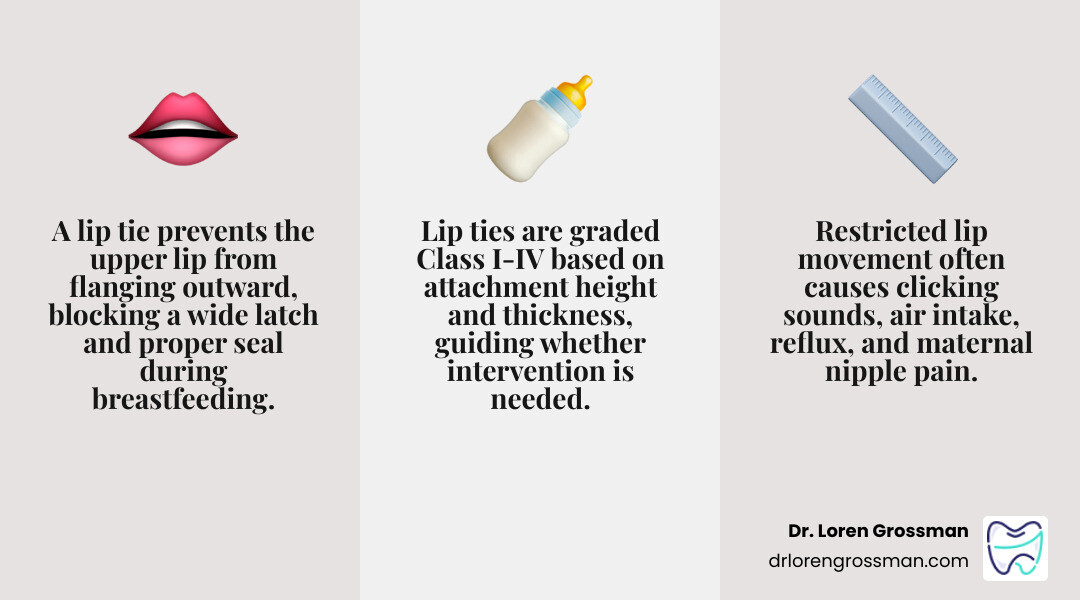
When we talk about a “lip tie,” we are specifically referring to a restricted maxillary labial frenulum. In normal anatomy, this is a fold of tissue that connects the inner part of the upper lip to the gum line. However, when this tissue is too tight, it prevents the upper lip from “flanging” or curling outward.
Think of a proper breastfeeding latch like a fish mouth—the lips should be wide and flared. If the upper lip is tethered down, the baby cannot create a proper seal. This leads to them taking in excess air (hello, colic and gas!) and causes the mother significant pain because the baby is essentially “gumming” or pinching the nipple to stay attached.
It is important to understand that the presence of a frenulum doesn’t automatically mean there is a “tie.” A tie is a functional diagnosis. According to Ankyloglossia (Tongue-Tie) – StatPearls, ankyloglossia (tongue-tie) affects approximately 0.1% to 4.8% of newborns, though some studies suggest rates as high as 10.7% depending on the criteria used. While lip ties are often discussed alongside tongue-ties, they are distinct anatomical issues.
Lip Tie vs. Tongue-Tie: What’s the Difference?
While they often go hand-in-hand (about 50% of babies with one may have the other), they affect different mechanics of feeding.
| Symptom | Lip Tie (Labial Frenulum) | Tongue-Tie (Lingual Frenulum) |
|---|---|---|
| Primary Restriction | Upper lip cannot flare out | Tongue cannot lift or protrude |
| Visual Cue | “Tucked” upper lip during feeding | Heart-shaped or notched tongue tip |
| Feeding Sound | Clicking or smacking | Clicking or losing suction |
| Maternal Impact | Pinched/creased nipples | Nipple flattened like a lipstick tube |
| Dental Impact | Possible gap between front teeth | Possible high palatal vault/narrow jaw |
In our Kingston office, we look at the whole picture. A restricted lip can make it impossible for a baby to get enough breast tissue into their mouth, leading to shallow latches and a frustrated, hungry infant.
Step-by-Step Infant Lip Tie Evaluation for Parents
As a parent, you are the first line of defense. You spend the most time with your baby and are the first to notice if they are struggling. While a professional infant lip tie evaluation is necessary for a diagnosis, you can perform a preliminary check at home.
How to Check Your Baby at Home
- Positioning: Lay your baby flat on their back on a stable surface, like a changing table or your lap, with their head toward you. This is known as the supine position.
- Lighting: Use a good light source. A bright flashlight or even a LED headlamp (like the ones used for camping) is perfect because it keeps your hands free.
- The “Lip Lift”: Gently place your thumb and forefinger on your baby’s upper lip and lift it toward their nose.
- Observe the Tension: Does the lip move easily, or do you feel resistance?
- The Blanching Test: Look at the point where the tissue attaches to the gum. If you lift the lip and the gum tissue turns white (blanches), it indicates that the frenulum is pulling tightly on the blood vessels in the gingiva. This is a classic sign of restriction.

According to Clinical: Infant Tongue-Tie (Ankyloglossia): Assessment, Early Recognition, and Intervention Timing — DentalPedia, the first 2 to 4 weeks of life are a critical window for evaluation. During this time, the tissue is very compliant, and early intervention can prevent a cascade of breastfeeding failures.
Recognizing Symptoms During an Infant Lip Tie Evaluation
The physical appearance of the tissue is only half the story. The symptoms your baby displays are the most important part of the infant lip tie evaluation.
Infant Symptoms:
- The “Click”: If you hear a clicking or smacking sound while the baby is eating, they are losing their suction seal.
- Reflux and Colic: Because the seal is poor, the baby swallows a lot of air. This leads to “aerophagia,” which causes painful gas, bloating, and spitting up. Many babies are put on reflux medication when the actual culprit is a lip or tongue tie.
- Frustration at the Breast: The baby may pull off frequently, cry during feedings, or fall asleep from exhaustion because they have to work twice as hard to get half the milk.
- Lip Callus: A small blister or callus in the center of the upper lip is a sign the baby is using their lips to “grip” the breast rather than using a deep, functional seal.
Maternal Symptoms:
- Severe Pain: Breastfeeding should not hurt. If it feels like your baby is biting or pinching you, something is wrong.
- Damaged Nipples: Look for cracking, bleeding, or nipples that look flattened or blanched (white) immediately after a feeding.
- Poor Drainage: If your breasts still feel full or heavy after a long feeding, the baby isn’t transferring milk effectively. This can lead to clogged ducts and mastitis.
Functional Criteria in Infant Lip Tie Evaluation
We don’t just look at the lip; we look at the results. Is the baby thriving? We use several functional markers to determine the severity of the restriction:
- Milk Transfer: Is the baby actually swallowing? You should hear deep “gulping” sounds, not just fast shallow sucking.
- Weight Gain: Is the baby meeting their growth milestones? While some “tied” babies can maintain weight by nursing 24/7, many eventually fall behind as the mother’s milk supply regulates and the “easy” milk is gone.
- The 6/4 Rule: By day 5 of life, a healthy infant should have at least 6 wet diapers and 4 bowel movements every 24 hours.
- Satiety: Does the baby seem satisfied after a feed, or are they constantly “snacking” because they can’t get a full meal?
If these functional markers aren’t being met, it’s time to consult with an International Board Certified Lactation Consultant (IBCLC) and a dentist experienced in ties.
Clinical Assessment Tools and Professional Criteria
When you bring your baby to us in Kingston, we use standardized, evidence-based tools to ensure an accurate infant lip tie evaluation. We don’t believe in “guessing.”
Common Assessment Scales
- Hazelbaker Assessment Tool for Lingual Frenulum Function (ATLFF): This is the gold standard for tongue-ties, measuring both anatomy and function. A score below 8 on anatomy or below 11 on function typically suggests a need for intervention.
- BTAT (Bristol Tongue Assessment Tool): A simpler, four-item scale used to quickly assess the need for a release.
- LINNE Scoring: As noted in Tongue-tie diagnosis using the Lingual frenulum in newborn infants (LINNE) -scoring: A validation study, this validated tool combines anatomical findings with maternal breastfeeding symptoms and family history. This holistic approach helps prevent over-diagnosis.
The Class I-IV System
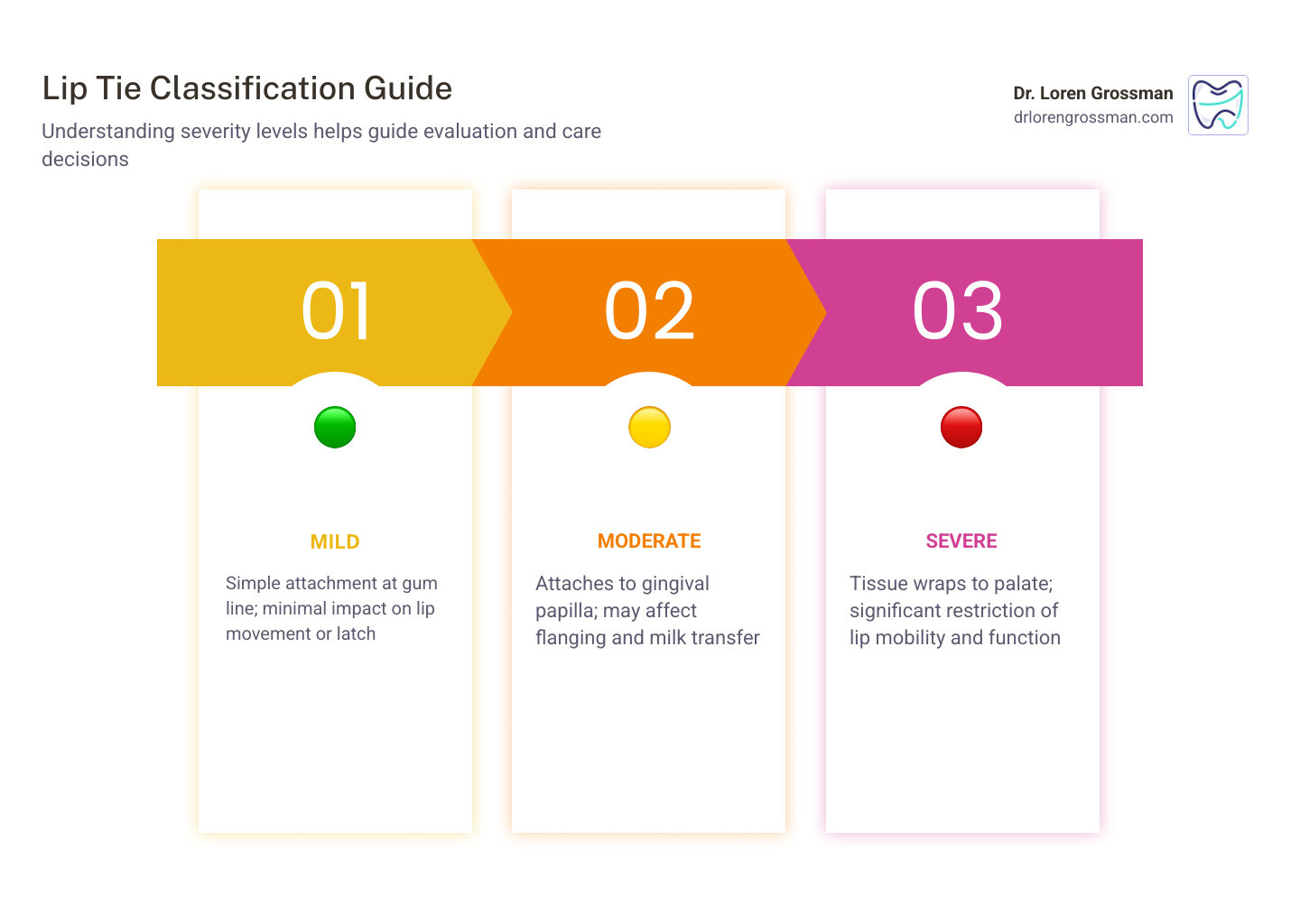
For lip ties, we often use the Kotlow classification system to describe where the tissue attaches:
- Class I: Simple attachment; doesn’t extend far down the gum.
- Class II: Attaches mostly into the gum tissue (gingiva).
- Class III: Attaches right into the “papilla” (the bump of gum between the two front teeth).
- Class IV: The most severe; the tissue wraps all the way around to the roof of the mouth (palate).
The Clinical Consensus Statement: Ankyloglossia in Children emphasizes that we must look at the “maternal-infant dyad.” This means we treat the mother and baby as a team. If the baby has a Class III tie but is gaining weight and the mother has zero pain, we may choose to monitor rather than operate.
Treatment Options: Frenectomy vs. Functional Monitoring
Once the infant lip tie evaluation is complete, we discuss the path forward. There are generally two routes: the “watch-and-wait” approach or a “frenectomy.”
The “Watch-and-Wait” Approach
If the feeding issues are mild, we may recommend working with a lactation consultant first. Sometimes, changing the baby’s position (like using the “laid-back” or biological nurturing position) can compensate for a slight restriction. However, if the baby is losing weight or the mother is in agony, waiting is rarely the best option.
What is a Frenectomy?
A frenectomy is the surgical release of the restricted tissue. In the past, this was done with surgical scissors (frenotomy), which often resulted in bleeding and a higher chance of the tissue growing back together.
Today, we use advanced laser technology.
- Precision: The laser “vaporizes” the tissue rather than cutting it.
- Minimal Bleeding: The laser cauterizes as it goes, so there is often very little to no blood.
- Faster Healing: Laser wounds tend to heal more quickly and with less discomfort than traditional surgery.
- No Stitches: Because the wound is so small and precise, no sutures are needed.
The procedure itself takes less than 60 seconds. Most babies are back at the breast immediately afterward—in fact, we encourage nursing right away because breast milk has natural healing properties and nursing provides instant comfort.

Post-Procedure Care: Preventing Reattachment
The mouth heals faster than almost any other part of the body. While that’s usually a good thing, it means the released tissue wants to grow back together (reattach) very quickly. To prevent this, parents must perform “stretching exercises” or “active wound management.”
We typically recommend:
- Stretches: Gently lifting the lip 3-4 times a day for about 3 weeks to ensure the “diamond” shaped wound heals open rather than closed.
- Oral Hygiene: Keeping the area clean and monitoring for the “white patch” (which is normal healing tissue, not an infection!).
- Bodywork: Sometimes, babies who have been “tied” have very tight neck and jaw muscles from compensating. We may refer you to a pediatric chiropractor or physical therapist to help the baby “unlearn” those old patterns.
Frequently Asked Questions about Infant Lip Tie Evaluation
Does every lip tie require surgical intervention?
Absolutely not. We only recommend a release if the tie is causing functional problems. If your baby is a “happy gainer” and you are breastfeeding comfortably, a visible tie may just be a variation of normal anatomy. However, we do look ahead—sometimes a severe lip tie can cause a large gap between permanent front teeth or make it difficult to brush properly, leading to early childhood cavities.
How soon will I see improvements in breastfeeding after a release?
It varies! Some mothers feel an “instant” change in the latch and a reduction in pain. For others, it takes a few days or even a week. Your baby has been using their muscles a certain way since they were in the womb. They may need a little “retraining” to learn how to use their new range of motion.
Can an untreated lip tie cause speech or dental issues later?
While the primary concern in infancy is feeding, untreated ties can have long-term effects. A severe lip tie can trap food and milk against the front teeth, increasing the risk of “bottle rot” or decay. In toddlers, it may contribute to a midline diastema (a large gap between the front teeth). While the link to speech is more commonly associated with tongue-ties, a restricted lip can occasionally affect the pronunciation of certain “labial” sounds (like p, b, and m).
Conclusion
Navigating the early weeks of parenthood is hard enough without the added stress of feeding difficulties. If you suspect your baby is struggling, trust your gut. You deserve a feeding relationship that is joyful and pain-free, and your baby deserves to eat without exhaustion.
At the office of Dr. Loren Grossman in Kingston, Pennsylvania, we provide a warm, compassionate environment for your infant lip tie evaluation. We combine decades of clinical expertise with a patient-focused approach to ensure your little one gets the best start possible. Whether it’s a simple “watch-and-wait” plan or a gentle laser release, we are here to support your family every step of the way.
If you’re in Northeastern Pennsylvania and have concerns about your baby’s latch or oral development, don’t wait. Early intervention is the key to a lifetime of healthy smiles.