Why Pediatric Dentistry Medicaid Coverage Matters for Your Child’s Smile
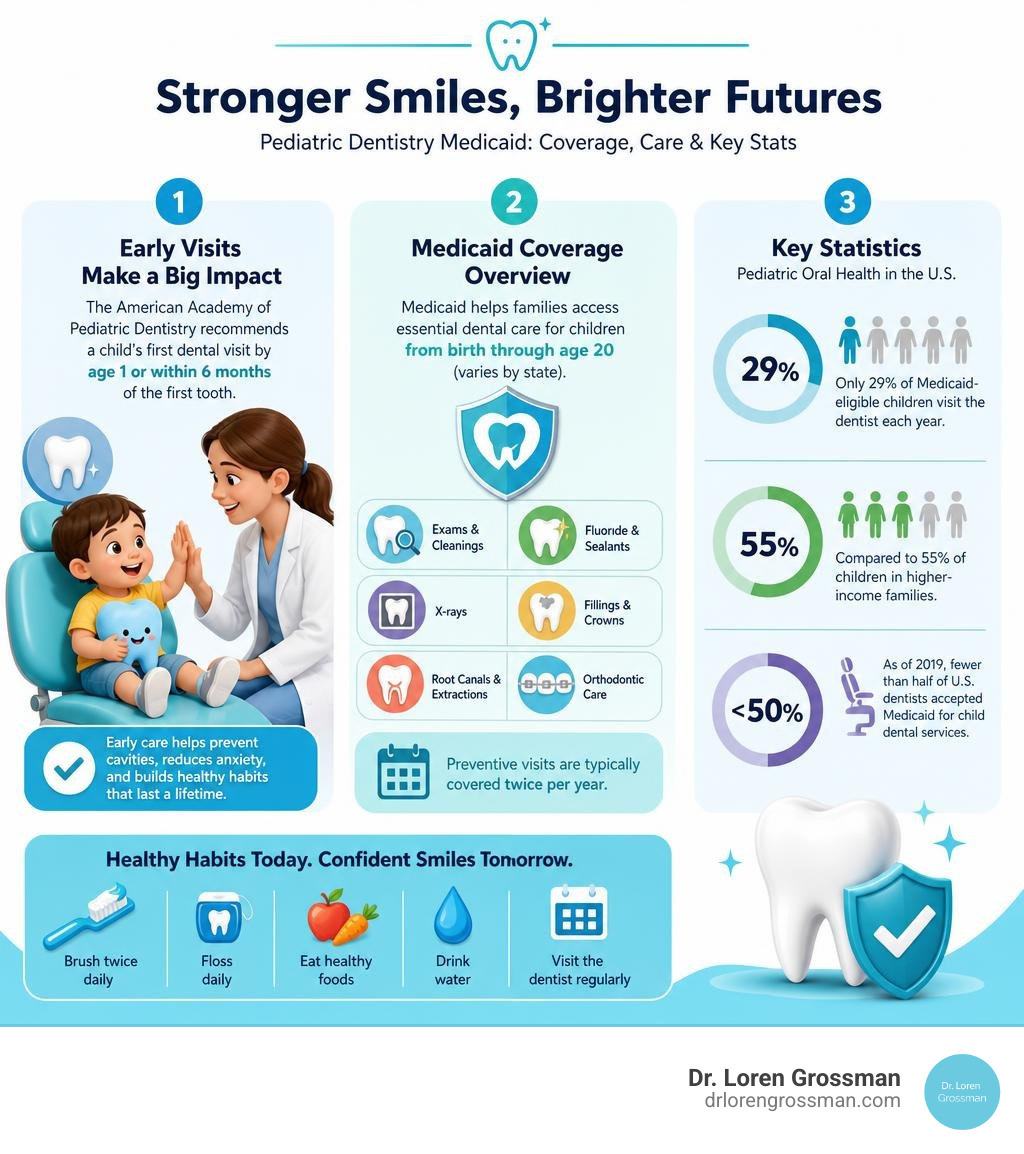
Pediatric dentistry Medicaid coverage gives low-income families access to essential dental care for children from birth through age 20 — at little or no cost.
Here’s a quick summary of what’s covered and who qualifies:
| Topic | Key Facts |
|---|---|
| Who qualifies | Children in low-income households based on Modified Adjusted Gross Income and Federal Poverty Level |
| Age range | Birth through age 20 (varies slightly by state) |
| Core services covered | Exams, cleanings, X-rays, fluoride, sealants, fillings, crowns, root canals, extractions, orthodontics |
| How often | Typically twice per year for preventive visits |
| Cost to families | Usually $0 for medically necessary services |
| How to find a dentist | Use Insure Kids Now or your state’s Medicaid provider lookup tool |
Despite these benefits, many families don’t use them. Only 29% of Medicaid-eligible children visit the dentist each year, compared to 55% of children in higher-income families. And finding a participating dentist can be a real challenge — as of 2019, fewer than half of U.S. dentists accepted Medicaid for child dental services.
This guide breaks down everything parents need to know: what’s covered, how to enroll, how to find a provider, and how coverage rules differ by state.
I’m Dr. Loren Grossman, D.M.D., a family dentist with over 40 years of experience serving children and adults across Northeastern Pennsylvania, including many families navigating pediatric dentistry Medicaid options. In the sections ahead, I’ll walk you through the details so you can get your child the care they deserve.
Understanding Pediatric Dentistry Medicaid Benefits and Eligibility
Navigating public health benefits can feel like trying to solve a Rubik’s Cube in the dark. Fortunately, the core structure of pediatric dentistry Medicaid benefits is built on a solid federal foundation designed to protect your child’s health.
The primary driver behind these benefits is the federal EPSDT (Early and Periodic Screening, Diagnostic, and Treatment) mandate. Under EPSDT, states are legally required to provide a comprehensive set of healthcare services to all enrolled children under the age of 21. For dental care, this mandate ensures that children receive services to relieve pain and infections, restore teeth, and maintain overall oral health.
While Medicaid is jointly funded by federal and state governments, each state administers its own program. This is where the Children’s Health Insurance Program (CHIP) comes in. CHIP provides low-cost health coverage to children in families that earn too much money to qualify for Medicaid but cannot afford private insurance. In many states, CHIP operates as an expansion of Medicaid, meaning the dental benefits are identical or highly similar.
To understand the federal standards that govern these programs, you can consult the AAPD Medicaid Policy Guide. For a practical look at how these rules translate to real-world care, check out our guide on Navigating the Medicaid Maze.
Covered Dental Services for Children Ages 0-20
Under the EPSDT mandate, Medicaid must cover any dental service that is deemed “medically necessary.” While cosmetic treatments (like professional teeth whitening) are excluded, virtually all preventive and restorative treatments are covered.
The core covered services generally include:
- Preventive Care: Regular dental exams, cleanings, and professional fluoride applications (typically covered twice per year).
- Diagnostic Services: Routine dental X-rays (such as bitewings and panoramic films) to monitor skeletal development and catch decay early.
- Dental Sealants: Thin protective coatings applied to the chewing surfaces of permanent molars to prevent cavities.
- Space Maintainers: Devices used to keep space open for permanent teeth if a primary (baby) tooth is lost too early.
- Restorative Treatments: Fillings (composite or amalgam) and crowns (including stainless steel crowns for primary teeth) to restore decayed teeth.
- Endodontic Care: Root canals and pulpotomies (often called “baby root canals”) to save infected teeth.
- Surgical Procedures: Simple and surgical tooth extractions when a tooth cannot be saved.
For detailed guidelines on how these pediatric benefits are structured administratively, you can reference the NYS Medicaid Child Reference Guide.
Eligibility Requirements and Enrollment Steps
To qualify for Medicaid or CHIP, your household income must fall below a specific threshold, which is calculated using your Modified Adjusted Gross Income (MAGI) relative to the Federal Poverty Level (FPL).
Because states set their own income limits, the threshold varies widely. For example, as of June 2026, some states allow families earning up to 150% of the FPL to qualify, while other states expand eligibility to over 300% of the FPL for children.
The enrollment process generally follows these steps:
- Gather Documentation: Collect proof of income (pay stubs, tax returns), proof of citizenship or legal residency, and identification for all family members.
- Submit an Application: You can apply online through your state’s health insurance marketplace, via the federal HealthCare.gov portal, or in person at your local Department of Social Services.
- Receive Your Determination: The state agency will review your application and determine whether your child qualifies for Medicaid or CHIP.
- Select a Managed Care Plan: In many states, Medicaid dental benefits are administered through private Managed Care Organizations (MCOs) or Dental Benefit Administrators (DBAs). You will need to select a plan that is accepted by your preferred pediatric dentist.
Finding and Verifying Medicaid Dental Providers

Finding a high-quality pediatric dentist who accepts Medicaid can sometimes feel like searching for a needle in a haystack. As of 2019, only 43% of U.S. dentists participated in Medicaid and CHIP for child dental services. In Pennsylvania, that number was only slightly better at 44.9%. This low participation rate means that families must be proactive when searching for care.
Fortunately, there are several tools and strategies you can use to find the right provider. For a comprehensive strategy on finding the right fit, read our guide on How to Find a Pediatric Dentist Accepting Medicaid.
How to Locate a Pediatric Dentistry Medicaid Provider
To begin your search, use these official resources:
- Insure Kids Now Directory: The federal government maintains a national database of dentists who accept Medicaid and CHIP. You can search by zip code and filter by specialty on the Insure Kids Now National Directory.
- State Provider Lookup Tools: Most state Medicaid portals feature a localized search engine where you can find active, enrolled providers in your county.
- Federally Qualified Health Centers (FQHCs) and Local Health Departments: FQHCs and community clinics receive federal funding to provide comprehensive care in underserved areas. They almost always accept Medicaid and often feature dedicated pediatric dental wings.
Verifying Medicaid Acceptance and Scheduling Appointments
Once you find a potential dentist, always call the office to verify active enrollment before scheduling an appointment.
Because provider directories are not always updated in real-time, ask the receptionist directly: “Are you currently accepting new pediatric Medicaid patients under our specific plan?”
When preparing for your child’s visit, keep these administrative details in mind:
- Broken Appointment Policies: Medicaid programs strictly prohibit offices from charging Medicaid members for missed or late appointments. However, many practices enforce a “three-strike” policy. If you miss multiple appointments without 24-hour notice, the practice may dismiss your child from their care.
- Translation Services: Under Section 1557 of the Affordable Care Act, any dental practice accepting federal funds (including Medicaid) must provide free language translation services or qualified interpreters for patients with limited English proficiency.
State-by-State Differences in Medicaid Dental Coverage
Because Medicaid is administered at the state level, the specific rules, limits, and administrators vary significantly depending on where you live. For families living near state borders, understanding these differences is crucial.
| State | Primary Dental Program / Administrator | Preventive Limit | Orthodontic Coverage |
|---|---|---|---|
| Pennsylvania | Medicaid Access (various MCOs) | 2x per year | Severe handicapping malocclusion (prior auth required) |
| Delaware | Delaware Medical Assistance Program (DMAP) | 2x per year (AAPD Periodicity) | Score of 26+ on HLD evaluation form |
| New York | Child Medicaid / Child Health Plus | 2x per year | Severe malocclusion (HLD score 26+) |
| Florida | Statewide Medicaid Managed Care (SMMC) | 2x per year | Medically necessary (prior auth required) |
| North Carolina | NC Medicaid (Direct & Managed Care) | 2x per year | Severe malocclusion (prior auth required) |
| Virginia | Cardinal Care Smiles (DentaQuest) | 2x per year | Medically necessary (prior auth required) |
| Mississippi | MS Division of Medicaid | 1x every 6 months | Once per lifetime (prior auth required) |
For local families in Northeastern Pennsylvania, keeping up with local guidelines is essential. You can read our Kingston Pediatric Dentistry Tips for specialized advice tailored to our community.
Coverage Rules in Pennsylvania, Delaware, and New York
In Pennsylvania, dental benefits are integrated into the state’s Medicaid Access program, which is largely delivered through physical and behavioral HealthChoices Managed Care Organizations. The state covers comprehensive diagnostic, preventive, and restorative services for children under 21 with no copays.
In Delaware, the Delaware Medical Assistance Program (DMAP) administers pediatric dental care. Delaware officially endorses the American Academy of Pediatric Dentistry (AAPD) Periodicity Schedule, meaning they cover exams and cleanings at intervals tailored to the child’s individual risk level. For more details on Delaware’s strict guidelines, refer to the Delaware Children’s Dental Policy Manual.
In New York, Child Medicaid covers children up to age 21, while Child Health Plus covers children up to age 19. New York places strict limits on restorative treatments, ensuring that only clinically essential fillings, crowns, and root canals are approved.
Coverage Rules in Florida, North Carolina, Virginia, and Mississippi
- Florida: Florida utilizes the Statewide Medicaid Managed Care (SMMC) program. Florida’s program is notable for its active efforts to improve quality metrics through provider incentives.
- North Carolina: Beneficiaries can search for providers using the state’s specialized health plan lookup tools. The state covers basic preventive services through general dentists, local health departments, and FQHCs.
- Virginia: Virginia’s pediatric dental benefits are consolidated under the Cardinal Care Smiles program, which is administered by a single Dental Benefits Administrator (DentaQuest). This single-administrator model makes it easier for families to navigate their benefits.
- Mississippi: Mississippi Medicaid enforces strict frequency limits. For example, dental cleanings and fluoride varnishes are covered exactly once every six months. Root canals on permanent teeth are limited to once per lifetime per tooth.
Prior Authorization, Orthodontics, and Special Program Rules
While basic preventive care like cleanings and fillings can be completed during your routine visit, more complex procedures require prior authorization (PA). This means your pediatric dentist must submit X-rays, treatment plans, and clinical documentation to Medicaid for approval before the treatment can begin.
Understanding these administrative hurdles is a key part of choosing the right dental home. To learn why this matters, read our article on Why Choosing the Right Pediatric Dentist Matters.
Navigating Prior Authorization and Treatment Limitations
Prior authorization is typically required for:
- Crowns: Especially porcelain or ceramic crowns on permanent anterior (front) teeth. Stainless steel crowns on primary molars often do not require prior authorization.
- Root Canals: Medicaid plans require proof that the tooth has adequate bone support and can be successfully restored after the root canal is complete.
- General Anesthesia and IV Sedation: Covered only when medically necessary, such as for very young children with extensive decay or patients with special healthcare needs who cannot safely tolerate treatment in a standard chair.
Managing Orthodontic Care and Loss of Eligibility
Orthodontic coverage (braces) is one of the most tightly regulated benefits under Medicaid. Medicaid never covers braces for cosmetic reasons. To qualify, a child must have a “severe physically handicapping malocclusion.”
Most states use the Handicapping Labio-Lingual Deviation (HLD) Index. A dentist or orthodontist must evaluate the child’s bite and score it based on specific measurements (such as cleft palate, deep impactions, or severe overbites). Typically, a score of 26 or higher on the HLD evaluation form is required to qualify for coverage.
Once approved, comprehensive orthodontic treatment is usually capped at a maximum of 24 to 36 months of active care, plus one year of retention.
What happens if your child loses Medicaid eligibility during active treatment? This is a common and stressful scenario for families. If your child loses coverage (for example, due to a change in household income), Medicaid will stop paying the monthly or quarterly installment fees to the orthodontist.
If this happens:
- Immediate Verification: The orthodontist’s office will verify the loss of eligibility.
- Transition of Care: You will need to transition to a private payment plan, slide-scale fee, or seek alternative coverage (like a CHIP plan) to cover the remaining balance.
- Do Not Ignore It: Leaving braces on without professional monitoring can lead to severe decay and gum disease.
Dental Provider Incentive Programs and Access to Care
To combat low provider participation rates, several states have launched incentive programs. For example, the Florida 2024-2025 Dental Provider Incentive Program (which runs through September 30, 2025) offers enhanced payment rates of 140% of the standard fee-for-service rate to dentists who meet specific quality benchmarks.
These benchmarks include ensuring that at least 65% of their enrolled pediatric patients receive regular oral evaluations and preventive services. These programs play a vital role in encouraging more dentists to open their doors to Medicaid-eligible children.
Long-Term Benefits of Early Pediatric Dental Care
The American Academy of Pediatric Dentistry (AAPD) recommends that children visit a pediatric dentist when their first tooth appears, or no later than their first birthday.
Establishing a “dental home” early in life has massive long-term benefits. Children with healthy teeth are more likely to attend school regularly, perform better academically, and develop positive self-esteem. Untreated dental decay, on the other hand, can lead to chronic pain, difficulty concentrating, and emergency room visits.
If you are nervous about your child’s first appointment, our guide on Preparing for Your Child’s First Visit offers gentle, practical tips to make the experience stress-free.
Establishing Lifelong Habits with Pediatric Dentistry Medicaid Services
By taking full advantage of preventive pediatric dentistry Medicaid services, you can establish healthy oral hygiene habits that last a lifetime. Regular visits allow pediatric dental specialists to:
- Assess cavity risk and design customized prevention plans.
- Provide personalized oral hygiene instructions to both parents and children.
- Monitor dental development to catch orthodontic issues before they become severe.
- Normalize the dental environment, reducing dental anxiety in adulthood.
Frequently Asked Questions about Pediatric Dental Medicaid
What happens if my child loses Medicaid eligibility during active orthodontic treatment?
If your child loses Medicaid eligibility while wearing braces, the program will stop making payments to your orthodontist. You will need to discuss a private payment plan with the orthodontist to cover the remaining active treatment and retention phase. Alternatively, you can explore whether your child qualifies for a CHIP plan or a local dental school clinic that offers reduced fees.
How often should my child visit the dentist under Medicaid coverage?
Under standard Medicaid guidelines, children should visit the dentist every six months for routine cleanings, exams, and preventive treatments like fluoride varnish. If your child has a high risk of decay, your dentist may request prior authorization for more frequent visits.
Who should I contact for non-dental Medicaid questions or finding other medical providers?
For non-dental questions, such as general health coverage, finding a pediatrician, or updating your income details, you should contact your state’s Medicaid Member Services department or your local Department of Social Services (DSS). If your benefits are administered through a Managed Care Organization, call the member services number listed on the back of your insurance card.
Conclusion
At the office of Dr. Loren Grossman, we believe that every child deserves a healthy, radiant smile. While navigating pediatric dentistry Medicaid options can sometimes feel complex, understanding your benefits is the first step toward securing your child’s oral health.
If you live in Kingston, Pennsylvania, or the surrounding Northeastern Pennsylvania area, we invite you to learn more about our comprehensive Pediatric Dentistry Services. Our team is dedicated to providing personalized, compassionate, and advanced care to help your child’s smile shine bright for years to come. Contact us today to schedule an appointment!