When Every Minute Counts: A Guide to Emergency Dentistry
Emergency dentistry covers urgent dental care for situations that cause severe pain, risk permanent damage, or threaten your overall health. Here’s a quick look at what qualifies — and what to do right now:
Common dental emergencies that need immediate care:
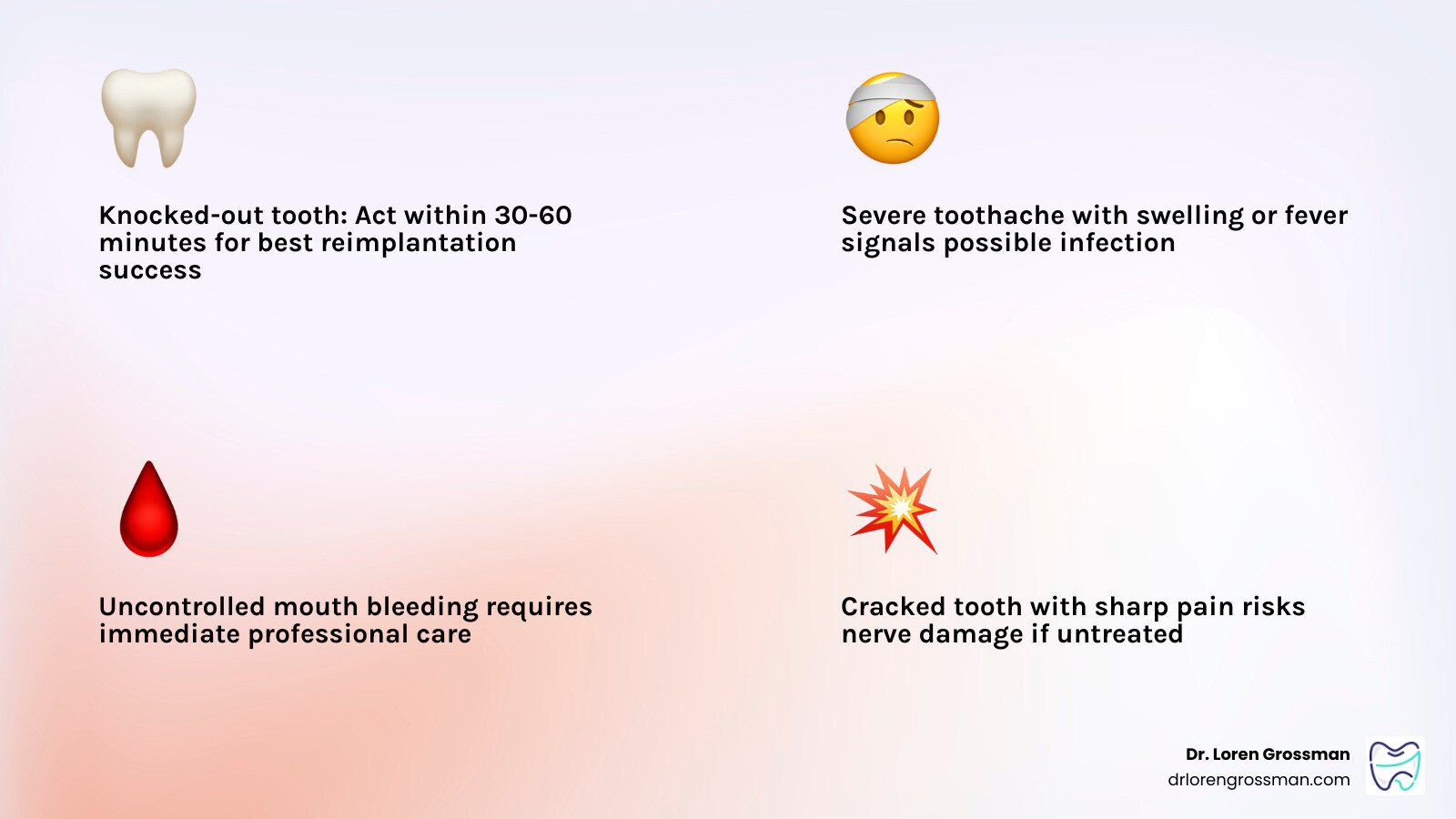
- Knocked-out tooth (act within 30-60 minutes)
- Severe toothache with swelling or fever
- Dental abscess or signs of infection
- Uncontrolled bleeding in the mouth
- Cracked or broken tooth causing sharp pain
- Lost crown or filling with significant pain
- Facial swelling or possible jaw fracture
Not sure if yours is an emergency? If the pain is severe, worsening, or keeping you up at night — treat it as one until you know otherwise.
Accidents don’t wait for a convenient time. A hard bite into a piece of candy, a collision during a pickup basketball game, or a sudden throbbing pain at 2 a.m. — any of these can turn into a dental crisis fast. And in the US alone, dental problems send roughly 2 million people to hospital emergency rooms every year — most of them for issues a dentist could have handled better, faster, and for less money.
This guide walks you through exactly what to do, step by step.
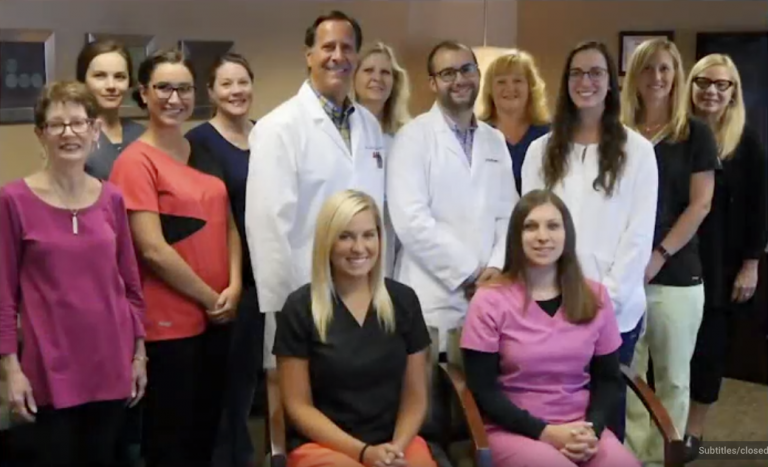
I’m Dr. Loren Grossman, a family and cosmetic dentist serving Northeastern Pennsylvania since 1984, with decades of hands-on experience handling all aspects of emergency dentistry — from knocked-out teeth to abscesses and complex restorations. Whether it’s the middle of a weekday or the start of a weekend, I’ll help you understand your options so you can act quickly and confidently.
What Qualifies as a Dental Emergency?
When you’re in the middle of a dental crisis, it’s hard to think clearly. Is that throb in your molar a “wait until Monday” problem or a “call the dentist at 3 a.m.” problem? Generally, emergency dentistry is required when you are experiencing life-threatening symptoms, uncontrolled bleeding, or trauma that could lead to the permanent loss of a tooth.

According to the American Dental Association (ADA), true emergencies are often potentially life-threatening. This includes uncontrolled bleeding or bacterial infections (cellulitis) that result in swelling so severe it compromises your airway. However, in a clinical setting, we also categorize “urgent care” as an emergency because it involves severe pain or high infection risk.
Here are the Top 5 Common Dental Emergencies we see in our Kingston and Wilkes-Barre offices:
- Knocked-Out Tooth (Avulsed Tooth): This is the ultimate “tick-tock” scenario. You have about a 30-to-60-minute window to get that tooth back in the socket for the best chance of survival.
- Abscessed Tooth: This is a serious infection at the root of the tooth or between the gum and the tooth. It can spread to your jaw, neck, or even other parts of your body if left untreated.
- Severe Toothache: We aren’t talking about a little sensitivity to ice cream. We mean a deep, throbbing pain that makes it impossible to sleep or function.
- Broken or Cracked Tooth: If the crack extends into the pulp (the center of the tooth where the nerves live), the pain will be excruciating, and the risk of infection is immediate.
- Soft Tissue Trauma: Deep cuts to the tongue, cheeks, or lips that won’t stop bleeding after 15 minutes of pressure.
For a deeper dive into these definitions, the Cleveland Clinic offers an excellent resource on What Is a Dental Emergency and Where To Go for Care.
Identifying Non-Urgent Situations
While every dental “oops” feels like a crisis, some things can actually wait for a regular business hour appointment. If you aren’t in severe pain and there is no active bleeding or swelling, you might be looking at a non-urgent situation.
Common non-urgent issues include:
- A dull ache: If it’s annoying but manageable with over-the-counter (OTC) meds.
- A small chip: If there are no sharp edges cutting your tongue and no pain.
- A lost filling or crown: While it feels weird, if there’s no pain, you can often wait a day or two (just keep the area clean!).
- Broken braces: Unless a wire is poking into your cheek and you can’t cover it with wax, this is usually an orthodontic call for Monday morning.
If you find yourself in that “gray area” where you aren’t sure if you can wait, check out our guide on Urgent Dental Care for People Who Can’t Wait.
Immediate First Aid for Common Dental Crises
What you do in the first ten minutes after an accident can determine whether we can save your smile. We recommend every household in Northeastern Pennsylvania keep a small dental first aid kit.
The Knocked-Out Tooth Protocol
If your tooth is knocked out, stay calm.
- Pick it up by the crown (the chewing part): Never touch the root. The root has delicate fibers that are essential for re-attachment.
- Rinse gently: Use only water. Do not scrub it, do not use soap, and do not wrap it in a dry tissue.
- Try to reinsert it: If possible, gently push the tooth back into the socket and hold it there by biting down on a piece of gauze.
- Storage: If it won’t go back in, keep it moist. The best options are a cup of milk, your own saliva, or an ADA-approved tooth preservation kit like “Save-a-Tooth.”
- Get to us immediately: Time is of the essence.
Handling Other Injuries
- Cracked Tooth: Rinse your mouth with warm salt water immediately to keep the area clean. Apply a cold compress to the outside of your face to minimize swelling. For more tips, see the ADA’s advice on Dental Emergency – What if I break a Tooth.
- Lost Filling: As a temporary fix, you can put a piece of sugarless gum into the cavity or use over-the-counter dental cement.
- Stuck Objects: If something is wedged between your teeth, try using dental floss gently. Never use a sharp or pointed tool (like a needle or toothpick) as you could pierce your gums or scratch the enamel.
Managing Pain and Swelling at Home
Until you can get into our office, managing the discomfort is the priority. Here is how we recommend handling the “waiting period” for Emergency Dental Services in Kingston PA: What to Do in a Dental Crisis:
- Salt-Water Rinse: Mix half a teaspoon of salt in eight ounces of warm water. This helps draw out infection and cleans the area.
- Cold Compress: Apply an ice pack to the cheek for 20 minutes on, 20 minutes off. This is the gold standard for reducing swelling.
- Elevation: If you have a throbbing toothache, try to keep your head elevated, even while sleeping. This prevents blood pressure from building up in the head and worsening the throb.
- Tea Bags: For bleeding gums or tongue, a wet caffeinated tea bag can help. The tannic acid in the tea helps the blood clot faster.
- The “Aspirin” Warning: Never put aspirin directly on your gums or the aching tooth. It is an acid and will cause a severe chemical burn on your soft tissues. Swallow the pill; don’t “apply” it!
Choosing the Right Care: Emergency Room vs. Emergency Dentistry
One of the biggest mistakes patients make is heading straight to the hospital for a toothache. While the ER is great for many things, most hospitals do not have a dentist on staff. They can give you antibiotics for an infection or painkillers for the ache, but they cannot perform a root canal or fix a broken filling.
| Feature | Hospital Emergency Room | Emergency Dentist (Dr. Grossman) |
|---|---|---|
| Primary Focus | Life-saving stabilization | Restoring and saving teeth |
| Can perform extractions? | Rarely | Yes |
| Can perform root canals? | No | Yes |
| Can fix broken crowns? | No | Yes |
| Wait times | Often 4+ hours | Prioritized for emergencies |
| Cost | High (ER facility fees) | Standard dental/emergency fees |
When should you go to the ER? Go to the hospital or call 911 immediately if you have:
- A suspected broken jaw.
- Swelling that is making it hard to breathe or swallow.
- Uncontrolled bleeding that hasn’t stopped after 20 minutes of pressure.
- Severe facial trauma or broken facial bones.
For most other dental issues, our Emergency Dentistry Services are the more effective and affordable route.
Common Treatments in Emergency Dentistry
When you arrive at our practice, our goal is two-fold: stop the pain and save the tooth. Depending on your situation, we might provide:
- Root Canals: If an infection has reached the nerve, we remove the infected tissue to save the structure of the tooth.
- Emergency Extractions: If a tooth is too damaged to be saved, we remove it to prevent the infection from spreading to your jawbone.
- Dental Bonding: To quickly repair a chip or crack and protect the sensitive inner layers of the tooth.
- Re-cementation: If you’ve lost a crown or bridge, we can often clean it and bond it back into place.
We provide these Emergency Dental Services in Northeastern Pennsylvania: Quick Care with Dr. Grossman using the latest technology to ensure the process is as painless as possible.
What to Expect During Your Urgent Dental Visit
We know that “emergency” usually equals “stress.” Our team is trained to provide a calm, patient-focused environment the moment you walk through the door.
When you come in for an urgent visit, here is the typical workflow:
- Triage: We’ll ask about your symptoms and when the pain started.
- Diagnostic Evaluation: We use digital X-rays to see what’s happening below the gumline. This is much faster and involves less radiation than traditional film.
- Immediate Pain Management: Before we start any work, we ensure you are comfortable. This might involve local numbing or, in some cases, sedation options for those who are particularly anxious.
- The Fix: We perform the necessary procedure (like a filling or stabilization) to resolve the immediate crisis.
- Follow-up Plan: Sometimes an emergency visit is “Phase 1.” We will create a comprehensive plan to ensure your smile stays healthy long-term.
We pride ourselves on offering No More Waiting: Find a Dentist Open Now for All Your Dental Needs to our neighbors in Kingston and Dallas, PA.
Navigating Costs and Insurance Coverage
We believe that financial stress shouldn’t keep you from getting the care you need.
- Insurance: Most dental insurance plans cover emergency dentistry at a higher rate than cosmetic work. Typically, diagnostic exams are covered, and restorative care (like fillings or extractions) is often covered between 50% and 80%.
- Financing: For those without insurance or with high deductibles, we offer various financing options to break the cost into manageable monthly payments.
- Transparency: We provide an honest assessment and a clear breakdown of costs before we begin treatment.
Learn more about managing these situations in our guide: Emergency Dentist in Kingston PA: What to Do When You Need Immediate Care.
Proactive Steps to Prevent Future Dental Crises
If you’re “accident-prone,” you don’t have to just wait for the next disaster to strike. There are several ways to “emergency-proof” your mouth.
- Wear a Mouthguard: If you play sports — even non-contact ones like mountain biking or gymnastics — a custom mouthguard is your best friend. It acts as a shock absorber for your teeth and jaw.
- Stop Using Your Teeth as Tools: Your teeth are for chewing food, not for opening Amazon packages, cracking nuts, or biting your nails. Buy a pair of scissors!
- Watch Your Diet: Hard candies, ice cubes, and popcorn kernels are the “Big Three” when it comes to cracked teeth.
For more preventative wisdom, check out these Tips from an Emergency Dentist on How to Prevent Dental Emergencies.
Long-term Prevention of Emergency Dentistry Needs
The best way to handle a dental emergency is to never have one. Many “sudden” toothaches are actually the result of decay that has been brewing for months.
- Bi-annual Checkups: Regular cleanings allow us to remove plaque and tartar that your toothbrush can’t reach.
- Early Detection: During an exam, we can spot a tiny cavity or a hairline fracture and fix it with a simple filling before it turns into a midnight root canal.
- Night Guards: If you wake up with a sore jaw or a headache, you might be grinding your teeth at night (bruxism). A custom night guard prevents you from literally grinding your teeth down to the nubs.
Frequently Asked Questions about Urgent Dental Care
What should I do if my tooth is knocked out?
Handle the tooth only by the crown (top), rinse it gently with water if dirty, and try to place it back in the socket. If it won’t stay, store it in a container of milk or tucked inside your cheek to keep it moist. You must see a dentist within 30 to 60 minutes for the best chance of saving the tooth.
How do I know if a toothache is an emergency?
A minor ache that comes and goes might just be sensitivity. However, if the pain is severe, persistent, prevents you from sleeping, or is accompanied by fever and facial swelling, it is an emergency. These are often signs of an abscess or deep infection that requires immediate intervention.
Will my dental insurance cover an emergency visit?
In most cases, yes. Most insurance plans prioritize emergency exams and basic restorative procedures. While every plan is different, we often see coverage ranging from 50% to 100% for the initial emergency exam and X-rays.
Conclusion
At the office of Dr. Loren Grossman, we’ve seen it all — from sports injuries to the sudden, agonizing pain of an infected root. Serving the communities of Kingston, Wilkes-Barre, Scranton, and Dallas, we are committed to providing the residents of Northeastern Pennsylvania with the highest level of care when they need it most.
By combining personalized care with the latest advanced technology, we ensure that your “emergency” is handled with precision and compassion. Don’t let a dental crisis ruin your smile or your health. If you are in pain or have suffered an injury, contact us immediately to learn more about our Emergency Dentistry Services. We are here to help you get back to your life — and your smile — as quickly as possible.