When a Tooth Gets Knocked Out in Pennsylvania, Every Minute Counts
If you’re dealing with a knocked out tooth and need to know what to do in Pennsylvania, here are the most important steps to take right now:
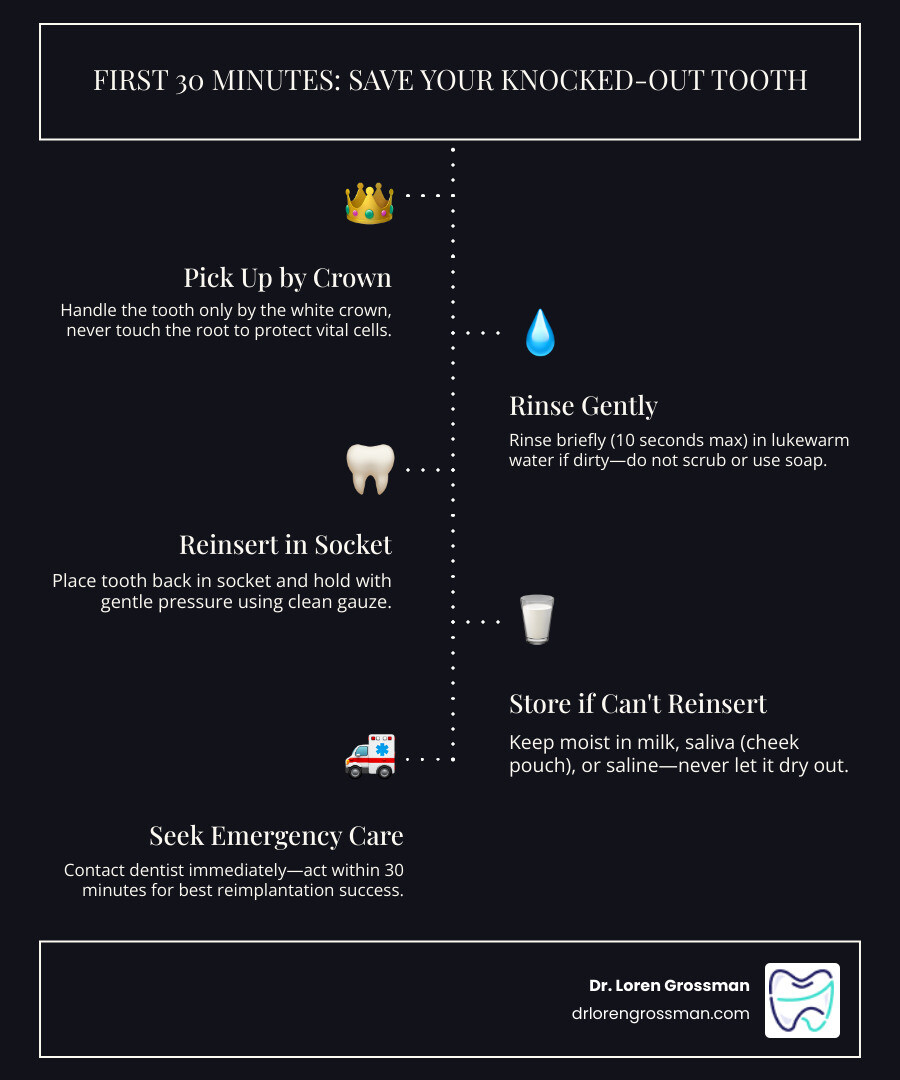
- Pick up the tooth by the crown (the white part) — never touch the root
- Rinse gently with lukewarm water for no more than 10 seconds if it’s dirty
- Try to place it back in the socket and hold it there with gentle pressure
- If you can’t reinsert it, store it in milk or between your cheek and gum
- Call an emergency dentist immediately — ideally within 30 minutes
A knocked-out tooth is one of the most alarming things that can happen to your smile. Your heart races. You’re not sure what to grab first. And the clock is already ticking.
Here’s the hard truth: only about 9% of adults in the U.S. know what to do in this situation. That means most people lose a perfectly saveable tooth simply because they didn’t know the right steps.
The good news? With the right actions in the first 30 to 60 minutes, there’s a real chance your tooth can be reimplanted and saved.
I’m Dr. Loren Grossman, D.M.D., a family and cosmetic dentist serving the Wyoming Valley and Northeastern Pennsylvania since 1984 — and handling dental emergencies like a knocked out tooth is something I’ve guided countless Pennsylvania patients through over my four decades of hands-on practice. In this guide, I’ll walk you through exactly what to do, step by step, so you can act fast and give your tooth the best possible chance.
Knocked Out Tooth What to Do Pennsylvania: The First 5 Minutes Matter
In dental emergencies, we often talk about the “Golden Hour.” However, according to the American Association of Endodontists, when it comes to a knocked out tooth what to do pennsylvania, the “Golden 30 Minutes” is a much more accurate target. While success is still possible after an hour, the survival rate of the delicate cells on the tooth root drops dramatically after the 30-minute mark. By the time two hours have passed, the chances of a successful reimplantation are unfortunately very low.
If you are a Pennsylvania resident dealing with this right now, the most important thing you can do is stay calm. Panicking leads to mistakes—like scrubbing the tooth or dropping it. Control any bleeding by biting down on a clean piece of gauze or cloth, and follow these five critical steps.
Step 1: Make Sure It’s a Dental Emergency and Not a Medical Emergency
Before you worry about the tooth, check the person. If the tooth was knocked out due to a heavy blow to the head, a car accident, or a serious fall, you might be dealing with more than just a dental issue.
If you see signs of a concussion, experience uncontrolled bleeding, have severe facial swelling, or suspect a broken jaw, call 911 or head to the nearest Pennsylvania emergency room immediately. A tooth can be replaced, but a traumatic brain injury needs medical doctors. If the injury is limited to the mouth, your local emergency dentist is the better choice for specialized care.
Step 2: Pick Up the Tooth the Right Way
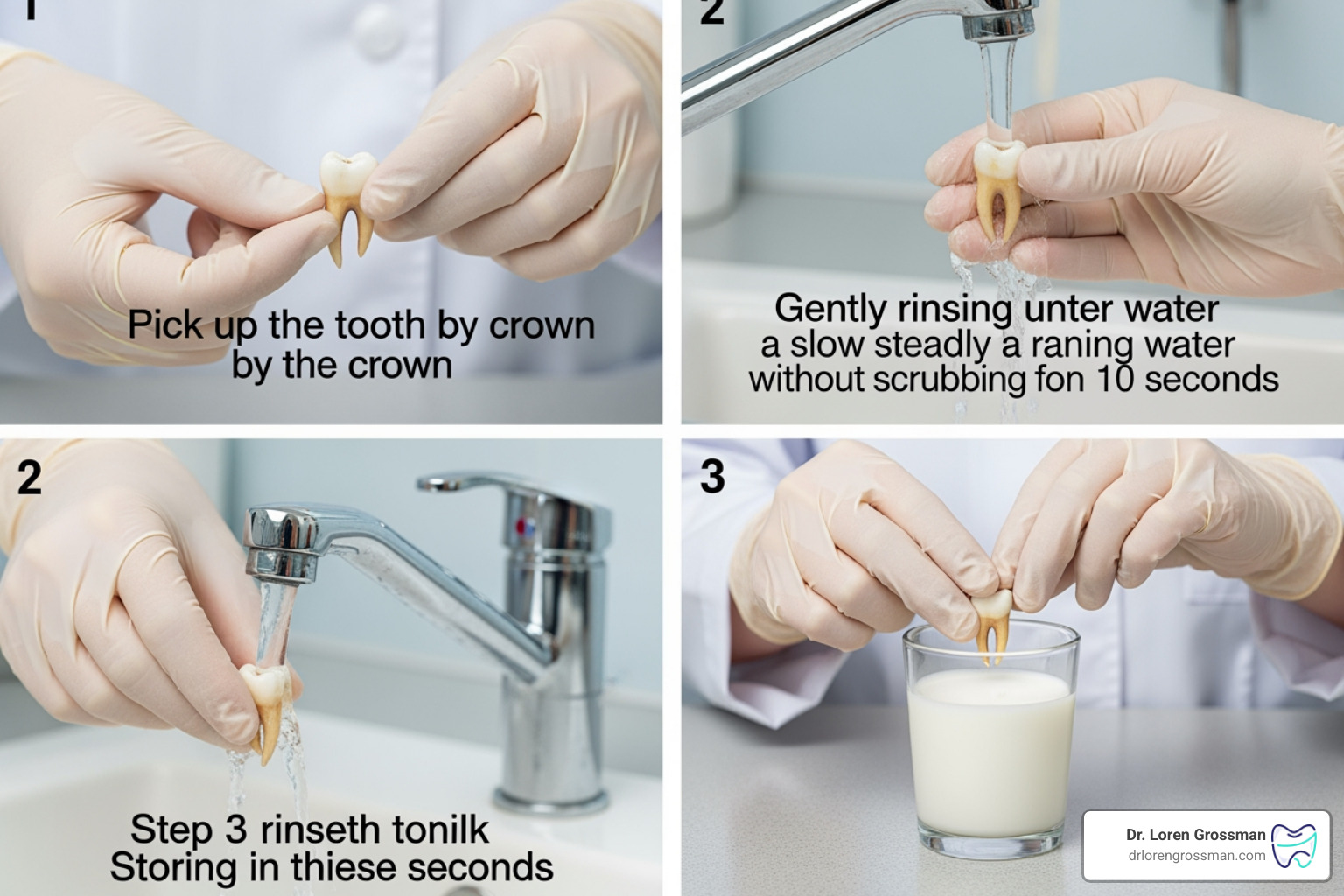
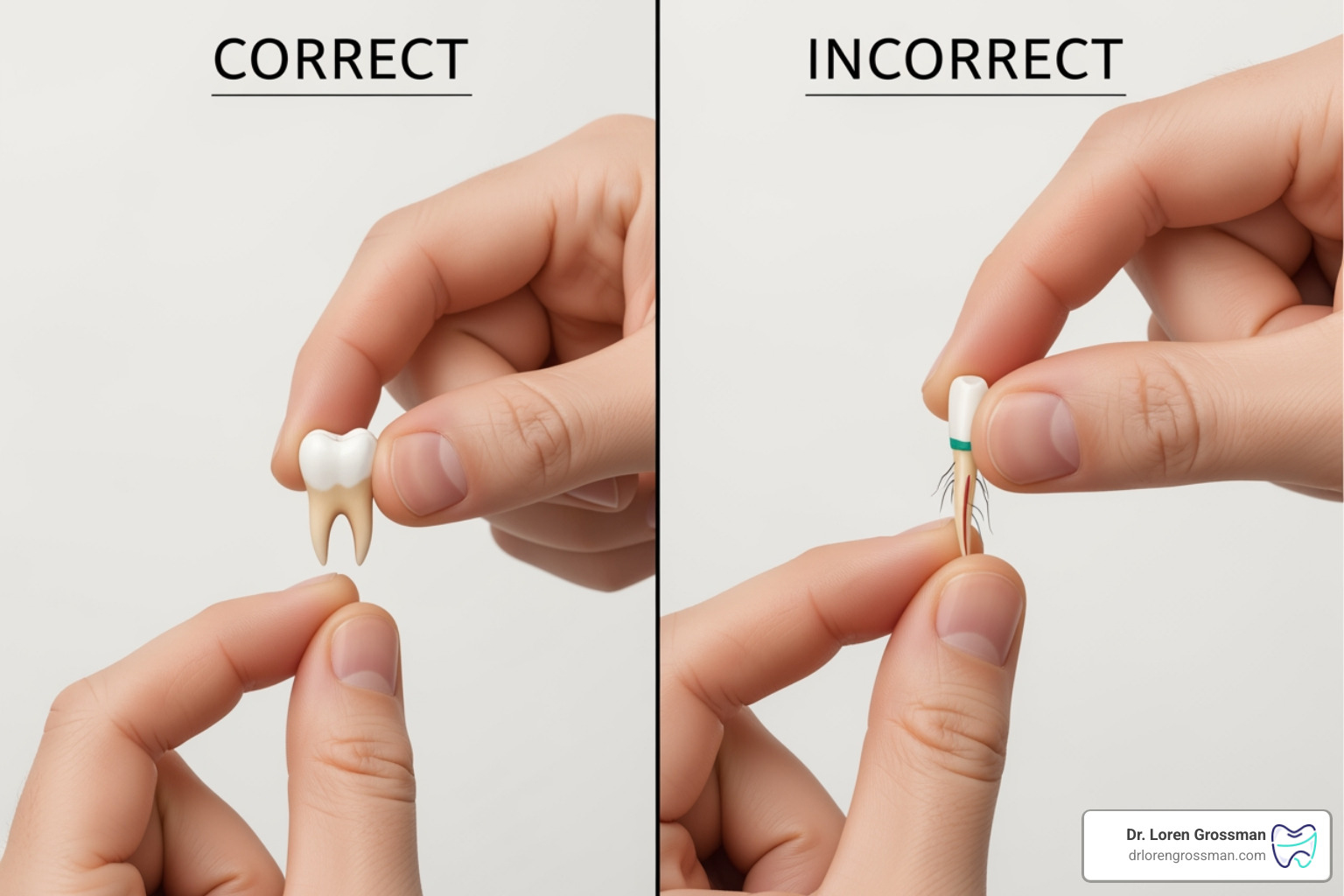
This is where most people make a fatal mistake for the tooth. When you find the tooth, pick it up by the crown only. The crown is the chewing surface—the white part you see when you smile.
Never touch the root (the pointed part that was inside the gum). The root is covered in delicate periodontal ligament cells that act like “glue” to help the tooth reattach to your jaw. Touching, scrubbing, or scraping these cells will kill them, making reimplantation impossible.
Step 3: Rinse Gently and Try to Reinsert It
If the tooth is dirty, hold it by the crown and rinse it very briefly (no more than 10 seconds) under lukewarm tap water. Do not use soap, chemicals, or a brush.
Once clean, the best place for that tooth is back where it came from. Try to gently guide the tooth back into its socket. If it goes in, hold it in place by biting down softly on a piece of gauze. This natural “storage” keeps the root cells alive and in their proper environment.
Step 4: If You Can’t Reinsert It, Keep It Moist
Sometimes, pain or swelling makes it impossible to put the tooth back in the socket. If that happens, do not let the tooth dry out. A dry tooth is a dead tooth.
The best storage mediums are:
- Milk: It has a pH balance that keeps root cells alive.
- Saliva: You can keep the tooth tucked inside your cheek pouch (be careful not to swallow it!) or spit into a small cup and submerge the tooth.
- Saline or a preservation kit: If you have an emergency dental kit (like Save-A-Tooth), use it.
Avoid storing the tooth in plain tap water for long periods, and never wrap it in a dry paper towel.
Step 5: Call an Emergency Dentist Immediately
Now that the tooth is stabilized, you need professional help. You need a same-day visit to have the tooth professionally splinted. In Kingston and across Northeastern Pennsylvania, we prioritize these crises because we know that every minute counts toward saving your natural smile.
What Not to Do With a Knocked-Out Tooth
Knowing what not to do is just as important as knowing the right steps. Many well-meaning people accidentally ruin the chances of saving a tooth by following old myths.
- Don’t use tap water for long-term storage: The chlorine and lack of proper proteins in tap water can actually damage the root cells.
- Don’t scrub the tooth: Even if it fell in the dirt, a gentle rinse is all it needs. Scrubbing removes the vital tissue needed for reattachment.
- Don’t handle the root: We cannot stress this enough—the root is “live” tissue. Treat it like a vital organ.
- Don’t delay: Thinking “I’ll just wait until Monday morning” is the fastest way to ensure you’ll need a dental implant instead of a simple reattachment.
- Don’t reinsert a baby tooth: If a toddler knocks out a primary tooth, do not try to put it back in. Doing so can damage the permanent adult tooth developing underneath.
Why Water and Dry Storage Can Hurt Your Chances
The root of your tooth is covered in living cells. When these cells dry out, they die. When they are placed in tap water, the water’s chemistry causes the cells to swell and eventually burst. Milk is the “gold standard” because its chemical makeup closely mimics the fluids in your body, providing the nutrients needed to keep those cells in a “hibernation” state until you reach our office.
Why Time Changes the Outcome So Quickly
Statistics show that teeth reinserted within 30 minutes have the highest success rates. While we can often save a tooth that has been out for 60 minutes, the success rate drops significantly after that. By the 2-hour mark, the periodontal ligament cells are usually non-viable, meaning the tooth won’t “take” to the socket again. This is why a knocked out tooth what to do pennsylvania requires an immediate, urgent response.
Pennsylvania-Specific Emergency Care: Where to Go and When
In Northeastern Pennsylvania, residents have several options, but choosing the right one saves time.
| Feature | Emergency Dentist (e.g., Kingston PA) | Hospital Emergency Room |
|---|---|---|
| Knocked-Out Tooth | Best Choice (Has tools to splint) | Backup (Stabilization only) |
| Severe Toothache | Best Choice | Only if fever/swelling is extreme |
| Broken Jaw | No | Yes (Go immediately) |
| Uncontrolled Bleeding | No | Yes |
| Lost Filling/Crown | Best Choice | Not an ER emergency |
When to Go to an Emergency Dentist Instead of the ER
For a tooth avulsion (knocked-out tooth), a dentist is almost always the better choice. Most ERs do not have a dentist on staff and aren’t equipped with the specialized wires and resins needed to splint a tooth back into place. They may give you pain medication or antibiotics, but they likely won’t be able to save the tooth itself.
When the ER Is the Better Choice
If your dental emergency is accompanied by a high fever, difficulty breathing, or swelling that is closing your eye or moving down your neck, go to the ER. These are signs of a spreading infection (abscess) that can become life-threatening if it enters the bloodstream.
Finding Fast Help in Northeastern Pennsylvania
If you are in Kingston, Wilkes-Barre, or the surrounding Wyoming Valley, you don’t have to wait. We offer emergency dental services designed to get you into the chair as quickly as possible. We understand that a dental crisis doesn’t happen on a schedule.
What Happens at the Dentist After a Tooth Is Knocked Out
When you arrive at our Kingston office with your tooth, we move quickly. First, we will perform a brief exam and likely take an X-ray to ensure the jawbone isn’t fractured.
Next, we will gently clean the socket and the tooth. If the tooth hasn’t been reinserted, we will place it back in. To keep it there while it heals, we use a “splint.” This involves bonding a thin wire or mesh to the knocked-out tooth and its neighbors to hold it steady—much like a cast for a broken arm.
Treatment for a Saved Permanent Tooth
The splint usually stays on for 1 to 2 weeks, though in cases of bone damage, it may stay longer. Because the blood supply to the tooth was severed during the accident, the tooth will eventually need a root canal (usually within a week or two) to prevent infection, as the internal “pulp” of the tooth will no longer be alive.
If the Tooth Can’t Be Saved
Sometimes, despite our best efforts, a tooth cannot be saved—perhaps it was out too long or was shattered upon impact. In these cases, we pivot to tooth replacement options. Leaving a gap can lead to jawbone loss and shifting teeth, so we may discuss:
- Dental Implants: The gold standard for a permanent, natural-looking replacement.
- Dental Bridges: A fixed bridge that uses neighboring teeth for support.
- Partial Dentures: A removable option for one or more missing teeth.
Aftercare for the Next Few Days
The days following a reimplantation are critical for healing.
- Eat soft foods: Think smoothies, yogurt, and mashed potatoes.
- Avoid the area: Don’t chew on the splinted tooth.
- Keep it clean: Brush very gently around the site.
- No smoking: Smoking restricts blood flow and significantly hinders the healing process.
Prevention Tips So It Doesn’t Happen Again
While we are always here to help, we’d much rather see you for a routine cleaning than an emergency!
Why Prevention Matters More Than Most People Realize
With 31.6% of adults aged 20-44 having untreated cavities, many teeth are already weakened before an accident even happens. A tooth with a large, untreated cavity is much more likely to fracture or be knocked out completely during a minor fall than a healthy, strong tooth.
Smart Habits That Lower Your Risk of Dental Emergencies
- Wear a Mouthguard: If you or your children play sports—even non-contact sports like gymnastics—a custom-fitted mouthguard is your best defense.
- Don’t Use Your Teeth as Tools: Never use your teeth to open packages, crack nuts, or tear tags.
- Regular Checkups: We can spot weakened teeth or common dental emergencies before they happen.
- Home Safety: Use non-slip mats in the bathroom, especially for children and seniors.
For more advice, check out our tips on preventing dental emergencies.
Frequently Asked Questions About Knocked Out Tooth What to Do Pennsylvania
Can a knocked-out tooth still be saved after an hour?
Yes, it is possible, but the chances are lower. If you have kept the tooth moist in milk or saliva, the cells may still be viable. Always come in and let us try; modern dentistry can be very resilient!
Should I put a baby tooth back in?
No. Never attempt to reinsert a baby tooth. It can fuse to the bone or damage the permanent tooth underneath. However, you should still call us for an emergency exam to make sure no fragments are left behind and that the surrounding teeth are okay.
What if I can’t find a dentist open right away in Pennsylvania?
If it is the middle of the night and you cannot reach an emergency dentist, keep the tooth in milk and go to the nearest emergency room. While they may not be able to splint it, they can provide initial stabilization and pain relief until you can find a dentist open the next morning.
Conclusion
A knocked out tooth what to do pennsylvania is a high-stakes situation, but it doesn’t have to result in a permanent gap in your smile. By acting fast, handling the tooth by the crown, keeping it moist, and getting to Dr. Loren Grossman’s office in Kingston as quickly as possible, you are doing everything in your power to save your natural tooth.
If you are experiencing a dental emergency right now, don’t wait. Time is the most critical factor. Contact us immediately for emergency dentistry services and let our experienced team help you save your smile.