Is It Veneers or Invisalign? Here’s How to Choose the Right Treatment for Your Smile
If you’re weighing veneers vs Invisalign, which is right for me is exactly the right question to ask — and the answer comes down to one thing: what problem are you actually trying to solve?
Quick answer:
| Your main concern | Better option |
|---|---|
| Crooked teeth, gaps, or bite issues | Invisalign |
| Stains, chips, worn edges, or shape | Veneers |
| Both alignment and surface flaws | Invisalign first, then veneers |
| Want results in weeks, not months | Veneers |
| Want to keep your natural tooth structure | Invisalign |
Invisalign moves your teeth. Veneers cover them. Both can dramatically improve your smile — but they solve different problems, carry different costs, and involve very different commitments.
Nearly half of adults say a smile is the most memorable feature when meeting someone. It’s no wonder so many people in Northeastern Pennsylvania are exploring their options.
I’m Dr. Loren Grossman, a cosmetic and family dentist serving the Wyoming Valley since 1984, with decades of hands-on experience helping patients navigate exactly this decision — from porcelain veneers crafted with trusted local labs to personalized Invisalign treatment plans. In this guide, I’ll walk you through everything you need to know so you can confidently answer veneers vs Invisalign: which is right for me.
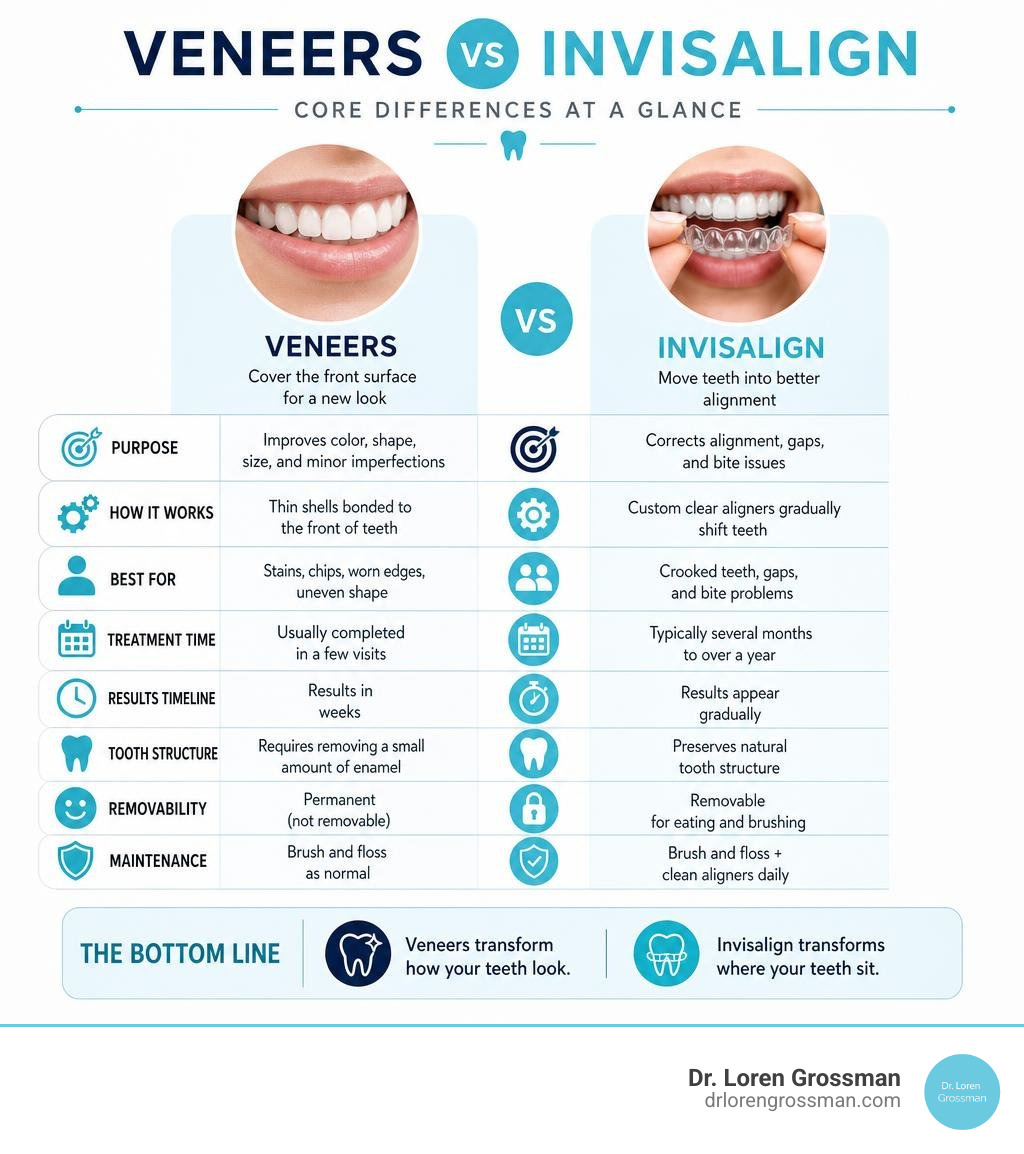
Discover more about veneers vs invisalign which is right for me:
Understanding the Core Differences: Veneers vs Invisalign Which Is Right for Me
To make the best decision for your smile, it helps to understand the fundamental mechanics of these two powerhouse treatments.
Think of your teeth as a row of houses. If the houses are sturdy and beautiful but built slightly out of alignment, you need to physically move them into a straight line. That is Invisalign.
If the houses are structurally in the right place, but the siding is cracked, faded, or chipped, you do not need to move the houses—you need to give them a gorgeous new exterior. That is a set of porcelain veneers.

The core difference boils down to physical movement versus visual camouflage:
- Invisalign is an orthodontic treatment. It uses biological force to gently and gradually shift your natural teeth into their ideal alignment. Your teeth remain completely unaltered; they simply change their address.
- Porcelain veneers are a cosmetic restoration. They do not move your teeth. Instead, they cover the front surface of your teeth to instantly reshape, resize, and brighten them. Because traditional veneers require the removal of a thin layer of natural enamel to fit seamlessly, they represent a permanent alteration to your teeth.
Choosing between them is not about finding which treatment is “better” overall, but rather identifying which one addresses your unique dental anatomy and aesthetic goals.
What Are Porcelain Veneers and What Can They Correct?
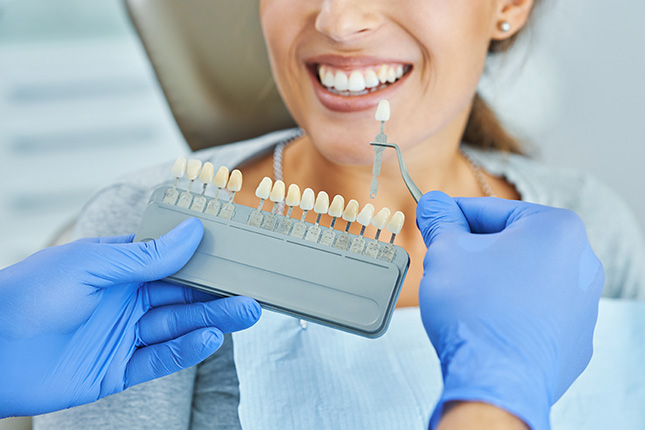
Porcelain veneers are ultra-thin, custom-crafted shells of dental-grade ceramic that are permanently bonded to the front of your teeth. Think of them as custom-tailored suits for your smile. They are handcrafted to match the precise translucency, shading, and contours of natural tooth enamel, meaning they can look incredibly natural while providing a complete aesthetic overhaul.
Veneers are the ultimate solution for surface-level imperfections. They are highly effective at correcting:
- Severe Tooth Discoloration: Stains caused by tetracycline, excessive fluoride, or internal trauma often do not respond to chemical teeth whitening. Veneers can mask these stubborn stains permanently.
- Chipped, Cracked, or Worn Teeth: If years of wear and tear, nail-biting, or minor accidents have left your teeth with jagged, uneven, or shortened edges, veneers can restore their youthful length and symmetry.
- Misshapen or Small Teeth: Some people naturally have teeth that are smaller than average (microdontia) or have unusual shapes. Veneers can easily create a balanced, uniform look.
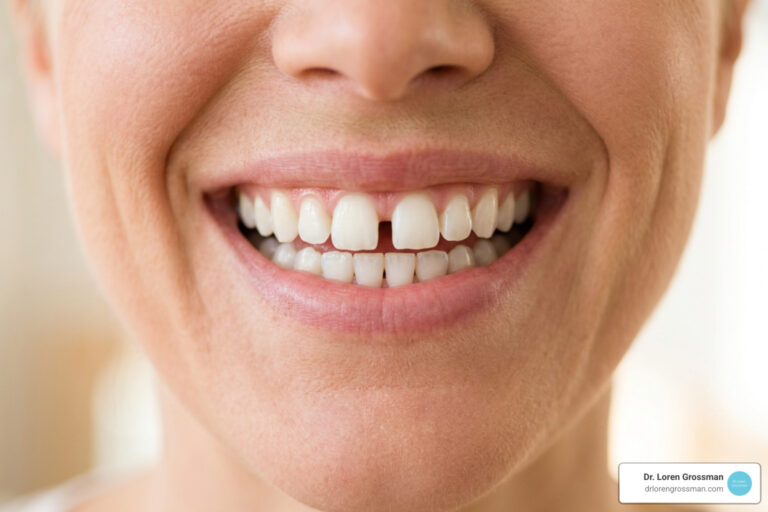
- Minor Spacing Issues: If you have small gaps between your front teeth but your bite is otherwise perfectly aligned, veneers can close those gaps in a fraction of the time it takes for orthodontic treatment.
Because the porcelain used is highly stain-resistant, your new smile will resist coffee, tea, and red wine far better than natural enamel ever could.
To learn more about how we design and place these custom restorations in our office, explore our detailed guide on Veneer Procedures in Kingston PA Transform Your Smile with a Trusted Cosmetic Dentist or visit our dedicated Services Dental Veneers page.
What Is Invisalign and What Can It Correct?
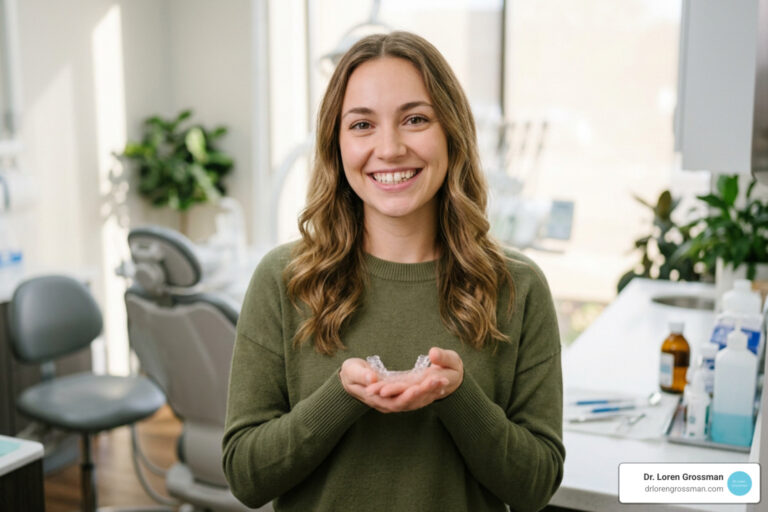
Invisalign is a modern orthodontic system that replaces the brackets and wires of traditional braces with a series of clear, medical-grade, BPA-free plastic aligners. These aligners are custom-designed using advanced 3D imaging technology to apply gentle, controlled pressure to specific teeth, gradually moving them into alignment over time.
Because the trays are virtually invisible, you can straighten your teeth without broadcasting your orthodontic journey to the world. You simply swap out your trays every one to two weeks as your teeth step-by-step find their correct positions.
Invisalign is designed to correct structural and functional alignment issues, including:
- Teeth Crowding: When there is not enough room in your jaw for all your teeth to fit normally, they can overlap and twist. Crowding is not just an aesthetic issue; crowded teeth are notoriously difficult to brush and floss, which can lead to plaque buildup, decay, and gum disease.
- Gaps and Spacing: Too much space between teeth can leave your gums vulnerable to plaque accumulation and periodontal issues.
- Bite Misalignments: Invisalign can correct overbites, underbites, crossbites, and open bites. Correcting a misaligned bite can relieve jaw pain (TMD), reduce uneven wear on your enamel, and improve your overall chewing function.
One of the greatest benefits of Invisalign is that the trays are entirely removable. This means you do not have to modify your diet, and you can brush and floss normally. In fact, clinical studies show that clear aligners support healthier gums and enable better oral hygiene compared to fixed metal braces, resulting in lower plaque index scores and healthier gum tissues within just a few months of starting treatment.
If you are ready to explore how clear aligners can improve both your health and your appearance, check out our resource on Invisalign in Kingston PA A Clear Path to Straighter Teeth with Dr Loren Grossman or view our Services Invisalign page.
Comparing the Treatment Process, Timelines, and Longevity
Deciding on a treatment is not just about the final look; it is also about how the process fits into your daily routine, your personal discipline, and your long-term lifestyle.

Let’s look at how the journey and the long-term commitment compare side-by-side:
| Feature | Porcelain Veneers | Invisalign |
|---|---|---|
| Primary Goal | Aesthetic transformation of the tooth surface | Structural alignment and bite correction |
| Enamel Alteration | Permanent (requires shaving ~0.3mm to 0.5mm) | None (completely non-invasive to enamel) |
| Treatment Time | 2 to 4 weeks (over 2-3 appointments) | 6 to 18 months on average |
| Daily Responsibility | Standard oral hygiene (brush & floss) | Wear trays 20-22 hours/day, clean trays daily |
| Durability | 10 to 15 years (will eventually need replacement) | Lifetime results (requires consistent retainer wear) |
| Stain Resistance | Extremely high | N/A (aligners are removed to eat/drink) |
Veneers vs Invisalign Which Is Right for Me Based on Timeline?
If you have a major life event on the horizon—such as a wedding, a milestone anniversary, or a big career transition—your timeline will likely play a massive role in your decision.
The Veneers Timeline: Instant Gratification Porcelain veneers are often called “instant orthodontics” because they deliver a brand-new smile in a matter of weeks. The process typically takes just two to three visits to our Kingston office:
- Consultation & Design: We discuss your aesthetic goals, take digital impressions, and design your ideal smile.
- Preparation: We gently prepare the teeth by removing a micro-thin layer of enamel (often as thin as 0.3mm to 0.5mm) so the veneers sit flush with your gum line. We take final impressions and place comfortable temporary veneers to protect your teeth while our trusted dental lab handcrafts your permanent porcelain shells.
- Bonding: Once your custom veneers arrive, we try them on, make any necessary micro-adjustments to the fit and color, and permanently bond them to your teeth.
Within a month, your smile is fully transformed.
The Invisalign Timeline: A Gradual, Rewarding Journey Invisalign is a journey of biological movement. Moving teeth safely through bone takes time and cannot be rushed without risking the health of your dental roots.
- Mild cases of crowding or spacing can sometimes be resolved in as little as six months.
- Moderate to complex cases typically require 12 to 18 months of consistent wear.
During this time, you will visit us every six to eight weeks so we can monitor your progress and hand you your next batches of custom aligners. While it takes longer than getting veneers, many patients find it incredibly rewarding to watch their natural teeth gradually shift into alignment week by week.
Veneers vs Invisalign Which Is Right for Me Based on Longevity and Maintenance?
How much effort are you willing to put into maintaining your smile, and how do you feel about the long-term commitment?
Veneers Longevity: A Beautiful, Permanent Commitment With proper care, high-quality porcelain veneers can last 10 to 15 years (and often longer). However, because a small amount of enamel is removed during preparation, your natural teeth will always need to be covered by veneers or crowns to remain protected. This means veneers are a lifetime commitment; when they eventually wear out, they will need to be replaced.
Maintenance is beautifully simple: you treat them just like natural teeth. Brush twice a day, floss daily, and visit us for your regular cleanings. To prevent chipping, you should avoid biting directly into hard foods like raw carrots or apples with your front teeth, and never use your teeth as tools to open packages.
For a deeper dive into preserving your restorations, read our article Transform Your Smile with Dental Veneers A Comprehensive Guide.
Invisalign Longevity: Lifetime Results with a Catch Because Invisalign does not alter your natural tooth structure, your results can literally last a lifetime. Your natural enamel remains perfectly intact, and there is no material that will ever need to be replaced.
However, the longevity of your Invisalign results depends entirely on one word: retainers.
Teeth have a natural “memory” and will want to drift back to their original, crooked positions once active treatment stops. To maintain your straight smile, you must commit to wearing a clear retainer (like a Vivera retainer) every night. If you are not disciplined enough to wear a retainer long-term, your teeth will shift, and your investment could be lost.
Cost and Insurance Comparison
When evaluating veneers vs invisalign which is right for me, understanding the financial landscape is essential. The way these treatments are priced—and how dental insurance views them—is completely different.
The “Scope Flip” Financial Rule The more cost-effective option often flips depending on how many teeth you need to treat:
- For a Single Tooth or Minor Flaws: If you have just one or two teeth that are chipped, uneven, or deeply discolored, a couple of porcelain veneers are highly targeted and will be far more cost-effective and efficient than undergoing a full orthodontic treatment plan.
- For a Full Smile Transformation: If you want to improve your entire smile, the math changes. Invisalign is typically charged as a flat fee for the entire treatment, regardless of how many teeth are being moved. Veneers, however, are priced per tooth. On average, high-quality porcelain veneers cost between $900 and $1,200 per tooth. If you require veneers on 8 to 10 of your upper teeth to achieve your goals, the total cost of veneers can quickly exceed the flat fee of a comprehensive Invisalign treatment.
Insurance and Financing
- Invisalign: Because alignment and bite correction directly impact your oral health, many dental insurance policies classify Invisalign as a standard orthodontic treatment. Up to 92% of US patients with orthodontic benefits qualify for coverage that can pay for a significant portion of their clear aligner treatment (often up to $3,000).
- Veneers: Because veneers are classified as a purely cosmetic procedure, dental insurance almost never covers them.
In our Kingston office, we believe financial considerations should never stand in the way of your self-confidence. We offer flexible, patient-friendly monthly payment plans and financing options through trusted partners like CareCredit to make both treatments comfortably fit your family budget.
The Staged Smile Makeover: Combining Both Treatments
What if the answer to “veneers vs Invisalign” is actually… both?
Many of the most breathtaking smile transformations we perform in Northeastern Pennsylvania are not the result of choosing one treatment over the other, but rather combining them in a thoughtful, phased approach. This is known as a staged smile makeover.
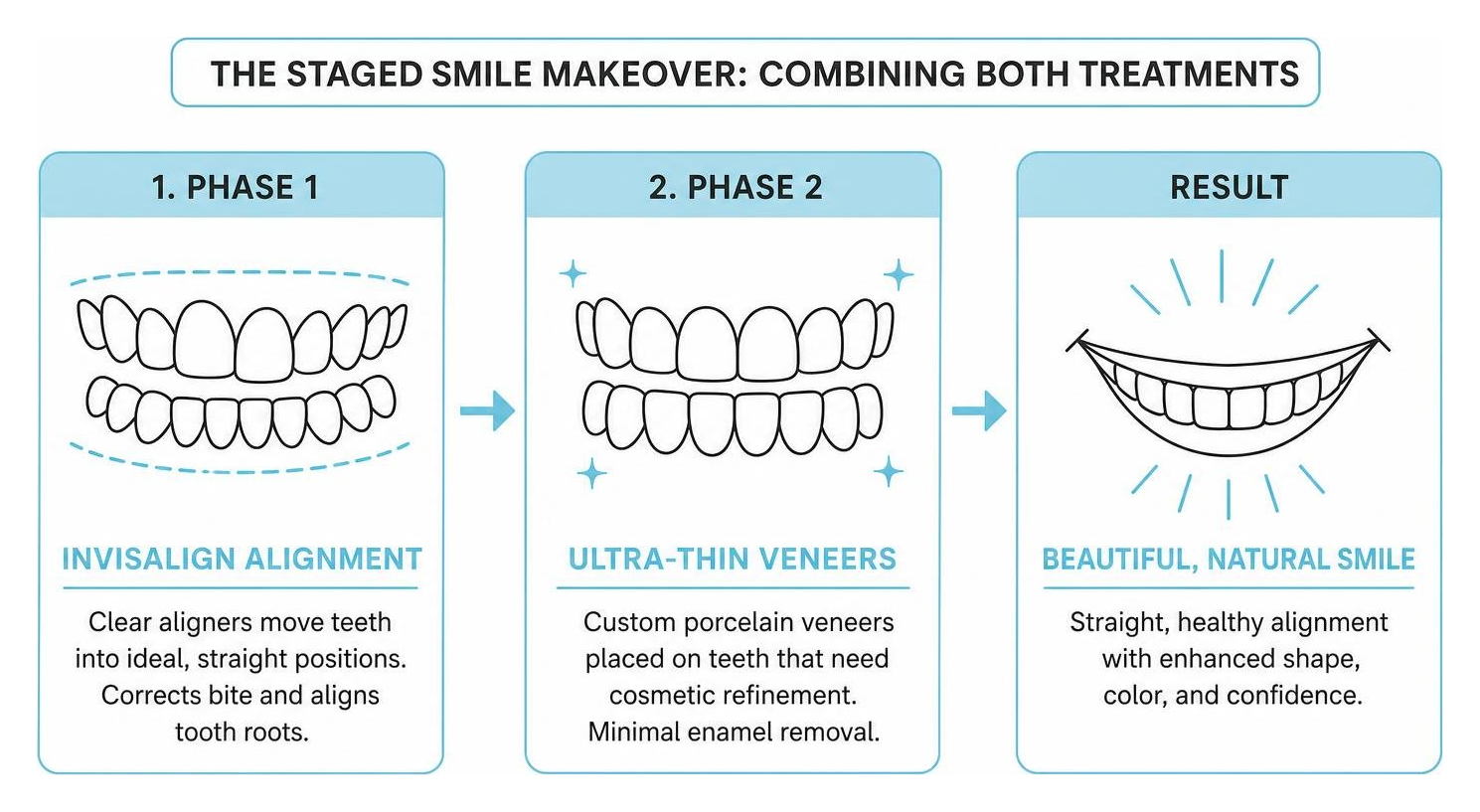
If you have teeth that are both severely crowded and heavily stained or chipped, trying to fix them with veneers alone is not ideal. To make crooked teeth look straight using only veneers, a dentist would have to shave down a substantial, unhealthy amount of your natural enamel on the protruding teeth.
By utilizing a staged approach, we can achieve spectacular, conservative results:
- Phase 1: Invisalign Alignment. We use clear aligners first to physically move your teeth into their ideal, straight positions. This corrects your bite and aligns the tooth roots.
- Phase 2: Ultra-Thin Veneers. Once the teeth are perfectly straight, we place custom porcelain veneers on only the teeth that need cosmetic refinement (such as those with chips, wear, or permanent discoloration).
Because the teeth are already straight, we only need to remove a microscopic amount of enamel (sometimes as thin as 0.3mm) to place the veneers. This preserves the maximum amount of your healthy, natural tooth structure while delivering a flawless, beautifully proportioned aesthetic result.
To explore how we design these comprehensive transformations, take a look at The Ultimate Cosmetic Dentistry Guide.
Frequently Asked Questions about Veneers and Invisalign
Are veneers permanent and do they damage natural teeth?
Yes, traditional porcelain veneers are considered a permanent, irreversible treatment. To ensure the veneers do not look bulky or sit awkwardly against your gums, a thin layer of natural enamel (typically 0.3mm to 0.5mm) must be gently removed.
When performed by an experienced cosmetic dentist, this process does not “damage” or ruin your teeth; it simply prepares them to form an incredibly strong, seamless bond with the porcelain. However, because that protective enamel is removed, those teeth will always require a veneer or a crown to remain protected from decay and sensitivity.
Can I whiten my teeth while undergoing Invisalign treatment?
Yes! One of the fantastic, lesser-known perks of Invisalign is that you can easily whiten your teeth during your orthodontic treatment. Because your aligners are custom-molded to the exact shape of your teeth, they can double as highly effective, professional whitening trays.
We can provide you with professional-strength whitening gel that you apply directly inside your clear aligners for a short period each day. This allows you to straighten and brighten your smile simultaneously, so you can debut a straight, dazzlingly white smile on the very same day your treatment finishes.
Which option is better for severe teeth grinding?
If you suffer from severe bruxism (clenching or grinding your teeth at night), Invisalign is generally the safer initial option. The heavy, repetitive forces of grinding can chip, crack, or completely loosen porcelain veneers over time.
If you do choose veneers, we highly recommend using high-strength ceramic materials like lithium disilicate and committing to wearing a custom nightguard every single night to protect your investment.
With Invisalign, the plastic aligners themselves actually act as a protective barrier between your upper and lower teeth while you sleep, protecting your natural enamel from wear while gradually correcting the alignment issues that may be contributing to your grinding in the first place.
Conclusion: Ready to Discover Your Perfect Smile?
At the end of the day, there is no single “right” answer when comparing veneers and Invisalign. The best choice is the one that aligns with your biology, fits your daily lifestyle, respects your budget, and brings you the confidence you deserve.
Whether you want to physically align your natural teeth for a healthy, lifetime foundation or structurally revitalize your smile’s appearance in just a few weeks, we are here to guide you every step of the way.
At the dental practice of Dr. Loren Grossman, we have spent over four decades providing personalized, compassionate, and state-of-the-art dental care to families throughout Kingston and the surrounding Northeastern Pennsylvania communities. We do not believe in high-pressure sales or one-size-fits-all treatments; we believe in listening to your story, understanding your goals, and crafting a customized smile design that feels completely natural and uniquely yours.
If you are ready to take the next step and find out once and for all which treatment is right for you, we invite you to read more about our practice philosophy at Discover Your Perfect Smile with a Trusted Cosmetic Dentist in Kingston PA and Schedule a consultation for cosmetic dentistry with us today. Let’s work together to build a smile you’ll be proud to share with the world!