What Does a Dental Crown Cost in Pennsylvania in 2026?
Dental crown cost in Pennsylvania averages $1,220 without insurance — but what you actually pay depends on your city, crown material, and coverage.
Here’s a quick snapshot:
| Situation | Typical Cost |
|---|---|
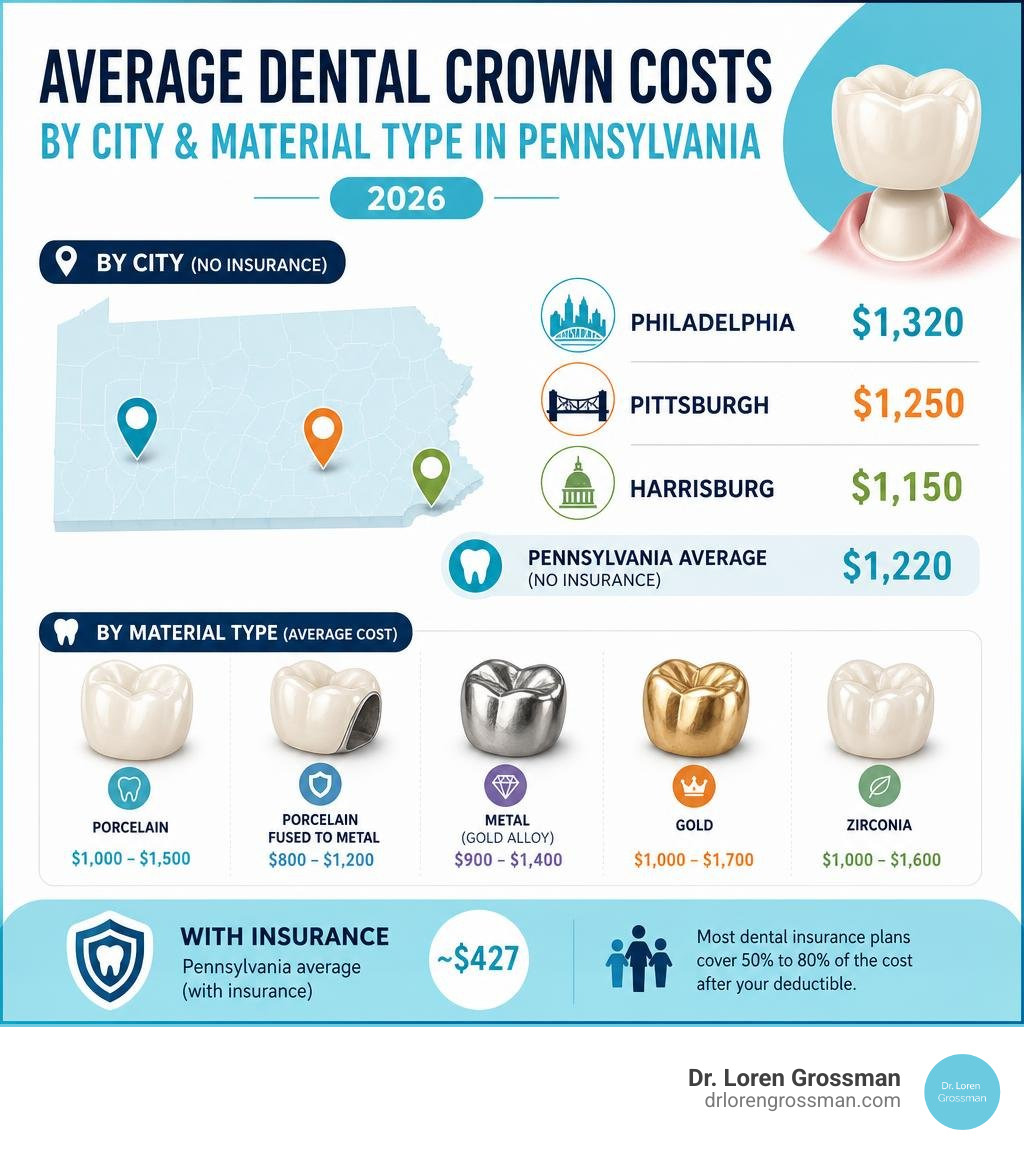
| Pennsylvania average (no insurance) | $1,220 |
| Pennsylvania average (with insurance) | ~$427 |
| Lowest end (simple cases) | $800 |
| Highest end (complex cases) | $1,700+ |
| Philadelphia (no insurance) | $1,320 |
| Pittsburgh (no insurance) | $1,250 |
| Harrisburg (no insurance) | $1,150 |
Source: American Dental Association Fee Survey data, 2025.
Most dental insurance plans classify crowns as a major procedure and cover 50% to 80% of the cost after your deductible — though annual maximums (typically $1,000–$2,000) often limit how much you actually receive.
If you have no insurance, you’re generally looking at $800 to $1,700 per crown in Pennsylvania, depending on the material and complexity of your case.
Getting a crown can feel overwhelming — especially when the costs aren’t always clear upfront. The price differences between cities, materials, and dental offices can be confusing. And if you need additional work like a root canal or core buildup before the crown goes on, the total bill can climb fast.
This guide breaks it all down in plain language, so you can walk into any Pennsylvania dental office knowing exactly what to expect and what questions to ask.
I’m Dr. Loren Grossman, D.M.D., a cosmetic and family dentist serving Northeastern Pennsylvania since 1984, and I’ve placed countless crowns across a wide range of budgets — making dental crown cost in Pennsylvania a topic I discuss with patients every single week. In the sections ahead, I’ll walk you through everything from city-by-city pricing to insurance tips to finding genuinely affordable care without sacrificing quality.
Similar topics to dental crown cost pennsylvania:
Average Dental Crown Cost Pennsylvania: State vs. National Trends
When we look at the numbers, the average dental crown cost in Pennsylvania sits at a reasonable $1,220 without insurance. Nationally, the average cost of a dental crown typically hovers around $1,520. This means that, on average, Pennsylvanians enjoy slightly lower rates for restorative dental care compared to the rest of the country.
However, “average” is a tricky word. In reality, dental crown costs across the Keystone State range from $800 to $1,700 per crown. Why such a wide gap?
Several regional price factors influence what you see on your final estimate:
- Local Overhead: Rent, utilities, and wages are much higher in bustling metropolitan areas than in quiet, rural towns.
- Lab Fees: High-quality local dental labs charge more for custom craftwork, which is reflected in the dentist’s fee.
- Dentist Expertise: Highly experienced prosthodontists or cosmetic dentists often charge premium rates for their specialized skill set.
Understanding these regional cost variations is crucial. If you live in a high-cost-of-living area, you can expect your baseline quote to lean toward the higher end of the spectrum.
Pennsylvania City-by-City Cost Breakdown
To give you a clearer picture of how location impacts your wallet, let’s look at the average cost of a dental crown across different Pennsylvania cities in 2026.
Prices fluctuate significantly as you travel from the southeastern corner of the state up through central Pennsylvania and over to the west. For instance, if you are looking at Dental Crown Cost in Philadelphia: $1,100-$3,850, you will notice the urban center pricing reflects higher city overhead.
Further west, the typical cost of a crown in Pittsburgh ranges from $1,067 to $1,778, with an average of $1,250. Meanwhile, central hubs like Harrisburg offer slightly lower averages at $1,150. If you are shopping around the historic Susquehanna Valley, you will find Dental Crowns Cost in Lancaster, PA (2026 Prices) | Dentists Ranked lists a typical range of $800 to $1,800, averaging out right around $1,200.
Here is how these cities compare side-by-side:
| Pennsylvania City | Average Cost (No Insurance) | Typical Range |
|---|---|---|
| Philadelphia | $1,320 | $1,100 – $3,850 |
| Pittsburgh | $1,250 | $1,067 – $1,778 |
| Lancaster | $1,200 | $800 – $1,800 |
| Harrisburg | $1,150 | $900 – $1,600 |
| Doylestown | $1,250 | $800 – $1,700 |
| York | $1,150 | $800 – $1,500 |
| Kingston (NEPA) | $1,100 | $800 – $1,500 |
As you can see, staying outside of the absolute largest metro areas can sometimes save you hundreds of dollars per tooth.
Types of Dental Crowns and Their Cost Differences

Not all crowns are created equal. The material your dentist uses to sculpt your new tooth plays a massive role in both the aesthetic outcome and the final price tag. To help you understand your choices, we recommend checking out our comprehensive Beginner’s Guide to Dental Crowns & Bridges.
Different materials are suited for different parts of your mouth. A front tooth requires a highly artistic, light-transmitting material, while a back molar needs pure, unyielding strength to crush food.
Porcelain and Ceramic Dental Crown Cost Pennsylvania
For teeth that show when you smile, all-porcelain or all-ceramic crowns are the gold standard. They mimic the natural translucency of tooth enamel beautifully, making them virtually indistinguishable from your organic teeth.
In Pennsylvania, porcelain and ceramic crowns generally cost between $900 and $1,800 per tooth. The factors influencing this price point include the artistic detail required by the dental lab, the specific brand of ceramic used (such as E-max), and the complexity of matching the crown to your surrounding teeth. While they are on the higher end of the price spectrum, their natural appearance makes them the preferred choice for front-tooth restorations.
Zirconia, Metal, and Porcelain-Fused-to-Metal (PFM) Crowns
When it comes to back molars, durability is the name of the game. Your molars endure over 200 pounds of chewing force per square inch, which is why alternative materials are often recommended.
- Zirconia Crowns: These are incredibly tough, metal-free crowns that offer a great balance of strength and natural look. They are highly resistant to chipping and typically cost $1,000 to $1,800.
- Porcelain-Fused-to-Metal (PFM) Crowns: A classic choice where porcelain is baked over a metal structure. They offer great strength and a natural look, though a dark metal line can sometimes show at the gumline over time. These are highly cost-effective, ranging from $800 to $1,400.
- Metal and Gold Alloy Crowns: Gold doesn’t fracture, wears gently against opposing teeth, and lasts the longest of any material. However, because gold is a precious metal, these crowns can be expensive, ranging from $1,200 to $2,000+ depending on market gold prices.
Additional Procedures That Increase the Total Cost
One of the most common surprises patients face is realizing that the “crown fee” is rarely the only fee. A crown is a cap, but the foundation of the tooth must be healthy and structurally sound before we can place it.
If you experience pain after a procedure, it might not be the crown itself; you can read more about troubleshooting post-placement discomfort in our guide: Is Your Crown Too High? Solving the Mystery of Biting Pain.
Core Buildups, Posts, and Root Canals
If a tooth is heavily decayed or broken, there might not be enough physical tooth structure left to hold a crown in place.
- Core Buildup ($250 – $500): We use a specialized composite material to rebuild the “core” of the tooth, giving the crown a solid anchor.
- Post and Core ($200 – $400): If the tooth has had a root canal, we may need to insert a small metal or carbon-fiber post down into the root canal space to help support the core buildup.
- Root Canal Therapy ($700 – $1,800): If decay has reached the nerve of the tooth, a root canal must be performed before the crown can be placed to prevent severe infection.
Crown Lengthening and Preparatory Surgery
Sometimes, a tooth breaks off right at or below the gumline. In these cases, we cannot safely attach a crown without trapping bacteria and causing chronic gum inflammation.
- Crown Lengthening ($500 – $1,500): This minor surgical procedure involves gently reshaping the surrounding gum tissue and bone to expose more of the natural tooth structure. While it adds to the upfront cost, it is absolutely essential for the long-term structural stability of your restoration.
Same-Day CEREC vs. Traditional Lab-Made Crowns
In the modern dental landscape of 2026, patients have two primary pathways for getting a crown: the traditional two-visit method or same-day CEREC technology.
Traditional crowns require two appointments spaced about two weeks apart. During the first visit, we prep the tooth, take physical impressions, and place a temporary plastic crown. A professional dental lab then custom-crafts your permanent crown. At the second visit, we remove the temporary and cement the permanent crown.
CEREC (Chairside Economical Restoration of Esthetic Ceramics) uses advanced 3D imaging and an in-office milling machine to design and carve your ceramic crown right in the office while you wait.
Here is how they compare:
- Convenience: CEREC wins handily. You walk in, get prepped, and walk out with your permanent crown in a single two-hour visit. No gooey impressions, and no wearing a temporary crown for weeks.
- Cost: Surprisingly, the fees are often very similar. While CEREC technology requires significant office investment, it eliminates the third-party lab fee. Most offices charge roughly the same rate for both, though some may charge a small premium for the convenience of same-day service.
- Aesthetics: For back teeth, CEREC is fantastic. For highly visible front teeth, many dentists still prefer traditional lab-made crowns because a specialized lab technician can hand-paint and layer porcelain to match your surrounding teeth perfectly.
Insurance Coverage and Financing Options in Pennsylvania
Navigating dental insurance can feel like learning a foreign language. Because crowns are restorative, most PPO plans cover them under their “Major Services” category.
Typically, insurance covers 50% to 80% of the contract fee, leaving the patient to pay the remaining portion out-of-pocket. However, you must keep your annual maximum in mind. Most plans cap their yearly payout between $1,000 and $2,000. If your crown and prep work cost $2,000, your insurance might pay its 50% ($1,000) and completely max out your benefits for the rest of the year.
To get a highly accurate estimate of your potential out-of-pocket costs based on your specific plan and location, we highly recommend using the How Much Does a Dental Crown Cost? Calculator.
Affordable and Low-Cost Dental Crown Cost Pennsylvania Options
If you do not have private insurance or are on a tight budget, there are several avenues to explore within Pennsylvania to keep your smile healthy:
- Dental Schools and Teaching Clinics: Dental students supervised by licensed faculty dentists perform high-quality work at a fraction of the cost. Institutions like Penn Dental Medicine offer excellent, budget-friendly care. You can learn more about these programs by reading Get the Facts About Low-Cost Dental Crowns – Penn Dental Medicine.
- Medicaid (Medical Assistance): In Pennsylvania, adult Medicaid dental benefits can be limited and vary. While basic extractions and fillings are usually covered, crowns are only covered under very specific, medically necessary conditions and require strict prior authorization.
- Regional Options: If you live in our local area of Northeastern Pennsylvania, we pride ourselves on providing highly personalized, competitive rates right here in Kingston. Restorative care costs can vary by region, so finding a trusted local provider who offers transparent pricing is key to managing your budget.
Payment Plans, Financing, and Dental Savings Plans
At Dr. Loren Grossman’s office, we believe that financial stress should never stand between you and a healthy smile. We offer several ways to break down the cost of care:
- Third-Party Financing: We accept CareCredit, which allows you to split your treatment costs into interest-free monthly payments over 6, 12, or 18 months.
- In-House Dental Savings Plans: For patients without insurance, our in-house savings plan provides preventive care (cleanings and exams) alongside flat discounts of 15% to 25% on major restorative work like crowns.
- Cash Discounts: Many dental offices, including ours, offer a 5% to 10% discount for patients who pay in full with cash or check upfront on the day of service.
Lifespan, Maintenance, and Long-Term Value
A dental crown is a significant investment, but when properly maintained, it is an incredibly durable one. On average, a high-quality dental crown lasts between 10 and 15 years, though it is not uncommon for well-cared-for crowns to last 20 years or more.
To maximize your investment, we recommend reading our detailed guide on Dental Crown Lifespan: How to Make Your Crown Last a Lifetime.
Taking care of a crown doesn’t require any fancy tools. You should treat it just like a natural tooth. However, there are a few simple habits that will keep the margins clean and prevent premature failure. For a daily checklist, see our expert advice on the Top Ways to Take Care of Your Dental Crown.
Frequently Asked Questions About Pennsylvania Dental Crowns
What should I ask my dentist before getting a dental crown quote in Pennsylvania?
Before you sign off on a treatment plan, ask for an itemized quote. Make sure to ask:
- Is a core buildup or post included in this price, or is that billed separately?
- What material are you recommending for this specific tooth, and why?
- Do you offer a warranty or guarantee on your crowns if they chip or fail early? (For example, some offices offer a 5-year warranty if you stay current on your routine cleanings).
Can a tooth with a dental crown still get a cavity?
Yes, absolutely. While the ceramic or metal crown itself cannot decay, your natural tooth underneath it absolutely can. Decay typically starts at the “margin” — the microscopic seam where the crown meets your natural tooth at the gumline. If plaque is allowed to sit there, a cavity will form underneath the crown, which eventually ruins the restoration. Excellent brushing and flossing are vital.
Why do dental crown costs vary so much between Pennsylvania dental offices?
Fees vary based on the dentist’s overhead (rent in downtown Philadelphia is much higher than in Kingston), the specific dental lab they partner with, the quality of materials selected, and the dentist’s level of clinical experience. A cheaper crown often means the dentist is using a high-volume, lower-cost dental lab, whereas premium pricing usually reflects custom, hand-layered artistry.
Conclusion
At the end of the day, a dental crown is more than just a cosmetic fix — it is a protective shield that preserves your natural tooth, keeps your bite aligned, and allows you to eat and smile with confidence.
If you are looking for top-tier cosmetic and general dentistry in Northeastern Pennsylvania, we are here to help. At Dr. Loren Grossman’s practice in Kingston, PA, we combine advanced technology with a warm, personalized approach to deliver comfortable, durable, and highly affordable smile transformations.
Ready to restore your smile? Explore our Services: Crowns & Bridges and schedule a consultation with our friendly team today!