Is Professional Teeth Whitening Worth It Compared to At-Home Options?
When weighing professional teeth whitening vs at home methods, here is the quick answer:
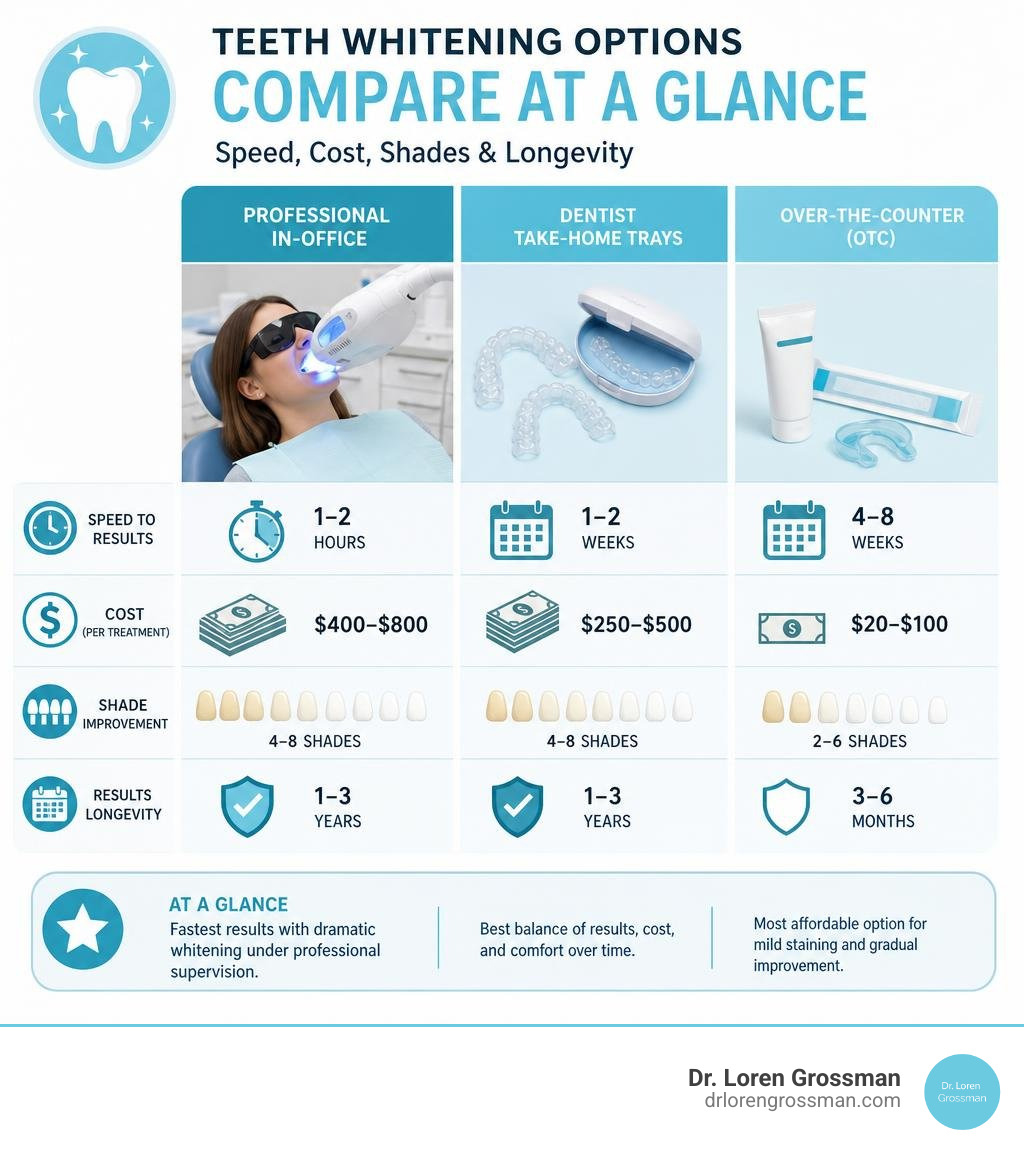
| Factor | Professional In-Office | Dentist Take-Home Trays | Over-the-Counter |
|---|---|---|---|
| Shade improvement | 4–8 shades | 4–8 shades | 2–6 shades |
| Time to results | 1–2 hours | 1–2 weeks | 4–8 weeks |
| Peroxide concentration | 25–40% hydrogen peroxide | 10–22% carbamide peroxide | 3–10% hydrogen peroxide |
| Cost (per treatment) | $400–$800 | $250–$500 | $20–$100 |
| Results longevity | 1–3 years | 1–3 years | 3–6 months |
| Sensitivity risk | Higher short-term | Lower, gradual | Moderate |
| Best for | Fast, dramatic results | Best long-term value | Mild staining, tight budget |
The short version: Professional whitening delivers faster, more dramatic results under safe supervision. At-home options cost less but work more slowly and less predictably. For most people, dentist-prescribed take-home trays offer the best balance of results, cost, and comfort over time.
Nearly one in five Americans has whitened their teeth, according to the American Dental Association — and it is easy to see why. A brighter smile is one of the most requested cosmetic improvements in dentistry today. But standing in the dental aisle, or scrolling through options online, the choice between a $30 box of strips and an $800 in-office treatment can feel overwhelming.
The truth is, both methods work — but they work differently, for different situations, and at very different speeds. The right choice depends on your starting shade, your timeline, your budget, and whether you have any existing dental restorations or sensitivity concerns.
I’m Dr. Loren Grossman, D.M.D., a cosmetic and family dentist serving Northeastern Pennsylvania since 1984, and I have guided thousands of patients through decisions about professional teeth whitening vs at home options — including performing in-office whitening with the Zoom II chairside system. In the sections below, I will walk you through everything you need to know to make the right call for your smile.
Must-know professional teeth whitening vs at home terms:
- best teeth whitening treatment options
- how long does teeth whitening last
- how many shades whiter with zoom
Professional Teeth Whitening vs At Home: The Core Differences
To truly understand how these two paths diverge, we must look at the science of a brighter smile. All legitimate teeth whitening methods rely on the exact same fundamental chemistry: peroxide-based bleaching. However, the way that peroxide is packaged, concentrated, and applied is what creates the massive divide between a clinical treatment and a store-bought strip.

When we apply a bleaching gel to your teeth, the active molecules—either hydrogen peroxide or carbamide peroxide—penetrate the porous enamel structure. Through a process called chemical oxidation, these compounds target the dark, complex organic molecules (known as chromogens) that cause discoloration. The peroxide breaks the chemical bonds holding these stain molecules together, turning them into smaller, colorless compounds.
The main difference between professional and at-home applications comes down to three things:
- Chemical Strength: Professional in-office treatments utilize a highly concentrated gel, typically featuring 25% to 40% hydrogen peroxide. By comparison, over-the-counter (OTC) products like whitening strips or paint-on pens usually contain much weaker concentrations, ranging from 3% to 10% hydrogen peroxide.
- Carbamide vs. Hydrogen Peroxide: Many dentist-supervised take-home kits utilize carbamide peroxide (usually between 10% and 22%). Carbamide peroxide is a more stable compound that breaks down slowly, releasing about one-third of its concentration as active hydrogen peroxide. This slower, gradual release makes it ideal for overnight or extended wear in custom trays, minimizing sudden nerve irritation.
- The Shielding Factor: Because professional gels are highly caustic to soft tissues, clinical settings require a rubber shield or a painted-on light-cured resin barrier to isolate and protect the gums. At-home kits lack these customized protective barriers, leaving your gums vulnerable to chemical irritation if the gel escapes the tray or strip.
For a deeper dive into how these chemical mechanisms stack up across various products, you can read our comparison in Which Whitening Method Wins? A Guide to Your Best Options.
Comparing the Results: Speed, Shade Improvement, and Longevity
When patients ask us about the real-world difference in results, we focus on three main metrics: speed, shade improvement, and how long those pearly whites will actually stay bright.
| Whitening Method | Shade Improvement | Time Commitment | How Long It Lasts |
|---|---|---|---|
| Professional In-Office | 6 to 10 shades | One 60–90 minute session | 1 to 3 years |
| Dentist Custom Trays | 4 to 8 shades | 1 to 2 weeks (30-60 mins daily) | 1 to 3 years |
| OTC Whitening Strips | 2 to 4 shades | 2 to 4 weeks (30 mins daily) | 3 to 6 months |
| Whitening Toothpastes | 1 to 2 shades (surface only) | Ongoing daily use | Temporary |
Speed: Immediate Results vs. Gradual Whitening
If you have a major event like a wedding, graduation, or a high-stakes job interview in Kingston, PA next week, speed is everything. Professional in-office whitening is the undisputed champion here. In just a single 60- to 90-minute session, the high-concentration peroxide gel (often activated by a specialized UV or LED light) lifts stains immediately.
At-home options, on the other hand, require patience. Over-the-counter strips and store-bought LED kits require daily dedication for anywhere from two to eight weeks to achieve a noticeable difference. Dentist-prescribed custom take-home trays offer a middle ground: they yield professional-grade results in about one to two weeks of brief daily wear.
Shade Improvement: How White Can You Go?
The natural ceiling of your tooth brightness is determined by your genetics and the thickness of your enamel. However, professional treatments consistently get you closer to that genetic ceiling. In-office systems can lighten your teeth by up to 8 (and sometimes 10) shades.
Store-bought strips typically max out at a 2-to-6 shade improvement. Because these strips are flat, they also struggle to reach the curved edges of your teeth or wrap around slightly crooked teeth, which can lead to uneven whitening or yellow borders.
Longevity: Keeping the Brilliancy Alive
No whitening treatment is permanent because our teeth are constantly exposed to staining agents in our diets. However, professional treatments provide far superior longevity. Because professional-grade peroxides deeply penetrate the dentin (the layer beneath your enamel), the results typically last between 1 and 3 years.
Over-the-counter products primarily target extrinsic (surface) stains. Because they do not penetrate as deeply, the results fade much faster—often within 3 to 6 months. To understand how to extend the lifespan of your treatment, explore our guide on How Long Does Teeth Whitening Last and How to Make It Stay?.
Cost and Value Analysis of Whitening Methods
At first glance, over-the-counter whitening kits seem like the obvious choice for budget-conscious shoppers. However, when you look at the financial investment over a five-year horizon, the math shifts in a surprising direction.
Store-bought whitening strips cost between $30 and $50 per box. Because the results fade in just a few months, a dedicated user will need to buy three to four boxes a year to maintain their bright shade. Over five years, that adds up to $600 to $1,000 in disposable plastic strips that often yield uneven results and cause chronic gum irritation.
With dentist-supervised custom trays, you make a one-time investment in the custom-fabricated trays (usually between $250 and $500). Because these medical-grade trays are molded perfectly to your teeth, they last for years. When your smile needs a boost, you only need to purchase inexpensive professional gel refills from our office (typically $20 to $40). Over five years, this “hybrid approach” of a single tray investment plus occasional refills is often the most economical and highly effective option available.
For a broader perspective on how these costs compare nationally, you can read the comprehensive breakdown in At-Home Teeth Whitening vs. Dentist: Cost, Results & Which Is Right (2026) – Bianca Bright.
Cost Comparison: Professional Teeth Whitening vs At Home
Let’s break down the typical upfront costs you can expect in 2026:
- Professional In-Office Whitening: Typically ranges from $400 to $800 per session. This fee covers the clinical application, protective barriers, light-activation technology, and the direct supervision of a dental professional.
- Dentist-Dispensed Custom Trays: Usually costs between $250 and $500. This includes the dental impressions, the fabrication of your custom-fitted trays, and a supply of professional-strength carbamide peroxide gel.
- Over-the-Counter Products: These range from $20 to $100 for basic strips, paint-on pens, or stock-tray LED kits. While cheap upfront, they lack customization and professional-strength chemistry.
If you are trying to decide which financial path makes the most sense for your wallet and your cosmetic goals, check out our Buyer’s Guide: Best Teeth Whitening Options for 2026.
Safety, Sensitivity, and Dental Conditions
The single most important reason to involve a dentist in your whitening journey is safety. Your mouth is a highly sensitive environment, and applying strong bleaching chemicals without a prior clinical exam can lead to painful consequences.
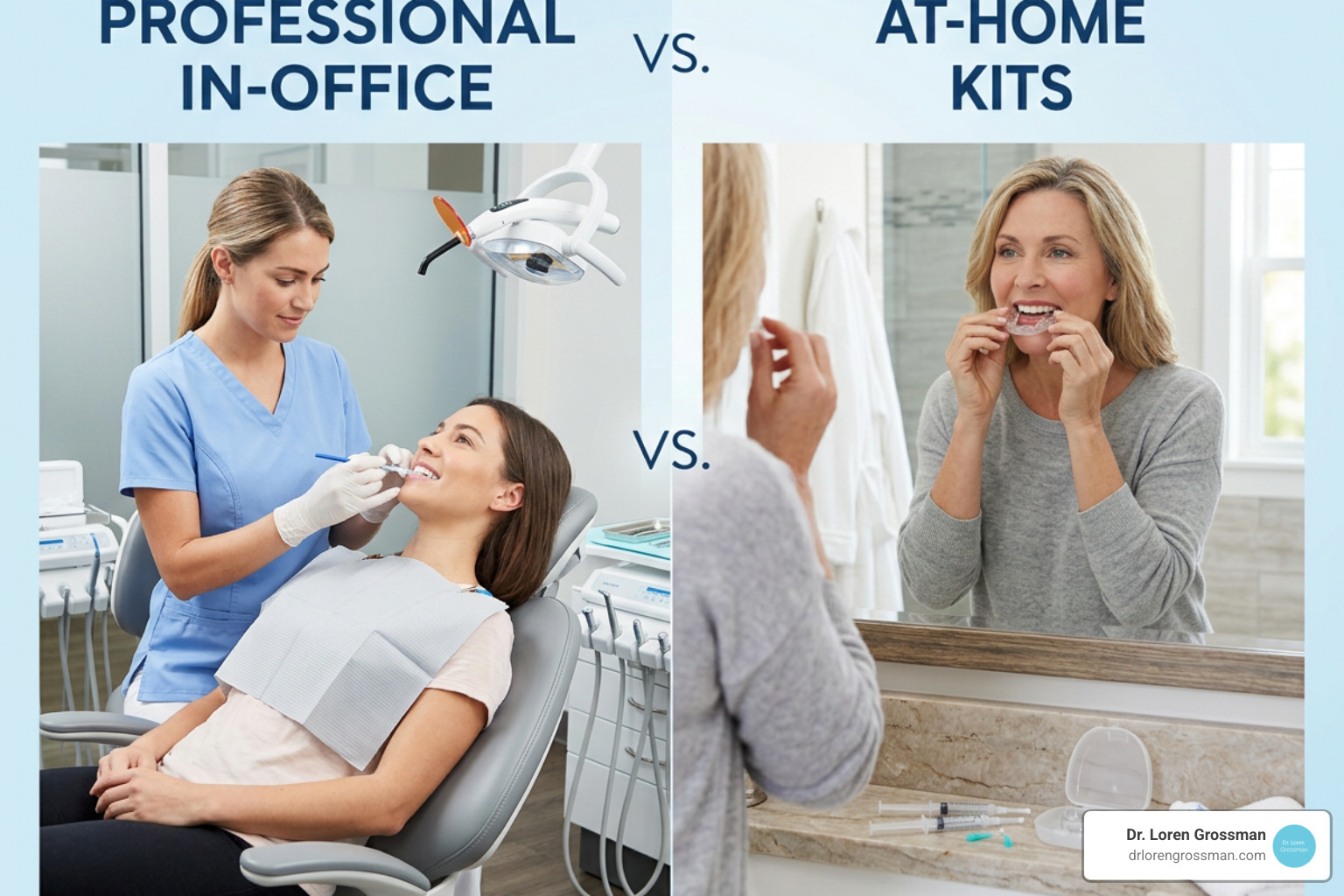
Before we perform or prescribe any whitening treatment at our Kingston, PA office, we conduct a thorough oral exam. We check for:
- Active tooth decay and cavities: If peroxide gel leaks into an open cavity, it can travel directly to the nerve, causing excruciating pain and potentially requiring a root canal.
- Gum recession and exposed roots: The root surfaces of your teeth are covered in cementum, not enamel. Cementum does not whiten, and exposing it to bleach causes extreme, sharp sensitivity.
- Gum disease: Bleaching over inflamed, bleeding gums will exacerbate oral health issues and cause chemical burns on the soft tissues.
During an in-office professional session, we isolate your teeth using specialized barriers to keep the highly concentrated gel entirely away from your gums. This clinical precision virtually eliminates the risk of chemical burns and uneven splotches. To learn more about how we prioritize your oral health during cosmetic procedures, read Whiten Your Way: The Safest Methods for a Brighter Smile.
Safety and Sensitivity: Professional Teeth Whitening vs At Home
Tooth sensitivity is the most common side effect of any whitening treatment, affecting about half of all patients. It occurs because peroxide temporarily dehydrates the enamel and opens up the microscopic “dentinal tubules” that lead directly to the tooth’s nerves.
Fortunately, modern professional whitening systems are formulated with state-of-the-art desensitizing agents that you simply won’t find in cheap over-the-counter kits:
- Potassium Nitrate: This compound penetrates the enamel to reach the pulp nerves, effectively “calming” or sedating the nerve endings to block pain signals.
- Amorphous Calcium Phosphate (ACP): ACP works by filling and sealing the open dentinal tubules. This not only dramatically reduces sensitivity but also helps remineralize and strengthen your enamel during the whitening process.
If you choose a dentist-supervised take-home kit, we can customize the peroxide concentration (for example, dropping down to a gentle 10% carbamide gel) and provide professional desensitizing gels to ensure a completely comfortable experience. We also recommend brushing with a high-quality potassium nitrate desensitizing toothpaste for two weeks prior to starting your treatment.
To discover why professional systems are engineered to protect sensitive teeth, explore our article on Why Choose Zoom Professional Teeth Whitening Services?.
When Whitening Will Not Work: Limitations and Contraindications
One of the biggest pitfalls of DIY whitening is spending money on products that are physically incapable of changing the color of your teeth. Peroxide-based bleaching agents only work on natural tooth enamel.
The Restoration Barrier
If you have dental restorations on your front teeth—including composite fillings, crowns, dental bonding, or porcelain veneers—they will not change color. Peroxide cannot penetrate or alter the synthetic porcelain or composite materials. If you apply strong whitening gels to a smile with restorations, your natural teeth will brighten while your crowns or fillings remain their original shade, resulting in a highly mismatched, uneven smile.
Intrinsic vs. Extrinsic Staining
Whitening is highly effective at removing extrinsic stains caused by lifestyle factors like coffee, tea, red wine, and tobacco. However, it has severe limitations when dealing with intrinsic staining (discoloration originating from inside the tooth structure).
These difficult stains are often caused by:
- Tetracycline Antibiotics: Exposure to certain medications during childhood tooth development can leave dark gray or brown bands across the teeth.
- Fluorosis: Excessive fluoride intake during childhood can cause chalky white or brown splotches.
- Trauma: A tooth that has suffered physical trauma may darken internally as the nerve dies.
These deep, intrinsic discolorations generally do not respond to standard at-home kits or basic in-office bleaching. For these complex cases, a customized cosmetic approach—such as porcelain veneers or professional deep-bleaching protocols—is required. Learn how we design customized solutions for these unique cases in our guide to Teeth Whitening for the Perfect Smile Makeover.
How to Choose the Right Option for Your Smile
Choosing between professional teeth whitening vs at home doesn’t have to be a guessing game. By using a simple decision framework, you can easily identify the best path forward for your specific situation.
The Decision Framework: Which Fits Your Life?
- Choose Professional In-Office Whitening if:
- You have a major event (wedding, reunion, photo shoot) in less than two weeks.
- You want dramatic, guaranteed results without spending weeks applying strips.
- You have a history of severe tooth sensitivity and want professional monitoring.
- You want the peace of mind that comes with direct clinical supervision.
- Choose Dentist-Supervised Take-Home Trays if:
- You want the absolute best long-term financial value.
- You prefer to whiten gradually in the comfort of your own home.
- You want a reusable system that allows for easy, inexpensive touch-ups over the next few years.
- Choose Over-the-Counter Strips if:
- Your teeth are already relatively bright and only need a minor touch-up.
- You are on a very tight budget and do not mind a slower, more uneven whitening process.
- You have recently had a dental exam and know your teeth are completely free of cavities and gum disease.
If you are looking for a highly personalized, expert consultation right here in Kingston, we invite you to read more about our custom approach in Brighten Your Smile: Expert Teeth Whitening Near Me.
Post-Whitening Maintenance and Follow-Up Care
Once you achieve your dream shade, the goal is to keep it that way. The first 48 hours after any whitening treatment are absolutely critical. During this window, your enamel’s microscopic pores remain open and highly susceptible to absorbing new stains.
The “White Diet”
For the first two days post-treatment, we advise patients to follow a strict “white diet.” Avoid heavily pigmented foods and beverages, including:
- Coffee, black tea, and red wine
- Dark colas and fruit juices
- Soy sauce, marinara sauce, and curry
- Berries, beets, and dark chocolate
If you must drink coffee or tea, try using a straw to bypass your front teeth entirely, and rinse your mouth with water immediately afterward.
Daily Maintenance Habits
To preserve your bright results long-term, maintain a rigorous oral hygiene routine:
- Brush twice daily and floss daily to prevent plaque buildup, which easily attracts stains.
- Use a gentle whitening toothpaste once or twice a week to polish away surface stains before they settle.
- Schedule regular professional cleanings every six months. Our dental hygienists can polish away stubborn extrinsic stains that regular brushing cannot touch.
When your smile eventually begins to naturally dull, simply pop in your custom trays for a single-night touch-up to instantly restore your brightness. Discover how we utilize advanced clinical maintenance in our Services: Zoom Whitening overview.
Frequently Asked Questions about Teeth Whitening
Will professional teeth whitening damage my enamel?
No. When performed or prescribed by a licensed dental professional, whitening is entirely safe for your enamel. Peroxide agents work by penetrating the microscopic pores of your teeth to break down stain molecules; they do not strip, scrape, or dissolve the enamel structure itself. However, using unapproved DIY methods—such as highly abrasive charcoal toothpastes or acidic lemon juice hacks—can permanently wear down your enamel.
How soon before an event should I whiten my teeth?
For professional in-office whitening, we recommend scheduling your session 1 to 2 weeks before your big event. This allows any minor, temporary sensitivity to completely resolve and gives your shade time to stabilize. If you choose dentist-supervised take-home trays, you should start your treatment 3 to 4 weeks before the event to ensure you can comfortably complete the full whitening cycle.
Can I whiten teeth that have crowns or veneers?
No. Bleaching gels only affect natural tooth structure. Synthetic dental materials like porcelain, composite resins, and acrylics do not react to peroxide. If you plan to replace old crowns or veneers on your front teeth, we highly recommend whitening your natural teeth first. Once you reach your desired shade, we can custom-match your new porcelain restorations to your brightened smile.
Conclusion
When comparing professional teeth whitening vs at home options, there is no single “correct” answer—only the answer that is right for your unique smile, budget, and timeline. While over-the-counter kits offer initial convenience, they cannot match the speed, safety, customization, and long-term value of professional dental care.
At the practice of Dr. Loren Grossman, we provide top-tier cosmetic and general dentistry in Northeastern Pennsylvania. We combine advanced technology like Zoom professional whitening with a warm, patient-focused approach to deliver safe, stunning smile transformations that truly boost your everyday confidence.
Ready to say goodbye to stains and hello to a brilliant new smile? Schedule a Teeth Whitening Consultation with our team in Kingston, PA today!