The Right Questions Make All the Difference When Choosing a Cosmetic Dentist
Knowing how to choose a cosmetic dentist can mean the difference between a smile you love for decades and one you regret within months.
Here’s a quick answer to help you get started:
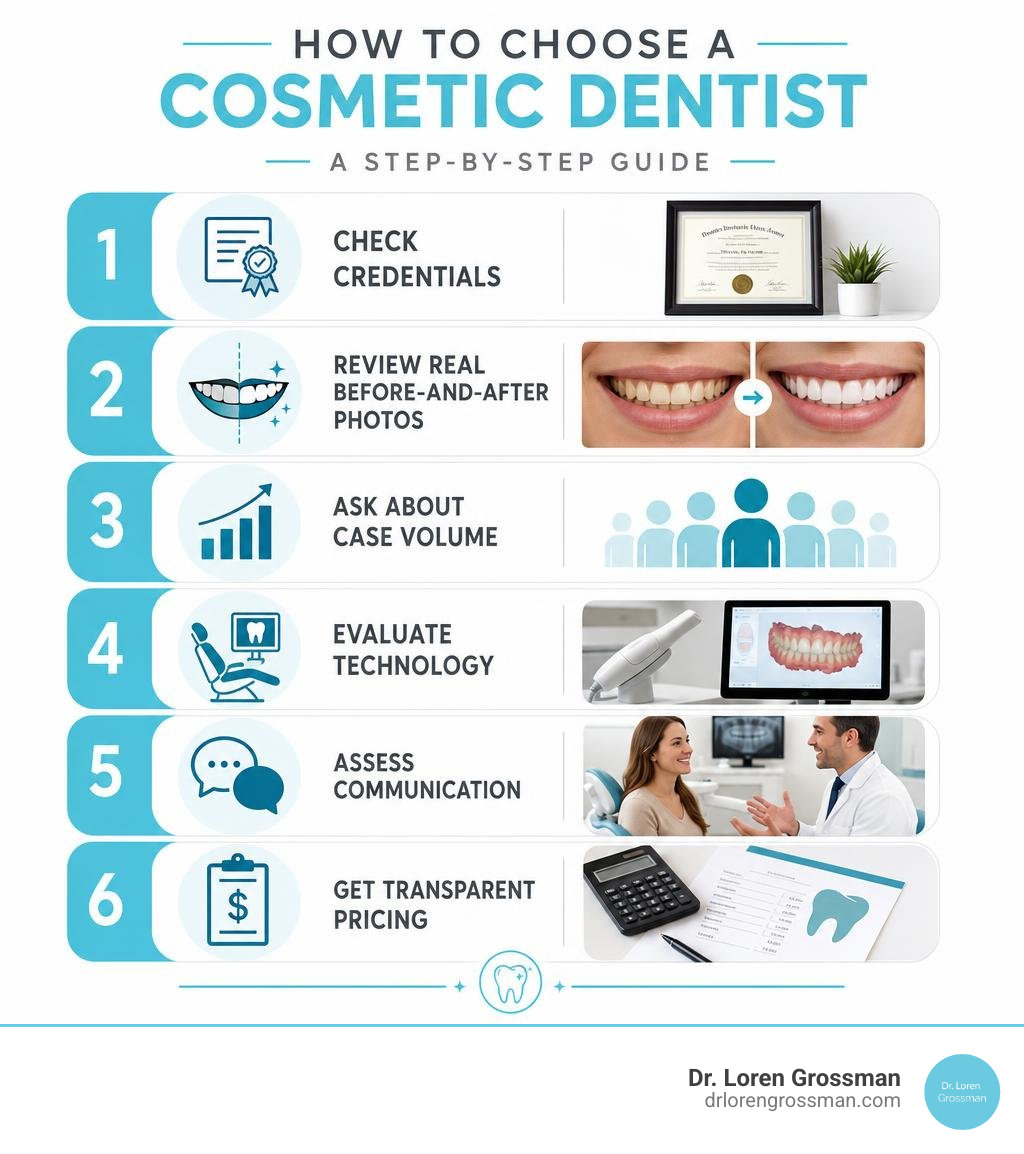
- Check credentials – Look for AACD membership and post-graduate cosmetic training.
- Review real before-and-after photos – Confirm they are actual patients, not stock images.
- Ask about case volume – Find out how often they perform the specific procedure you need.
- Evaluate technology – Modern tools like digital imaging and intraoral cameras matter.
- Assess communication – A good cosmetic dentist listens first and recommends second.
- Get transparent pricing – Ask for a written cost breakdown before agreeing to anything.
- Trust your gut – If the consultation feels rushed or pushy, keep looking.
Here’s why this matters: any licensed dentist can legally call themselves a cosmetic dentist. The American Dental Association does not recognize cosmetic dentistry as a formal specialty; you can review the ADA-recognized dental specialty definitions through the National Commission on Recognition of Dental Specialties and Certifying Boards. That means the burden of vetting falls entirely on you as the patient.
And the stakes are real. Poorly done cosmetic work – veneers that don’t fit your bite, whitening that doesn’t address the underlying issue – can cost far more to fix than getting it right the first time.
The good news? Asking the right questions during your consultation cuts through the guesswork fast.
I’m Dr. Loren Grossman, D.M.D., a cosmetic and family dentist serving Northeastern Pennsylvania since 1984, and over four decades of hands-on practice – from smile makeovers to complex implants – has shown me exactly what separates a trustworthy cosmetic dentist from one who will leave you disappointed. In this guide on how to choose a cosmetic dentist, I’ll walk you through the 10 questions that will give you the clearest picture of any provider before you commit.
Understanding Cosmetic Dentistry vs. General Dentistry
Before diving into the questions, we must first understand the fundamental differences between general dentistry and cosmetic dentistry.
General dentistry is primarily concerned with oral health, prevention, and structural maintenance. When you need a cavity filled, a root canal, or a routine cleaning, you visit a general dentist. Their priority is ensuring your mouth is free of disease and decay.
Cosmetic dentistry, or aesthetic dentistry, focuses on the appearance of your teeth, gums, and overall smile. It blends the clinical precision of restorative dentistry and prosthodontics with an artistic eye. While general dentistry focuses on function and health, cosmetic dentistry aims for symmetry, balance, and visual harmony—all while preserving a healthy foundation.

A great smile makeover should never sacrifice your oral health. In fact, the most successful cosmetic treatments are built on a healthy foundation. If a dentist offers to place veneers over active gum disease or untreated decay, that is a major red flag.
To help you visualize the differences, Finding the Right Cosmetic Dentist involves understanding how these two areas overlap and differ:
| Feature | General Dentistry | Cosmetic Dentistry |
|---|---|---|
| Primary Goal | Prevent, diagnose, and treat oral disease | Enhance the visual appearance of the smile |
| Common Procedures | Cleanings, fillings, root canals, crowns | Veneers, teeth whitening, bonding, smile designs |
| Training Focus | Standard dental school curriculum | Advanced post-graduate aesthetic education |
| Insurance Coverage | Usually covered (preventive & restorative) | Rarely covered (considered elective) |
| Artistic Element | Standard functional restoration | Highly customized shade, shape, and facial symmetry matching |
Why Knowing How to Choose a Cosmetic Dentist Matters
Because cosmetic dentistry is not a recognized specialty, any licensed dentist can market themselves as a cosmetic dentist. This is why knowing how to choose a cosmetic dentist is so critical for patients in Kingston, PA and the surrounding areas.
When you undergo a smile design, the dentist is not just changing the color of your teeth. They are altering your bite alignment, which requires advanced occlusal training. If your new veneers or crowns do not align perfectly with your natural jaw movement, you can develop severe long-term issues. We frequently see patients who have developed painful TMJ disorders, chronic headaches, and premature wear on their expensive new restorations simply because their dentist focused on “glamour and glitz” without respecting function.
Furthermore, if you struggle with dental anxiety, choosing the wrong provider can make the experience incredibly stressful. A qualified professional knows how to balance technical mastery with a compassionate, patient-first approach. If you want to learn more about the research process, you can Discover how to find a cosmetic dentist to protect both your health and your financial investment.
10 Essential Questions to Ask During Your Consultation
The consultation is the most critical hour of your smile transformation journey. It is where credentials meet real-world communication. A truly patient-centered approach means the dentist will spend time listening to your aesthetic goals, evaluating your oral health, and building a customized treatment plan.

To help you make the most of this visit, we recommend bringing a written list of questions. You can Explore questions to ask your cosmetic dentist to ensure you cover every angle. Let’s break down the ten most important questions you should ask.
1. What Advanced Training and Credentials Do You Have?
Because standard dental schools spend very little time on advanced cosmetic techniques, you must ask about post-graduate training. Look for dentists who have completed rigorous continuums at renowned post-graduate institutions.
Additionally, ask about professional memberships. The American Academy of Cosmetic Dentistry (AACD) is the world’s foremost authority on aesthetic dentistry. However, keep in mind that there is a difference between basic AACD membership and AACD accreditation.
- AACD Members: Any dentist can pay a fee to join the academy and access continuing education.
- Accredited Members: Only about 1% of dentists in the U.S. have achieved AACD accreditation. This status requires a minimum of five years to complete, involving written exams, peer review of multiple complex clinical cases, and oral examinations.
Choosing an accredited professional ensures you are working with someone who has undergone rigorous testing. Before moving forward, you may also want to Check if you are a good candidate for cosmetic dentistry to see if your goals align with these advanced procedures.
2. How Many Cases Similar to Mine Have You Completed?
A dentist who designs five smiles a year does not possess the same refined skills as a dentist who designs five smiles a month. You want to ask about their specific case volume.
If you are looking to correct a complex issue—such as a highly visible gap, a severely crooked smile line, or worn-down enamel from grinding—ask how many times they have treated that exact issue. Experience with the specific treatment you want is the single most important factor to evaluate. For instance, a dentist might perform hundreds of teeth whitening procedures but very few full-mouth porcelain veneer cases.
To ensure you get the results you deserve, take the time to Find the best cosmetic dentist for your needs by verifying their hands-on experience with your desired procedure.
3. Can I See Real Before-and-After Photos of Your Patients?
Over 90% of patients state that before-and-after photos and patient reviews are the most important factors when choosing a cosmetic dentist. However, you must look at these portfolios with a critical eye.
Many dental websites use purchased stock photos to advertise cosmetic services. Always ask: “Are these photos of your actual patients?”
When reviewing a patient gallery, look for cases that match your starting point. If you have chipped front teeth, look for veneer or bonding cases that corrected chipped front teeth. Pay attention to the details:
- Do the teeth look natural, or are they uniformly opaque and excessively white?
- Do they match the patient’s face shape, age, and lip line?
- Is the gum tissue healthy and natural-looking around the edges of the restorations?
To understand what goes into achieving these beautiful, lifelike results, you can Learn the secrets to cosmetic dentistry success and learn how to spot authentic clinical artistry.
4. What Modern Technologies and Materials Do You Use?
The field of aesthetic dentistry is constantly evolving. A commitment to continuing education naturally goes hand-in-hand with utilizing modern technologies and high-quality materials.
Ask if the practice uses digital impressions and intraoral scanners. Traditional gooey impression trays can be uncomfortable and are prone to minor distortions. Digital scans provide highly accurate 3D models of your teeth, ensuring a much tighter fit for your porcelain veneers or crowns.
Additionally, ask about the materials. High-quality dental ceramics, such as lithium disilicate or zirconia, offer superior strength and light-transmitting qualities that mimic natural tooth enamel. If a dentist offers unusually low prices, they may be using inferior materials or low-cost dental labs, which can lead to premature chipping, staining, or a chalky, artificial appearance.
5. How Do You Ensure My New Smile Functions Properly?
A beautiful smile that ruins your bite will not last. We believe that form must follow function. Your teeth, jaw joints (TMJ), and chewing muscles must work together in perfect harmony.
Ask the dentist how they plan to evaluate your bite function before designing your restorations. They should perform a comprehensive evaluation of your jaw alignment and check for signs of teeth grinding (bruxism). If you have an underlying bite issue, it must be addressed during the restorative care planning stage.
Advanced occlusal training allows a skilled cosmetic dentist to design restorations that not only look stunning but also distribute chewing forces evenly, protecting your natural teeth and your new dental work from cracking under pressure.
6. What Are the Risks, Limitations, and Maintenance Requirements?
Every dental procedure has its trade-offs, and an ethical dentist will discuss them openly. For example, preparing teeth for porcelain veneers is generally irreversible because a tiny amount of natural enamel must be removed to ensure a seamless fit.
Ask about the expected lifespan and maintenance of your restorations:
- Porcelain Veneers: Typically last 10 to 15 years (and often 15–20+ years with exceptional care). They are highly stain resistant.
- Dental Bonding: Typically lasts 3 to 10 years and is more prone to staining and chipping over time.
- Professional Whitening: Results can last from 6 months to 2 years, heavily depending on your diet and smoking habits.
Before making a final decision, it is wise to Consider these 5 things before getting cosmetic dental work to ensure your expectations align with long-term realities.
7. Who Else on Your Team and Lab Will Be Involved?
Cosmetic dentistry is a team sport. While the dentist prepares your teeth and designs the treatment plan, the actual restoration is hand-crafted by a dental ceramist in a professional dental laboratory.
Ask about the lab technician or ceramist the dentist partners with. Top-tier cosmetic dentists work with highly skilled, often AACD-accredited, dental laboratories. The relationship between the dentist and the ceramist is highly collaborative; they share high-resolution photography, shade measurements, and facial records to ensure the final product looks like a natural part of your smile. If a dentist uses a high-volume, discount commercial lab, the restorations may look generic and fail to match your natural teeth.
8. What Happens If I Am Not Happy with the Final Result?
Because aesthetic beauty is subjective, open communication quality is vital. You need to know what policies are in place if the final look does not meet your expectations.
Ask: “Do I get to preview my smile before the restorations are permanently bonded?”
A reputable dentist will use temporary veneers or crowns (a “trial smile”) to let you test-drive the look, shape, and feel of your new teeth. This trial run allows you to request adjustments before the final porcelain is fabricated. Once the permanent restorations arrive from the lab, the dentist should place them with temporary cement so you can approve the final aesthetics in natural light. If you are not happy, they should be sent back to the lab for adjustments before permanent bonding takes place.
9. What Is the Total Cost and What Financing Options Are Available?
We believe in complete pricing transparency. Before any treatment begins, you should receive a detailed, written breakdown of all costs associated with your smile transformation.
Because most cosmetic procedures are considered elective, standard dental insurance rarely covers them. However, if a procedure also provides restorative benefits—such as a dental crown that strengthens a cracked tooth while improving its appearance—your plan might offer partial coverage.
To help manage out-of-pocket costs, ask about flexible payment plans and third-party financing options like CareCredit. Many premier offices, including our Kingston, PA practice, work with these services to offer low-interest or interest-free monthly payment options that fit your budget.
10. How Do You Help Patients Manage Dental Anxiety?
If you feel nervous about dental visits, you are not alone. According to dental health reports, over 20% of adults avoid dental care due to anxiety.
Ask the dentist how they accommodate anxious patients. A compassionate, patient-first practice will offer a calming office environment, gentle care techniques, and dental sedation options. Whether you need mild oral conscious sedation or simply a supportive team that explains every step of the process without pressure, finding a dentist who prioritizes your comfort is essential for a positive experience.
Red Flags to Watch Out For When Selecting a Provider
When researching how to choose a cosmetic dentist, knowing what to avoid is just as important as knowing what to look for.
Keep an eye out for these common warning signs.
Red Flag #1: Vague Pricing and Lack of Transparency in how to choose a cosmetic dentist
If a dental office refuses to give you a clear, written estimate or tries to quote exact prices over the phone without an examination, proceed with caution. Genuine cosmetic dentistry requires a highly customized approach; a dentist cannot know what you need without looking at your teeth, bite, and bone structure. Watch out for hidden fees or practices that push “limited-time social media deals” that seem too good to be true. Bargain shopping in cosmetic dentistry often leads to poor placement, cheap materials, and expensive corrective work later on.
Red Flag #2: Rushed Consultations That Ignore Your Goals in how to choose a cosmetic dentist
Your consultation should never feel like a high-pressure sales pitch. If the dentist spends only a few minutes with you, avoids your questions, or immediately pushes aggressive, irreversible treatments (like crowning all your teeth when simple bonding or whitening would do), they may not have your best interests at heart. A great cosmetic dentist will perform a comprehensive evaluation, ask more questions than they answer initially, and present multiple treatment options tailored to your specific goals and budget.
Frequently Asked Questions about Cosmetic Dentistry
Is cosmetic dentistry painful?
With modern local anesthesia and minimally invasive techniques, most cosmetic procedures are highly comfortable. Treatments like teeth whitening and dental bonding are virtually painless. For more extensive procedures like porcelain veneers or dental implants, we ensure the treatment area is completely numb. Afterward, any minor sensitivity can easily be managed with over-the-counter pain relievers.
How long do cosmetic dental results last?
The longevity of your results depends heavily on the procedure and your oral hygiene habits:
- Porcelain Veneers: Typically last 10 to 15 years, and often much longer with proper care.
- Dental Bonding: Usually lasts between 3 and 10 years before needing touch-ups.
- Teeth Whitening: Professional results can keep your smile bright for 1 to 2 years, depending on your consumption of staining foods and beverages like coffee, tea, and red wine.
Does dental insurance cover cosmetic procedures?
Because cosmetic treatments are elective, standard dental insurance policies do not cover them. However, if a procedure serves a dual purpose—such as replacing a failing, decayed tooth with an aesthetic porcelain crown or implant—your insurance may cover the restorative portion of the treatment. We always recommend checking with your provider, and our team is happy to help you navigate your benefits.
Conclusion
Your smile is one of the first things people notice about you. Investing in a smile transformation is a deeply personal decision that can boost your self-confidence and improve your quality of life for decades.
If you are looking for a highly qualified professional in Northeastern Pennsylvania, we invite you to experience our patient-focused approach. For more information on why patients trust our practice, you can read about Why Choose Dr. Grossman Your Trusted Local Dentist in Northeastern Pennsylvania.
Ready to take the first step toward the beautiful, natural-looking smile you deserve? Schedule your consultation for cosmetic dentistry today with Dr. Loren Grossman in Kingston, PA, and let us design a customized plan tailored just for you.