When Your Crown Hurts When Biting Down: What’s Really Going On
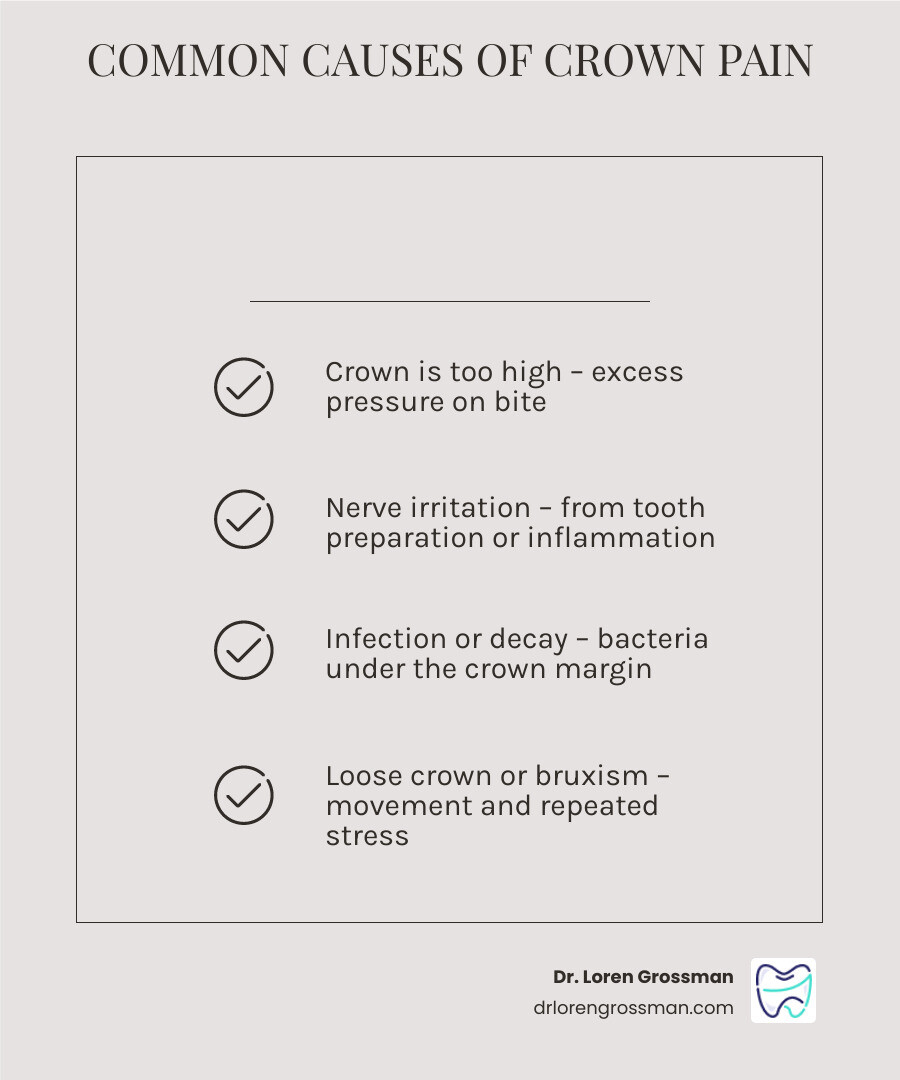
If your crown hurts when biting down, you’re not alone — and it’s usually fixable. Here are the most common reasons it happens:
- Crown is too high — the most common cause; even a tiny imbalance creates excess pressure
- Nerve irritation — tooth preparation can inflame the nerve inside the tooth
- Infection or decay — bacteria can sneak under the crown over time
- Loose or ill-fitting crown — allows movement and pressure buildup
- Teeth grinding (bruxism) — puts repeated stress on the crowned tooth
- Gum inflammation — tissue trauma around the crown margin
Quick answer: Mild soreness for a few days after placement is normal. Pain that lasts more than 2 weeks, worsens, or feels sharp when biting is not normal and needs a dental evaluation.
Crowns are built to protect damaged teeth and restore normal function. When something feels off — especially pain or pressure when you bite — it’s a signal worth paying attention to. The good news? Most causes are straightforward to diagnose and treat, often with a simple bite adjustment that takes just a few minutes.
I’m Dr. Loren Grossman, a family and cosmetic dentist serving Northeastern Pennsylvania since 1984, and over my four decades of practice I’ve diagnosed and resolved countless cases where a crown hurts when biting down — from minor bite adjustments to more complex restorative work. In this guide, I’ll walk you through every likely cause, how to recognize it, and exactly what can be done.
Why Your Crown Hurts When Biting Down
When we place a dental crown, we are essentially giving your tooth a new “helmet.” It is designed to withstand the significant forces of chewing—which, in the molar region, can exceed 400 to 800 newtons of force. However, because the tooth underneath is still a living part of your body (unless it has had a root canal), it can react to changes in pressure and environment.
If your crown hurts when biting down, the issue is often mechanical. According to the American Dental Association, pain triggered specifically by biting is frequently related to how the teeth meet. If the crown is even a fraction of a millimeter too tall, it takes the full force of your jaw before any other teeth touch. This sends a shockwave of pressure down into the periodontal ligament—the fleshy “hammock” that holds your tooth in the bone—causing it to become bruised and inflamed.
Other factors, such as Why Your Crown Hurts When Biting Down and What to Do, include the health of the pulp (the nerve) and the condition of the surrounding gums.
Common causes of crown pain when biting or applying pressure
- Mechanical Stress (The “High” Crown): This is the leading culprit. If the crown is misaligned, it creates “occlusal interference.” Imagine walking with a small pebble in your shoe; eventually, your foot will throb even if the pebble is tiny.
- Ligament Inflammation: When a tooth is overloaded due to a high bite, the periodontal ligament becomes stretched and sore. This makes the tooth feel tender to any touch or pressure.
- Cement Irritation: The dental cement used to bond the crown can sometimes irritate the tooth’s pulp during the first few days. In about 85-90% of cases, this sensitivity is reversible and fades as the tooth settles.
- Tooth Preparation Trauma: To fit a crown, we must remove a portion of the natural enamel. This process can occasionally irritate the nerve (pulpitis). If the inflammation is “reversible,” it will go away. If it becomes “irreversible,” it may lead to a persistent ache.
- Bruxism (Teeth Grinding): If you grind your teeth at night, you are putting immense pressure on your new restoration. This can lead to muscle fatigue in the jaw and localized pain in the crowned tooth.
The Healing Timeline: What’s Normal After Placement?
It is completely normal to feel like a “new arrival” is in your mouth for a little while. After all, we’ve just performed a procedure that involves anesthesia, tooth shaping, and chemical bonding. Understanding the difference between normal “settling” and a problem is key to your peace of mind.
Generally, you can expect some mild sensitivity for 3 to 7 days. During this time, the anesthesia wears off, and the tissues around the tooth may feel a bit tender from the dental dam or the physical work of the placement. You can learn more about the basics of this process in our Beginner’s Guide to Dental Crowns & Bridges.
How long should a new crown feel sensitive?
In most cases, any discomfort should steadily improve over 1 to 2 weeks. Here is a general breakdown of the timeline:
- Days 1-3: Mild aching or gum soreness is common. You might feel a “pressure” sensation as the tooth adjusts to the new material.
- Days 4-14: Sensitivity to hot and cold temperatures may linger, but it should be brief (lasting only seconds). If your crown hurts when biting down during this window, pay attention to whether the pain is decreasing or staying the same.
- Beyond 2 Weeks: If you are still experiencing sharp pain when chewing or if the sensitivity is getting worse, it’s time to call us. As noted in Why Does My Tooth with a Crown Hurt When Biting Down?, persistent pain beyond this timeframe usually indicates a need for a professional adjustment.
Is Your Crown Too High? Identifying Bite Misalignment
A “high bite” is the dental equivalent of a door that won’t quite shut because the hinges are slightly off. Even if the crown looks perfect in the mirror, your jaw knows when something is wrong. When you close your mouth, your teeth should all meet at the same time. If the crowned tooth hits first, it absorbs the entire force of your bite.
This malocclusion doesn’t just hurt the tooth; it can cause a “domino effect” of symptoms throughout your head and neck.
Signs your crown hurts when biting down due to a high bite
- Localized Soreness: The pain is specifically centered on the crowned tooth and only happens when you clench or chew.
- Uneven Pressure: When you close your teeth together slowly, you can feel the crowned tooth making contact before the others.
- Jaw Muscle Strain: Because your jaw is trying to “find” a comfortable way to bite around the high spot, the muscles can become overworked. This often feels like a dull ache near the ear or jaw joint.
- Headaches: Chronic bite misalignment is a frequent, often overlooked cause of tension headaches.
- The Articulating Paper Test: When you come in for an adjustment, we use special thin, colored paper (articulating paper). You bite down on it, and it leaves marks on the “high spots” of the crown. We can then gently polish those spots away—a process that usually takes less than five minutes and provides almost instant relief.
| Symptom | Normal Sensitivity | High Bite (Misalignment) |
|---|---|---|
| Timing | First 1-7 days | Can start immediately or weeks later |
| Trigger | Hot/Cold temperatures | Biting, chewing, or clenching |
| Duration | Fades over a week | Stays the same or worsens |
| Pain Level | Mild, dull ache | Can be sharp or “electric” |
| Solution | Time and soft foods | Professional bite adjustment |
Serious Red Flags: Nerve Irritation and Decay
While a high bite is the most common issue, sometimes the pain points to something deeper. A crown protects the top of the tooth, but the roots and the internal nerve remain. Furthermore, the “margin”—the area where the crown meets your natural gum line—is a place where bacteria can still gather.
If you have a crown that was perfectly comfortable for years and suddenly starts hurting, that is a significant red flag. This often indicates “recurrent decay” (a new cavity under the old crown) or a failure of the dental cement. You can read more about why pressure causes pain in these cases here: Why Does My Crown Hurt When I Put Pressure On?.
If you experience sudden, throbbing pain or swelling, you may need Urgent Dental Care for People Who Can’t Wait.
What to do if an old crown hurts when biting down years later
If your crown hurts when biting down after years of problem-free use, we need to investigate a few possibilities:
- Margin Leakage: Over time, the seal between the crown and the tooth can weaken. This allows bacteria to seep underneath, leading to decay that is hidden from the naked eye.
- Gum Recession: As gums recede with age, the sensitive root surface of the tooth may become exposed, leading to new sensitivity.
- Fractures: Even with a crown, the underlying tooth structure can develop a crack, especially if the tooth was heavily filled before the crown was placed.
- Infection: If the nerve inside the tooth dies (often due to old trauma or deep decay), an abscess can form at the root tip. This creates pressure that makes the tooth very painful to bite on.
For residents in Kingston or the surrounding areas, we provide Emergency Dental Services in Northeastern Pennsylvania to address these “red flag” symptoms quickly and prevent further damage.
Professional Solutions and Preventive Care
The good news is that you don’t have to live with a tooth that hurts. Most solutions are minimally invasive and can be handled in a single short visit.
- Bite Adjustment: As mentioned, this is the most common fix. We simply smooth down the high points on the ceramic or metal surface of the crown until your bite is perfectly balanced.
- Root Canal Therapy: If the nerve is infected or irreversibly inflamed, a root canal can save the tooth. In many cases, we can even perform the root canal through a small access hole in the existing crown, saving you the cost of a full replacement.
- Crown Replacement: If the crown is fractured, ill-fitting, or has decay underneath, we may need to remove it, clean the tooth, and place a new, modern restoration. Check out our Services – Crowns & Bridges page for more on how we approach these restorations.
- Gum Treatment: If the pain is actually coming from inflamed gums (perhaps due to trapped food or cement), a professional cleaning and localized treatment can resolve the issue.
Long-term maintenance and prevention strategies
Once your crown is comfortable, you want to keep it that way! Crowns typically last 5 to 15 years, but with excellent care, they can last even longer.
- Practice Impeccable Hygiene: Brush twice daily and floss specifically around the gum line of the crown. This prevents the “margin decay” mentioned earlier. Use a soft-bristled brush to avoid irritating the gum tissue.
- Wear a Night Guard: If you have a history of grinding, a custom-made night guard is the best insurance policy for your dental work. It cushions the crown and prevents the ligament from becoming inflamed.
- Avoid “Teeth as Tools”: Don’t use your crowned tooth (or any tooth!) to open packages, bite nails, or chew on ice.
- Regular Check-ups: During your six-month exams, we check the integrity of the crown and the health of the underlying tooth. Catching a small margin leak early can save you from a root canal later.
For more detailed tips, see our guide on the Top Ways to Take Care of Your Dental Crown.
Frequently Asked Questions about Crown Pain
Is it normal for a crown to hurt when biting down?
Mild tenderness or a “different” feeling is normal for the first 3 to 7 days after placement. However, sharp pain, pain that prevents you from eating, or discomfort that lasts longer than 14 days is not normal. If you find yourself avoiding one side of your mouth to eat, it’s a clear sign you need a bite adjustment.
Can a crown cause nerve pain?
Yes. The process of preparing a tooth for a crown involves removing enamel, which can sometimes irritate the dental pulp. If the pulp cannot recover, it leads to “irreversible pulpitis,” which causes spontaneous throbbing or intense sensitivity to heat.
Can a root canal fix pain under a crown?
Absolutely. If the pain is caused by an infection or a dying nerve, a root canal removes the source of the pain (the infected tissue) while leaving the crown and the tooth structure intact. It is one of the most effective ways to stop a persistent “crown toothache.”
Conclusion
A dental crown should be a solution, not a source of ongoing stress. Whether your crown hurts when biting down because of a simple high spot or a more complex underlying issue, getting it checked early is the best way to protect your investment and your health. At the office of Dr. Loren Grossman in Kingston, Pennsylvania, we combine over 40 years of experience with advanced technology to ensure your smile is as comfortable as it is beautiful.
If you are currently dealing with sensitivity and want to explore some at-home comfort measures while waiting for your appointment, you might find our guide on How to stop sensitive teeth pain without a dentist helpful. However, for a crowned tooth, a professional evaluation is the only way to ensure the problem is truly solved.
Don’t let a “high bite” or a hidden ache keep you from enjoying your favorite meals. Contact us today to get your bite back on track!