Is a Crown or Veneer Better for Your Smile? Here’s How to Decide
When it comes to crown vs veneer which is better, the honest answer is: it depends on your tooth’s condition and your goals.
Here’s a quick breakdown to help you decide:
| Your Situation | Best Option |
|---|---|
| Tooth is healthy but has stains, chips, or minor gaps | Veneer |
| Tooth is cracked, heavily filled, or had a root canal | Crown |
| You want maximum enamel preserved | Veneer |
| You need full structural protection | Crown |
| Purely cosmetic improvement on front teeth | Veneer |
| Tooth is structurally weak or severely worn | Crown |
Both options can look completely natural and last a decade or more — but they solve different problems. Choosing the wrong one can cost you more time, money, and tooth structure down the road.
Think of it this way: a veneer is like adding beautiful new siding to a structurally sound house. A crown is the full structural overhaul when the walls are compromised. Same great result on the outside — very different work underneath.
I’m Dr. Loren Grossman, a cosmetic and family dentist serving Northeastern Pennsylvania since 1984, and I’ve helped hundreds of patients navigate exactly this crown vs veneer which is better decision through personalized, hands-on care. In this guide, I’ll walk you through everything you need to know to make the right call for your smile.
Understanding the Core Differences: Crown vs Veneer Which is Better?
To understand crown vs veneer which is better, we first have to look at the anatomy of the restoration. While they might look identical once they are in your mouth, the “prep work” and the coverage are worlds apart.
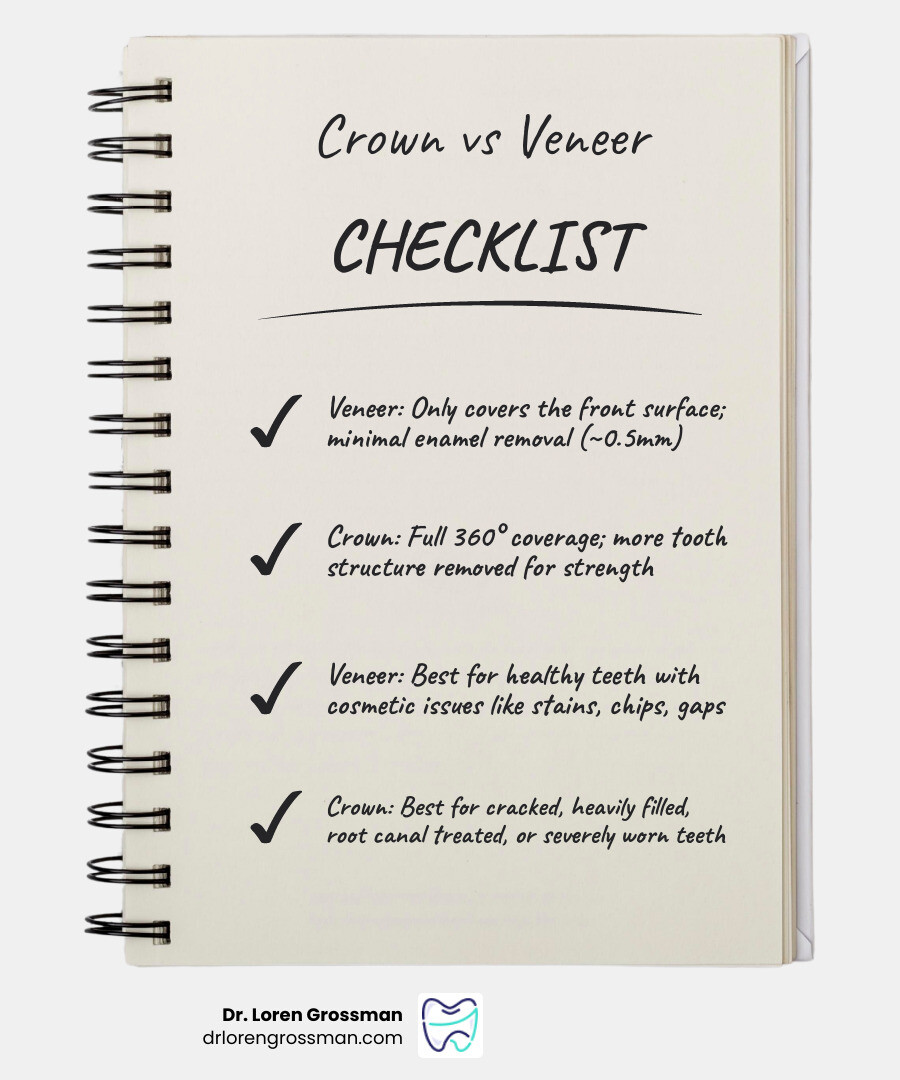
A dental veneer is a wafer-thin shell, usually made of high-quality porcelain or composite resin, that is bonded only to the front surface of your tooth. Think of it like a custom-fitted false fingernail, but for your smile. Its primary job is to hide imperfections while keeping as much of your natural tooth intact as possible.
On the other hand, a dental crown (often called a “cap”) is a full-coverage restoration. It encases the entire visible portion of the tooth—all 360 degrees of it—down to the gum line. While a veneer is an aesthetic “facing,” a crown is a structural “helmet.”
Preparation and 2026 Standards
In May 2026, modern dentistry focuses heavily on “biomimetic” principles—meaning we want to preserve as much of your natural enamel as we can. This is where the two treatments diverge significantly:
- Veneers: Typically require the removal of only about 0.5 mm of enamel from the front of the tooth. This is roughly the thickness of a fingernail.
- Crowns: Require more significant reshaping. We usually need to remove 1.5 mm to 2 mm of tooth structure from all sides to ensure the crown has enough thickness to withstand biting forces without breaking.
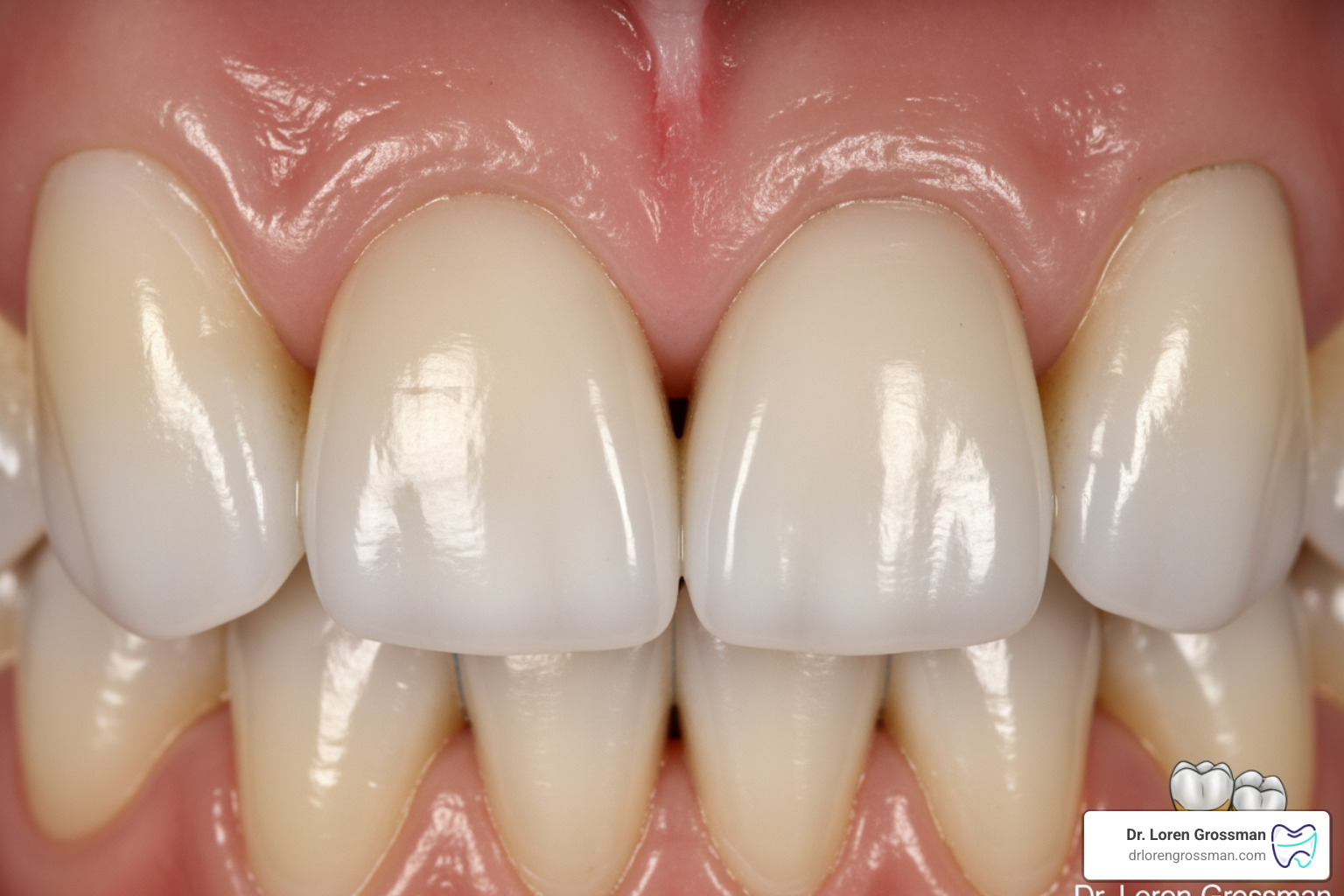
When debating crown vs veneer which is better, the amount of remaining tooth structure is often the deciding factor. If the tooth is mostly healthy but looks “off,” we lean toward the conservative veneer. If the tooth is crumbling or has a massive old filling, the crown is the undisputed champion of restoration.
For more technical details on how we handle these restorations, you can explore our crown and bridge services or read this clinical breakdown of Dental Crown vs Veneer: Differences.
| Feature | Dental Veneer | Dental Crown |
|---|---|---|
| Thickness | ~1.0 mm | ~2.0 mm |
| Enamel Removal | Minimal (0.5 mm) | Significant (1.5-2 mm) |
| Coverage | Front surface only | Entire tooth (360°) |
| Primary Purpose | Cosmetic enhancement | Structural protection & repair |
When to Choose a Veneer for Cosmetic Enhancement
If you’re looking in the mirror and your teeth are structurally sound but you’re unhappy with how they “present,” veneers are likely your best bet. Because they are so thin, they allow us to transform your look with very little “drilling.”

We often recommend veneers for:
- Persistent Staining: Some discoloration (like tetracycline staining or internal trauma) won’t budge with traditional whitening. A veneer provides a fresh, bright “mask.”
- Minor Chips and Cracks: If you have a small chip from a childhood accident, a veneer can restore the tooth’s edge perfectly.
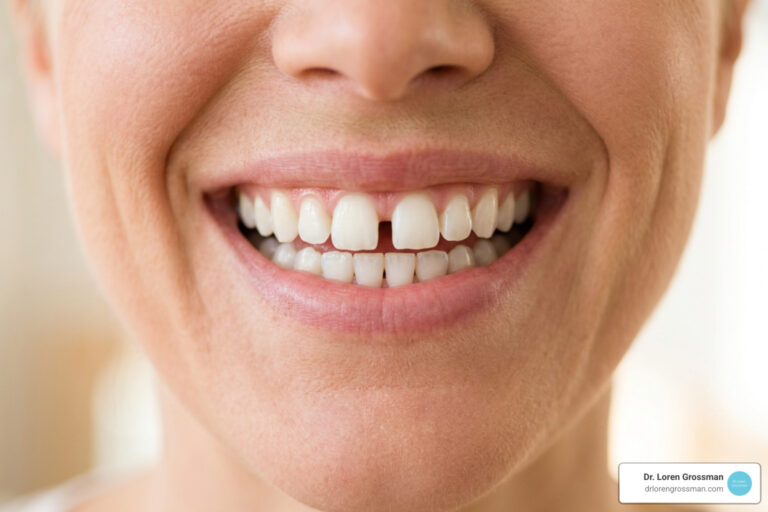
- Gaps (Diastemas): We can use veneers to slightly widen teeth and close unsightly gaps without the need for years of braces.
- Misalignment: While they don’t move the roots, veneers can make slightly crooked teeth appear perfectly straight—a process sometimes called “instant orthodontics.”
The veneers process is designed to be as non-invasive as possible. By keeping the preparation within the enamel layer, we ensure the strongest possible bond. For a deep dive into what to expect this year, check out our Complete Dental Veneers Guide 2026.
Aesthetic Benefits: Crown vs Veneer Which is Better for Front Teeth?
When patients ask crown vs veneer which is better for front teeth, the answer is almost always veneers—provided the teeth are healthy.
Veneers offer a level of translucency that is hard to beat. Because they are so thin, light passes through them and reflects off your natural tooth structure underneath, just like real enamel. This prevents that “opaque” or “flat” look that older dental work sometimes had. Furthermore, because the margin (the edge of the restoration) is usually kept at or above the gum line, there is less risk of that “dark line” appearing at the gums if they recede over time. You can learn more about the different types of veneers we use to achieve these results.
Minimal Invasiveness and Enamel Preservation
Enamel is the hardest substance in the human body, but once it’s gone, it’s gone for good. This is why we are so protective of it. When we talk about crown vs veneer which is better, the “invasiveness” factor is a huge win for veneers.
By removing only 0.5mm, we stay within the enamel. This is critical because dental adhesives bond much more predictably to enamel than they do to the dentin (the layer underneath). This means your veneer is less likely to pop off or leak over time. However, it is important to remember that even this minimal removal makes the process irreversible. You can read more about exactly how much enamel is removed during the prep phase.
When a Dental Crown is the Superior Choice for Protection
Sometimes, a tooth needs more than a “facelift”—it needs a “bodyguard.” If a tooth has been weakened by decay, trauma, or previous dental work, a veneer simply won’t provide the support needed to keep the tooth from fracturing.
A dental crown is the superior choice when:
- Root Canal Therapy: After a root canal, a tooth becomes more brittle. A crown protects it from splitting under the pressure of chewing.
- Large Fillings: If more than 50% of your tooth is a filling, the remaining natural walls are at high risk of breaking. A crown “binds” the tooth together.
- Severe Wear: Patients who grind their teeth (bruxism) often wear their teeth down until the sensitive inner layers are exposed. Crowns restore the lost height and protect what’s left.
- Major Fractures: If a crack extends deep into the tooth, a veneer will not stop it from spreading. A crown provides 360-degree “hoop strength” to hold the tooth together.
For a broader look at the trade-offs, Healthline’s guide on veneers vs. crowns provides an excellent external perspective, while our Beginners Guide to Dental Crowns Bridges offers local Kingston, PA patients a great starting point.
Durability and Strength: Crown vs Veneer Which is Better for Damaged Teeth?
When we evaluate crown vs veneer which is better for damaged teeth, strength is the priority. Modern crowns are made from incredibly tough materials:
- E-max (Lithium Disilicate): Beautiful and strong, with a flexural strength of about 400 MPa. Great for front teeth.
- Zirconia: The “titanium” of ceramics. With strength ratings up to 1,200 MPa, these are nearly indestructible and perfect for back teeth or patients who grind.
Because a crown covers the entire tooth, it redistributes the forces of your bite across the whole root structure, rather than just the front face. This makes them much more durable in high-pressure situations. To keep your investment safe, follow our top ways to take care of your dental crown.
Full Coverage for Severely Worn Teeth
For patients in Northeastern Pennsylvania who have struggled with acid reflux or a heavy soda habit, the enamel on the back of the front teeth is often as eroded as the front. In these cases, a veneer would leave the vulnerable back side exposed to further decay and sensitivity. A crown provides a total structural overhaul, sealing the tooth from bacteria and temperature changes completely. It’s the ultimate “reset button” for a compromised tooth.
Comparing Costs, Longevity, and Maintenance in 2026
When deciding crown vs veneer which is better, the “long game” matters. In 2026, we have excellent data on how these restorations perform over a decade.
Longevity Statistics:
- Porcelain Veneers: Have a 10-year survival rate of approximately 95.5%. They typically last 10–12 years, though many of our patients enjoy them for 15+ years with good care.
- Dental Crowns: Typically last 10–15 years. Because they are thicker and cover more surface area, they are often considered slightly more durable against heavy biting forces.
- Composite Veneers: A more budget-friendly option, but they generally only last 5–7 years and are prone to staining.
Cost Considerations: In the current 2026 market, porcelain veneers generally range from $900 to $2,500 per tooth. Dental crowns range from $1,000 to $3,500 per tooth.
The biggest difference often comes down to insurance. Because veneers are almost always classified as “cosmetic,” insurance companies rarely cover them. However, if a crown is “medically necessary”—meaning the tooth is broken or decayed—dental insurance will often cover 50% to 80% of the cost. This can make a crown significantly more affordable out-of-pocket, even if the total price is higher.
Maintenance: Both require excellent hygiene. You must brush twice a day and floss—especially around the “margins” where the porcelain meets your natural tooth. While the porcelain itself won’t decay, the tooth underneath still can! For more on the risks, see Veneers Side Effects and Risks.
Frequently Asked Questions about Crowns and Veneers
Are veneers or crowns reversible?
No. Both are considered permanent dental treatments. Because we have to remove a portion of your natural enamel to make room for the restoration, that tooth will always need to be covered by either a veneer or a crown to stay protected and look natural. It is a lifelong commitment to your smile.
Can I get a veneer after having a crown?
Generally, no. Once a tooth has been prepared for a crown, it has been reduced on all sides. A veneer requires a large amount of intact enamel on the front of the tooth to bond to. Since a crown preparation removes that enamel, the only “upgrade” or replacement for a crown is another crown. This is why we always try to start with the most conservative option (the veneer) if the tooth structure allows it.
Which option looks more natural over time?
Both can look stunningly natural. However, veneers have a slight edge in long-term aesthetics for front teeth. Because the margin of a veneer is very thin and usually sits at or just above the gum line, it is very “periodontally friendly.” Crowns, especially those with metal bases (PFM), can sometimes show a dark grey line at the gum line if the gums recede over the years. By choosing all-ceramic options like E-max or Zirconia, we can achieve a perfect smile that stays beautiful for a decade or more.
Conclusion
Deciding crown vs veneer which is better isn’t a choice you should make alone. It requires a detailed clinical exam, a look at your bite mechanics, and a clear understanding of your long-term goals.
At the office of Dr. Loren Grossman in Kingston, Pennsylvania, we pride ourselves on being “enamel conservationists.” We will always recommend the most conservative treatment that will safely and beautifully solve your dental concerns. Whether you need the artistic touch of a porcelain veneer or the protective strength of a custom crown, our team uses the latest 2026 technology to ensure your results are comfortable, durable, and life-changing.
If you’re in Northeastern Pennsylvania and ready to transform your smile, we invite you to schedule a personalized consultation. Let’s talk about your goals and find the path that’s right for you. Transform your smile with dental crowns and bridges or veneers today—your future self will thank you for the confidence boost!