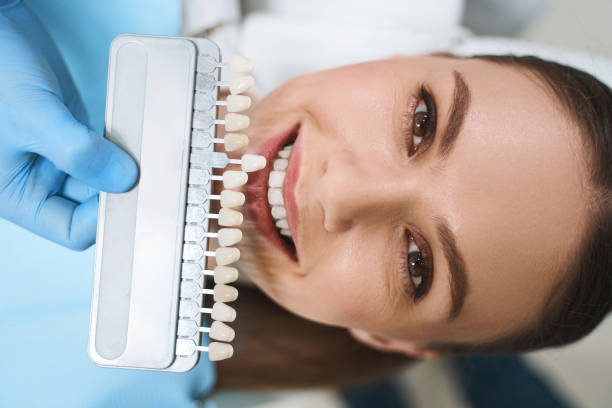
Why Caring for Dental Veneers Determines How Long Your Smile Lasts
Caring for dental veneers the right way is the single biggest factor in how long they last — and it’s simpler than most people think.
Quick answer: How to care for dental veneers
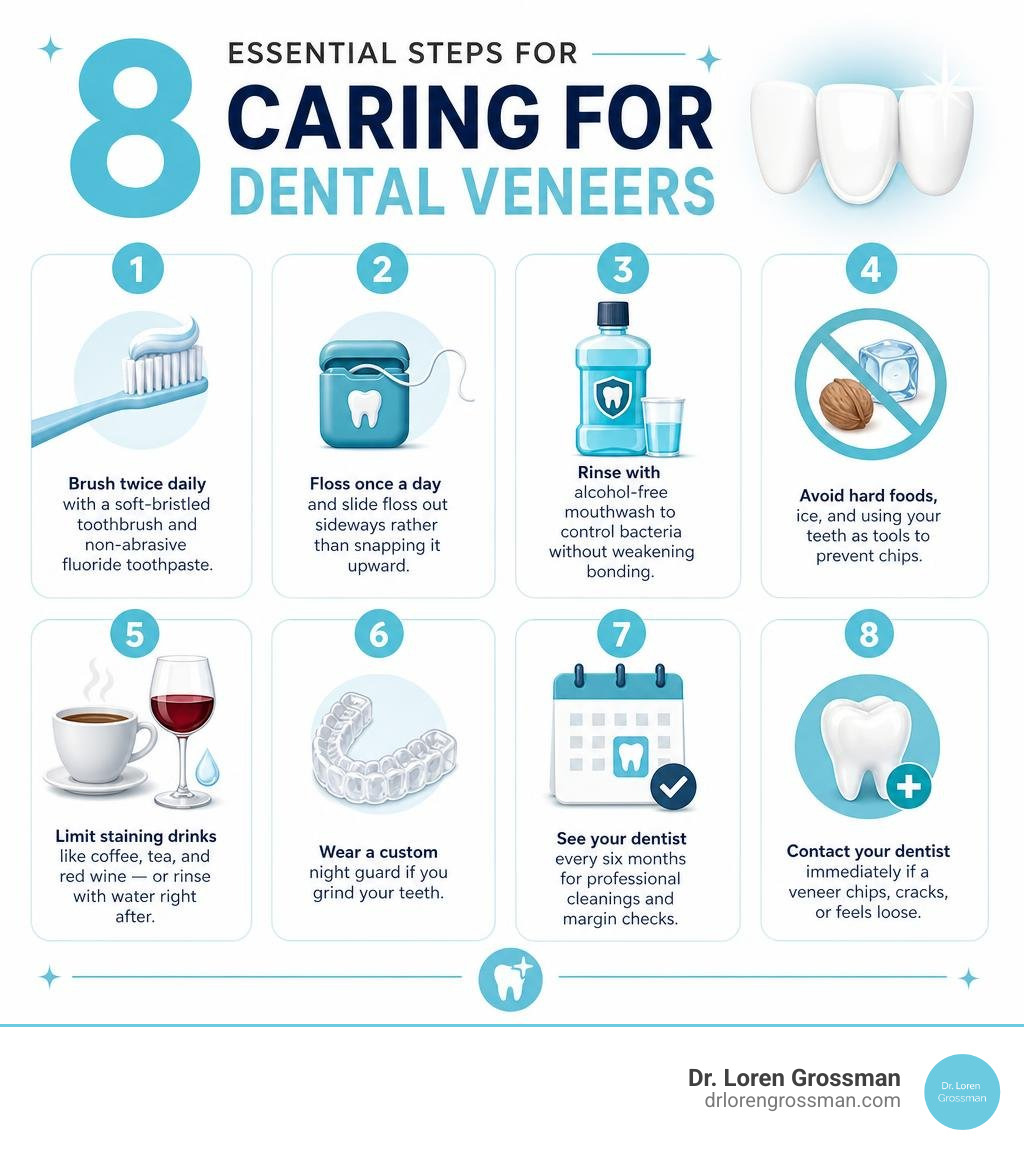
- Brush twice daily with a soft-bristled toothbrush and non-abrasive fluoride toothpaste
- Floss once a day and slide floss out sideways rather than snapping it upward
- Rinse with alcohol-free mouthwash to control bacteria without weakening bonding
- Avoid hard foods, ice, and using your teeth as tools to prevent chips
- Limit staining drinks like coffee, tea, and red wine — or rinse with water right after
- Wear a custom night guard if you grind your teeth
- See your dentist every six months for professional cleanings and margin checks
- Contact your dentist immediately if a veneer chips, cracks, or feels loose
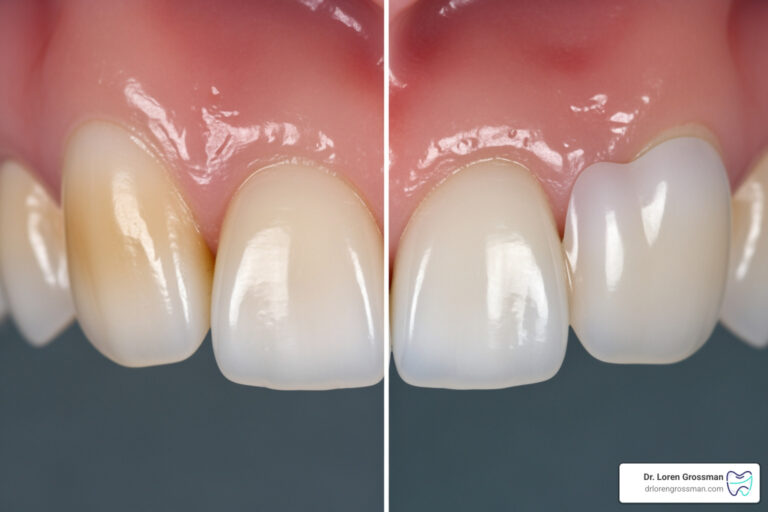
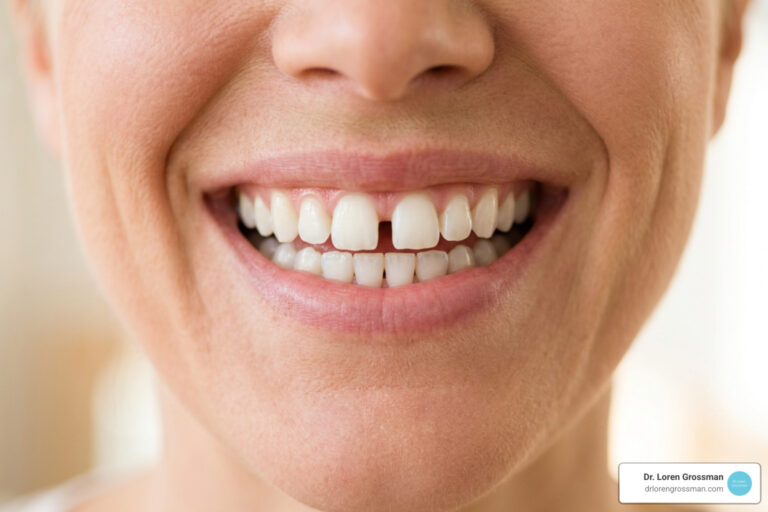
Porcelain veneers are one of the most transformative treatments in cosmetic dentistry. A thin shell of porcelain, bonded to the front of your tooth, can cover chips, stains, gaps, and uneven edges — giving you a naturally bright smile that can last 10 to 20 years.
But here’s what a lot of patients don’t realize: veneers are durable, not indestructible. The porcelain itself resists stains well, but the bonding material at the edges doesn’t. The underlying tooth can still develop decay. And habits like grinding, chewing ice, or using the wrong toothpaste can shorten your veneers’ lifespan significantly.
The good news? Most veneer problems are completely preventable with a few simple daily habits — and the right professional support.
I’m Dr. Loren Grossman, a cosmetic and family dentist serving the Wyoming Valley since 1984, and over the decades I’ve helped countless patients in Northeastern Pennsylvania get — and keep — beautiful smiles through proper veneer care. In this guide, I’ll walk you through everything I recommend to my own patients for caring for dental veneers so yours stay strong, bright, and natural-looking for as long as possible.
Essential caring for dental veneers terms:
Understanding Veneers and Why They Require Specific Care
To understand why specialized care is necessary, we have to look at how veneers are designed and attached to your teeth. Veneers are ultra-thin shells custom-crafted to fit over the front-facing surfaces of your natural teeth.
Depending on your aesthetic goals, budget, and dental anatomy, you might choose between different materials. Understanding What Are the Different Types of Veneers? is crucial because porcelain and composite resin have very different physical properties. Porcelain mimics the light-reflecting qualities of natural enamel and is highly stain-resistant, while composite resin is more economical but prone to surface staining and wear over time. For a general patient-friendly overview, the American Dental Association’s MouthHealthy resource also explains what dental veneers are and why they are used in cosmetic dentistry.
To place traditional veneers, a tiny amount of natural tooth enamel must be removed to ensure the shells lie flush with your gumline. This process is irreversible, which often leads patients to ask: Do Veneers Ruin Your Teeth or Just Give Them a Makeover? The truth is, when placed by a licensed cosmetic dentist, they protect and beautify your teeth, but they do require a lifelong commitment to care.
Once the enamel is prepped, we use a strong dental bonding agent (resin cement) to fuse the veneer to the tooth. This bond is incredibly strong, but it creates a tiny seam where the veneer meets your natural tooth near the gumline. We call this the margin.
The margin is the most vulnerable area of your restoration. If plaque and oral bacteria are allowed to accumulate along the margins, they can slip underneath the veneer, leading to:
- Decay of the underlying natural tooth structure
- Discoloration or darkening of the bonding resin
- Gum inflammation and recession, which exposes the edges of the veneers and ruins the seamless, natural look
Whether you choose traditional porcelain restorations, composite alternatives, or prepless veneers to preserve your natural enamel, focused daily maintenance is non-negotiable.
The Golden Rules of Caring for Dental Veneers

When we design a brand-new smile for our patients in Kingston, Pennsylvania, we emphasize that success is a partnership. We provide the precise clinical engineering, but your daily habits at home protect that investment.
To help you visualize how your daily routine changes based on the material you choose, review our Complete Dental Veneers Guide 2026 and refer to this comparison table of care needs:
| Care Aspect | Porcelain Veneers | Composite Resin Veneers |
|---|---|---|
| Stain Resistance | Outstanding (highly resistant to coffee, tea, and wine) | Moderate (can absorb pigments over time) |
| Abrasive Sensitivity | High (harsh toothpastes will scratch the protective glaze) | Extreme (very easily scratched by abrasive products) |
| Repairability | Low (chipped porcelain usually requires full replacement) | High (small chips can often be patched chairside) |
| Margin Vulnerability | High (requires meticulous daily flossing) | High (requires meticulous daily flossing) |
| Average Lifespan | 10 to 15 years (often 20+ with pristine care) | 4 to 8 years |
Daily Hygiene Habits for Caring for Dental Veneers
Your daily oral hygiene routine does not need to be complicated, but it must be precise and gentle.
- Use a Soft-Bristled Toothbrush: Hard or even medium bristles can wear down the polished glaze of your veneers and irritate your gums, leading to recession. Always opt for soft or extra-soft bristles.
- Select a Non-Abrasive Toothpaste: This is where many patients make a major mistake. Standard whitening toothpastes, charcoal-infused formulations, and baking soda scrubs contain microscopic abrasives. While these are meant to scrub stains off natural teeth, they act like sandpaper on veneers, leaving micro-scratches that dull the surface and trap stain-causing bacteria. Look for a gel-based toothpaste with a Relative Dentin Abrasivity (RDA) score below 70.
- Master the Flossing Technique: Flossing is crucial for protecting the margins of your veneers from decay. However, snapping your floss aggressively upward can catch the edge of the veneer and weaken the bond. Instead, slide the floss gently between your teeth, curve it into a “C” shape against the tooth surface, clean the area, and then slide the floss out sideways instead of pulling it back up.
- Rinse with Alcohol-Free Mouthwash: Many commercial mouthwashes contain high percentages of alcohol. Over time, alcohol can dry out your oral tissues and chemically degrade the bonding composite used to secure your veneers. Always choose an alcohol-free, antibacterial mouthwash to keep your gums healthy and your restorations secure.
Dietary Adjustments and Habits to Avoid
You don’t need to live on a liquid diet, but you do need to make smart adjustments to protect your dental work from structural and cosmetic damage.
- Avoid Hard and Sticky Foods: Biting directly into hard candies, ice cubes, raw carrots, or hard pretzels can exert sudden, concentrated pressure that chips the porcelain. We advise our patients to cut hard fruits and vegetables into bite-sized pieces and chew them using their back molars.
- Break the “Teeth as Tools” Habit: Never use your teeth to open plastic packaging, rip tape, bite your fingernails, or hold pens. Veneers are designed to handle vertical chewing forces, not lateral twisting forces.
- Mind Your Staining Beverages: While high-quality porcelain is highly stain-resistant, the bonding cement at the margins is not. Over time, heavy consumption of black coffee, dark teas, red wine, and berries can stain the edges, creating a dark outline around your veneers. If you do enjoy these treats, consider drinking through a straw and rinsing your mouth with plain water immediately afterward.
- Quit Tobacco Products: Nicotine and tar quickly discolor the bonding resin holding your veneers in place, leading to yellowing or brown margins that cannot be whitened. Quitting tobacco is one of the best things you can do for both your physical health and your cosmetic investment.
Protecting Your Investment from Physical Damage

Accidental trauma and physical stress are leading causes of premature veneer failure. If you live an active lifestyle or struggle with unconscious habits, physical protection is your best insurance policy.
One of the most destructive forces your veneers can face is bruxism (unconscious teeth grinding or clenching during sleep). Sleep-related clenching can exert forces up to 250 to 300 pounds per square inch on your teeth. Because porcelain is a glass-like ceramic, these extreme lateral forces can easily cause your veneers to crack, chip, or debond entirely.
To understand these physical stresses better, consult our guide on Veneers Side Effects and Risks You Need to Know Before You Go.
To protect your smile, we highly recommend a custom-fabricated hard acrylic night guard. Avoid cheap, over-the-counter “boil-and-bite” soft guards. Soft guards can actually stimulate your chewing reflex, encouraging you to clench more aggressively, which can lead to suction debonding of your restorations. A custom, hard-surface night guard fabricated by your dentist keeps your jaw in a neutral position and provides a protective barrier that absorbs grinding forces.
Additionally, if you play contact sports like soccer, basketball, or mountain biking around the trails of Northeastern Pennsylvania, always wear a custom sports mouthguard to shield your teeth from sudden impacts.
Caring for Temporary Veneers During the Transition
The process of getting permanent porcelain veneers typically takes a couple of weeks while our dental lab custom-crafts your restorations. During this waiting period, you will wear temporary veneers to protect your prepped teeth and keep your smile looking natural.
Because temporary veneers are designed to be removed easily, they require extra care:
- Spot Etching and Temporary Cement: We secure temporaries using a weaker temporary cement. This means they can dislodge if subjected to sticky, chewy, or hard foods. Stick to a soft diet (pasta, fish, cooked vegetables, yogurt) while wearing your temporaries.
- Gentle Hygiene: Continue to brush your temporaries gently with a soft toothbrush. When flossing, it is absolutely vital that you do not pull the floss upward. Insert the floss, clean the area, and pull the floss out horizontally through the side.
- Keep Your Appointment: If a temporary veneer comes loose, do not attempt to glue it back yourself with drugstore cement. Contact our office immediately so we can safely re-secure it and protect your prepped enamel.
Learn more about what to expect during this transition phase in our article on the Veneers Process: What You Must Know.
Professional Maintenance and Caring for Dental Veneers
While your daily home care keeps plaque at bay, professional maintenance is what pushes your veneers past the 10-year mark toward a 20-year lifespan.
During your routine six-month checkups, we perform specialized maintenance:
- Margin Inspection: We inspect the margins of each veneer using high-magnification loupes to check for microscopic gaps, early signs of decay, or gum recession.
- Professional Polishing: We use specialized, ultra-fine diamond-impregnated polishing pastes and soft rubber cups to buff away surface micro-scratches and restore the original mirror-like glaze of your porcelain. Standard dental scaling and polishing pastes used on natural teeth can scratch porcelain, so we modify our cleaning techniques specifically for our veneer patients.
- Bite Monitoring: We check your occlusion (bite alignment) to ensure your natural teeth are not putting uneven pressure on your restorations as your jaw naturally shifts over time.
For patients in our region, we always recommend consulting a highly trained local professional to understand the clinical standards of care expected in Northeastern Pennsylvania.
Troubleshooting Veneer Emergencies and Longevity Expectations
With proper care, porcelain veneers routinely last 10 to 15 years, and clinical studies show that patients with excellent oral hygiene and night guard compliance can enjoy their veneers for 20 years or more. However, if you neglect your restorations or suffer an accident, you may face a dental emergency.
Here is how to handle common veneer issues:
- If a Veneer Chips or Cracks: Do not panic, and do not attempt a DIY repair. Keep any broken pieces if possible and call our office immediately. Minor chips in composite veneers can often be smoothed or patched in a quick, single visit. For porcelain, a small chip might be polished out, but significant fractures usually require us to replace the veneer to maintain structural integrity and aesthetics.
- If a Veneer Feels Loose: A loose veneer indicates that the bonding cement has degraded or moisture compromised the bond during placement. Call us right away. If the veneer detaches completely, place it in a clean container and bring it to your appointment. If the veneer is intact and your underlying tooth is healthy, we can often clean and re-bond it.
- If You Notice Gum Recession: If your gums begin to recede, you may see a dark line or a visible ledge where the veneer meets the tooth. This is often caused by aggressive brushing or gum disease. While we cannot always reverse recession, we can treat the underlying gum issues and discuss cosmetic solutions to restore your seamless smile.
If you want to understand the steps involved in replacing or repairing restorations, explore our Dental Veneers Procedure: A Detailed Guide for an in-depth breakdown.
Frequently Asked Questions About Veneer Maintenance
To help you protect your investment, we have compiled answers to the most common questions our patients ask about caring for dental veneers.
Can I use an electric toothbrush on my veneers?
Yes! High-quality electric toothbrushes like Sonicare or Oral-B are excellent for veneer patients. They provide superior plaque removal along the gumline without requiring aggressive scrubbing.
However, you must use them correctly:
- Set the toothbrush to “sensitive” or low-power mode.
- Let the brush do the work — glide it gently along your teeth without pressing hard.
- Replace the brush head every three months to ensure the bristles remain soft and effective.
Can veneers get cavities or decay?
The porcelain veneer itself cannot decay, but the natural tooth structure underneath and around it absolutely can.
If plaque accumulates at the margins, bacteria can cause decay on the exposed back of the tooth or under the veneer’s edges. If a cavity develops under a veneer, the restoration must be removed, the decay treated, and a new veneer or crown placed. This is why daily brushing, flossing, and regular cleanings are vital.
Can I whiten my veneers if they get stained?
No. Porcelain is completely non-porous, meaning professional whitening gels, strips, and whitening toothpastes will not change the color of your veneers.
If your veneers have collected surface stains from coffee or tobacco, a professional polishing at our office can often restore their original shine. If your natural teeth have yellowed over time, making your veneers look mismatched, we recommend whitening your natural teeth to bring your entire smile back into harmony.
Conclusion
Your veneers are an investment in your self-esteem, your professional presentation, and your overall confidence. While they are built to be highly durable and beautifully mimic natural teeth, their lifespan is ultimately in your hands. By committing to a gentle daily hygiene routine, avoiding damaging habits, wearing protective guards, and keeping your regular dental appointments, you can enjoy a bright, flawless smile for decades to come.
At the office of Dr. Loren Grossman, we combine advanced dental technology with a warm, patient-focused approach right here in Kingston, Pennsylvania. Whether you are considering a smile transformation or need expert help maintaining your existing restorations, we are here to support you every step of the way.
Ready to protect, refresh, or transform your smile? Explore our Services: Dental Veneers page or contact our Kingston office today to schedule your personalized consultation!