How Much Does a Permanent Dental Bridge Cost? Here’s What to Expect
Permanent bridge teeth cost is one of the most common questions patients ask before committing to this procedure — and for good reason. It’s a significant investment.
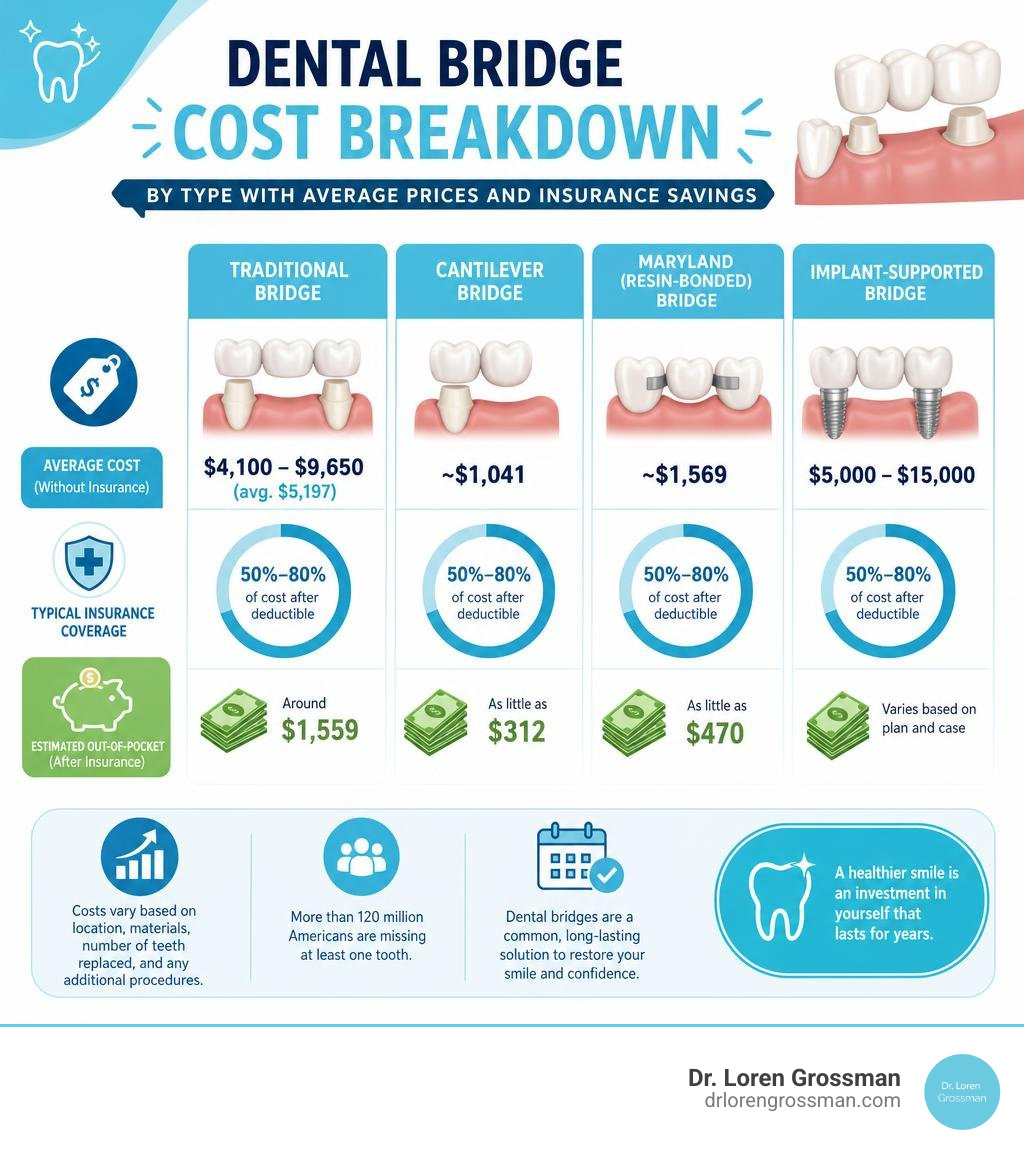
Here’s a quick snapshot of average costs by bridge type:
| Bridge Type | Average Cost (Without Insurance) |
|---|---|
| Traditional bridge | $4,100 – $9,650 (avg. $5,197) |
| Cantilever bridge | ~$1,041 |
| Maryland (resin-bonded) bridge | ~$1,569 |
| Implant-supported bridge | $5,000 – $15,000 |
With dental insurance, many plans cover 50%–80% of the cost after your deductible — potentially reducing your out-of-pocket expense to as little as $312 for a cantilever bridge or around $1,559 for a traditional bridge.
Costs vary based on your location, the materials used, how many teeth need replacing, and whether you need additional procedures like extractions or bone grafts.
More than 120 million Americans are missing at least one tooth. A dental bridge is one of the most common ways to fix that — but navigating the costs, insurance rules, and treatment options can feel overwhelming.
This guide breaks it all down clearly.
I’m Dr. Loren Grossman, a cosmetic and family dentist serving Northeastern Pennsylvania since 1984, and I’ve personally placed countless restorations — including dental bridges — giving me decades of hands-on experience helping patients understand their permanent bridge teeth cost and make confident, informed decisions. In the sections ahead, I’ll walk you through everything you need to know, from bridge types and pricing to insurance, financing, and aftercare.
What is a Dental Bridge and How Does It Work?
If you have ever felt self-conscious about a gap in your smile, or if you have noticed your remaining teeth starting to drift out of alignment, you are experiencing the real-world consequences of missing teeth. A dental bridge is a time-tested, highly reliable oral device designed to “bridge the gap” created by one or more missing teeth.
At its core, a dental bridge consists of two main components:
- Abutment Teeth: These are the anchor teeth on either side of the gap. During the preparation process, these teeth are reshaped so they can support dental crowns.
- Pontic: This is the artificial tooth (or teeth) that sits in the gap, suspended between the crowned abutment teeth.
To help you visualize, think of a physical bridge spanning a river. The abutment teeth act as the sturdy concrete pillars anchored into the riverbed, while the pontic is the road itself that allows traffic to cross. For a deeper look into the mechanics of this treatment, we recommend reading our Beginner’s Guide to Dental Crowns & Bridges.
When we prepare the abutment teeth, we carefully remove a portion of their enamel to make room for the crowns that will fit over them. This preparation is essential to ensure the bridge fits comfortably and securely, restoring both form and function to your smile.
Understanding the Permanent Bridge Teeth Cost Without Insurance

When evaluating the permanent bridge teeth cost out-of-pocket, it is helpful to look at both national averages and local benchmarks. Nationally, the average cost for a traditional dental bridge sits at $5,197, with a typical range between $4,100 and $9,650 depending on the complexity of the case.
According to data from the How Much Does Dental Bridge Cost? (2026 Guide) | CostWhale , prices across the United States have increased by approximately 17.7% over the last five years. However, in Pennsylvania, the average cost for a traditional bridge is highly competitive, averaging around $3,060 to $5,050 depending on the number of units. The average out-of-network cost for a standard three-unit dental bridge (which replaces one missing tooth using two crowned anchor teeth) is approximately $3,965.
To help you compare the base costs of different types of bridges, we have compiled the following table:
| Bridge Type | Low-End Cost | Average National Cost | High-End Cost |
|---|---|---|---|
| Traditional (3-Unit) | $2,000 | $5,197 | $9,650 |
| Cantilever (per unit) | $1,000 | $2,000 – $5,000 | $6,000 |
| Maryland (Resin-Bonded) | $1,500 | $1,569 | $2,500 |
| Implant-Supported | $5,000 | $8,500 | $15,000+ |
For a broader perspective on national dental pricing standards, you can review the comprehensive breakdown on How Much Does a Dental Bridge Cost? | Forbes Health.
How Bridge Type Affects Your Permanent Bridge Teeth Cost
The specific design of your bridge is the single most significant driver of your total bill. Let’s break down the four primary types of bridges and how their designs influence their pricing:
- Traditional Dental Bridge: This is the most common variety. It consists of one or more pontics held in place by dental crowns cemented onto the adjacent abutment teeth. Because it requires two custom crowns and at least one custom pontic, a traditional bridge typically costs between $2,000 and $5,000 per pontic and crown for each abutment tooth.
- Cantilever Bridge: This design is used when there is an adjacent tooth on only one side of the missing tooth gap. While it requires less tooth preparation (since only one anchor tooth is crowned), it is less structurally stable than a traditional bridge and is generally reserved for the front of the mouth where chewing forces are lighter. It typically costs slightly less upfront but carries a higher risk of leverage damage over time.
- Maryland Bridge (Resin-Bonded): Often used to replace front teeth, a Maryland bridge uses a metal or porcelain framework with “wings” that are bonded to the backs of your existing teeth. Because it does not require adjacent teeth to be shaved down for crowns, it is a conservative and highly affordable option, averaging $1,500 to $2,500.
- Implant-Supported Bridge: Instead of resting on natural teeth, this bridge is anchored by titanium posts surgically placed into your jawbone. This is the gold standard for durability and bone health. However, because it involves oral surgery and premium hardware, it typically costs between $5,000 and $15,000 for a bridge with two dental implants spanning three or four teeth.
For a detailed clinical overview of how these designs are matched to individual patient needs, check out the Dental Bridge: Types, Benefits, Cost & What to Expect | Cleveland Clinic guide.
Additional Factors Influencing the Total Price
Beyond the style of the bridge itself, several secondary factors will influence your final invoice:
- Materials Used: Bridges can be crafted from porcelain-fused-to-metal (PFM), gold alloys, all-ceramic, or solid zirconia. Zirconia and high-quality porcelain offer unmatched aesthetics and biocompatibility, but they carry a higher laboratory fabrication cost than metal-based options.
- Geographic Location: Dental fees reflect local overhead costs. While major metropolitan areas on the West Coast or Northeast corridor have higher averages, patient fees in Northeastern Pennsylvania remain highly reasonable.
- Preparatory Procedures: If the anchor teeth are decayed, we may need to perform root canals or core buildups before placing crowns. Additionally, if the tooth being replaced is still in your mouth, an extraction (typically costing $50 to $500) will be required first. If you are opting for an implant-supported option, a bone graft ($1,500 to $5,000) may be necessary to rebuild the jawbone.
At Dr. Loren Grossman’s office, we use advanced diagnostic tools to map out these requirements ahead of time. You can learn more about our materials and custom design process on our Services: Crowns & Bridges page.
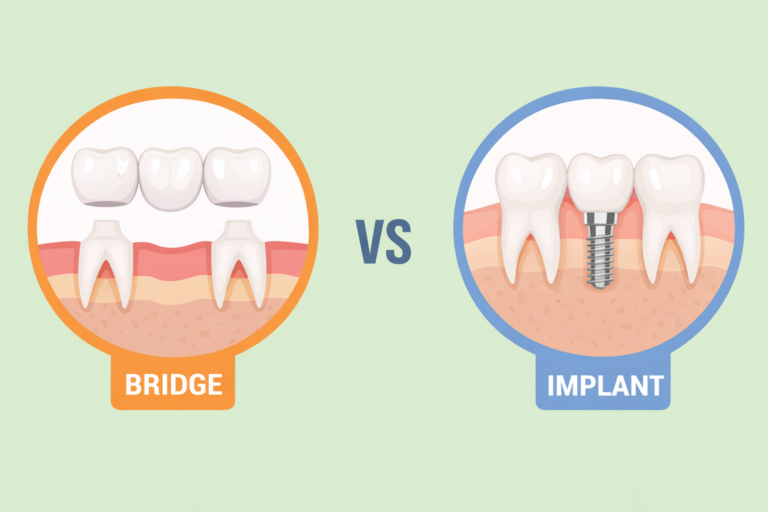
Dental Bridges vs. Implants and Dentures
Choosing how to replace your missing teeth is a major decision. The three primary options — dental implants, fixed bridges, and removable partial dentures — each represent a different balance of upfront cost, longevity, and long-term oral health.
When you lose a tooth, the jawbone underneath no longer receives stimulation from chewing forces. This triggers a process called bone resorption, where the bone tissue begins to shrink. In fact, studies show a horizontal ridge width loss of about 50% in the first 12 months following tooth extraction.
- Dental Implants: These are the only solution that prevents jawbone loss because the titanium post fuses with your bone through a process called osseointegration. While implants have a higher upfront cost ($3,000 to $6,000 per tooth), they boast a cumulative survival rate of 96.8% at 10 years and 94.0% at 15 years, often lasting a lifetime.
- Fixed Dental Bridges: A bridge is a faster, non-surgical solution that can be completed in just 2 to 3 weeks. However, because the bridge sits above the gumline, it does not stimulate the bone, meaning jawbone loss will continue beneath the pontic. Furthermore, a bridge requires us to alter healthy adjacent teeth to serve as anchors.
- Partial Dentures: The most budget-friendly upfront option, dentures sit on the gums and are held in place by clasps. They only restore about 25% to 30% of your natural chewing force and must be relined or replaced every 5 to 8 years as your jawbone shape changes.
For an extensive side-by-side analysis of these three treatment paths, we recommend reading The Ultimate Showdown: Dental Bridge or Implant?. You can also explore the American Dental Association’s consumer resources on Bridges and Partial Dentures | MouthHealthy – American Dental Association or review the Dental Implants vs Bridge vs Denture: Complete 2026 Comparison Guide | Rodin Dental Office Tokyo Insights to understand the long-term total cost of ownership over 20 years.
Navigating Insurance and Financing Options
Many patients assume that because a dental bridge is a major procedure, their insurance will not cover it. Fortunately, because bridges are restorative and medically necessary to prevent shifting teeth and bite issues, most dental insurance policies do provide coverage.
However, you must navigate several common insurance limitations:
- Deductibles: The flat amount you must pay out-of-pocket before your insurance benefits kick in (typically $50 to $150).
- Waiting Periods: Many policies enforce a 6- to 12-month waiting period for major restorative work if you recently purchased the plan.
- Annual Maximums: Most dental insurance plans cap their annual payout between $1,000 and $2,000 per year. Since a high-quality bridge can easily exceed this limit, strategic treatment planning is essential.
- Missing Tooth Clause: A common policy restriction that denies coverage for replacing a tooth that was already missing before your policy’s effective date.
If your insurance coverage is limited, utilizing Health Savings Accounts (HSAs) or Flexible Spending Accounts (FSAs) is an excellent way to pay for your treatment using pre-tax dollars, saving you up to 30% depending on your tax bracket.
Dental Insurance and Your Out-of-Pocket Permanent Bridge Teeth Cost
Most standard dental PPO plans classify dental bridges as a “major service” and cover 40% to 50% of the cost. However, some premium plans cover up to 70% or 80%.
For example, with a plan offering 70% coverage for major services:
- For a traditional bridge costing $5,197, your insurance would pay $3,637.90, leaving your out-of-pocket permanent bridge teeth cost at $1,559.10.
- For a cantilever bridge costing $1,041, your out-of-pocket cost would drop to $312.30.
Before starting treatment, our administrative team always submits a pre-determination of benefits to your insurance provider. This document outlines the proposed treatment plan and gives you an official, written estimate of what your insurance will cover and exactly what your out-of-pocket responsibility will be. To learn more about how insurance programs structure these benefits, you can read about affordable dental bridges | Penn Dental Medicine Cosmetic Dentistry .
Step-by-Step Dental Bridge Procedure and Aftercare
Getting a dental bridge is a precise, multi-step process that typically requires two visits to our Kingston office over a span of two to three weeks:
- Consultation and Imaging: We take digital X-rays and intraoral scans to evaluate the health of your potential anchor teeth and surrounding bone.
- Tooth Preparation: Under local anesthesia to ensure you remain completely comfortable, we carefully reshape the abutment teeth by removing a small layer of enamel.
- Impressions: We take highly accurate digital impressions of your prepared teeth. These scans are sent to a specialized dental laboratory where your custom bridge is milled to match your natural bite.
- Temporary Bridge Placement: We fabricate and cement a temporary bridge to protect your exposed teeth and maintain your smile’s appearance while your permanent bridge is being made.
- Fitting and Cementation: At your second visit, we remove the temporary bridge, thoroughly clean the area, and place your permanent bridge. We check your bite carefully to ensure perfect alignment before permanently cementing it in place.
Once your bridge is placed, proper aftercare is vital to protect your investment. Because the pontic sits above your gums, food particles and plaque can easily accumulate underneath it. You must use specialized cleaning tools, such as floss threaders, interdental brushes, or water flossers, to clean beneath the artificial tooth daily.
If you want to maximize the lifespan of your restoration, we highly recommend reading our guide on the Top Ways to Take Care of Your Dental Crown as well as our deep dive into Dental Crown Lifespan: How to Make Your Crown Last a Lifetime.
Frequently Asked Questions About Dental Bridges
How long do dental bridges typically last?
With excellent oral hygiene and regular professional cleanings, a traditional fixed dental bridge typically lasts between 5 and 15 years. Some exceptionally well-maintained bridges can even last 20 years or more.
In contrast, implant-supported bridges regularly last 30 years to a lifetime because the implants themselves are fused directly into the jawbone and are not susceptible to decay. For more details on bridge longevity and health considerations, you can read the Dental Bridge: What It Is, Types, and What to Expect | WebMD resource.
Is getting a dental bridge painful?
The preparation and placement of a dental bridge are virtually pain-free because we use local anesthetics to completely numb the area. After the anesthetic wears off, you may experience some mild sensitivity or soreness in the gums and anchor teeth for 2 to 3 days. This is completely normal and can be easily managed with over-the-counter pain relievers.
If you experience sharp pain when biting down after your permanent bridge is placed, your bridge might be sitting slightly too high. To understand why this happens and how we easily fix it, read our troubleshooting guide: Is Your Crown Too High? Solving the Mystery of Biting Pain.
Can I switch from a dental bridge to an implant later?
Yes, you can. If a traditional dental bridge fails — which usually happens because of decay developing on the anchor teeth beneath the crowns — we can remove the bridge, treat the decay, and evaluate you for dental implants.
However, because the bone beneath the old pontic has likely resorbed (shrunk) over the years, you will most likely require a bone grafting procedure to rebuild the bone density before an implant can be safely placed. To learn more about how these two options compare when making a transition, explore Dental Bridge vs. Implant: Which Is Best for You? | Healthline.
Conclusion
A missing tooth is far more than just a cosmetic concern — it impacts your ability to chew comfortably, speak clearly, and maintain the structural alignment of your entire mouth. Investing in a permanent dental bridge is a highly effective way to restore your bite, protect your remaining teeth, and bring back your confident smile.
While understanding your permanent bridge teeth cost is a crucial step in your journey, the most important step is choosing a dental team you can trust. At the office of Dr. Loren Grossman, we provide top-tier cosmetic and general dentistry in Northeastern Pennsylvania. We combine advanced dental technology with a warm, patient-focused approach to deliver exceptional smile transformations that fit your budget and lifestyle.
If you are ready to explore your tooth replacement options, we invite you to take the first step toward a healthier, more beautiful smile. Schedule a consultation for dental implants or fixed restorations with our expert team in Kingston, Pennsylvania today!