The Real Answer to Whether Veneers Are Covered by Insurance
Are veneers covered by insurance? In most cases, no — but there are important exceptions worth knowing about before you write off coverage entirely.
Here is the quick answer:
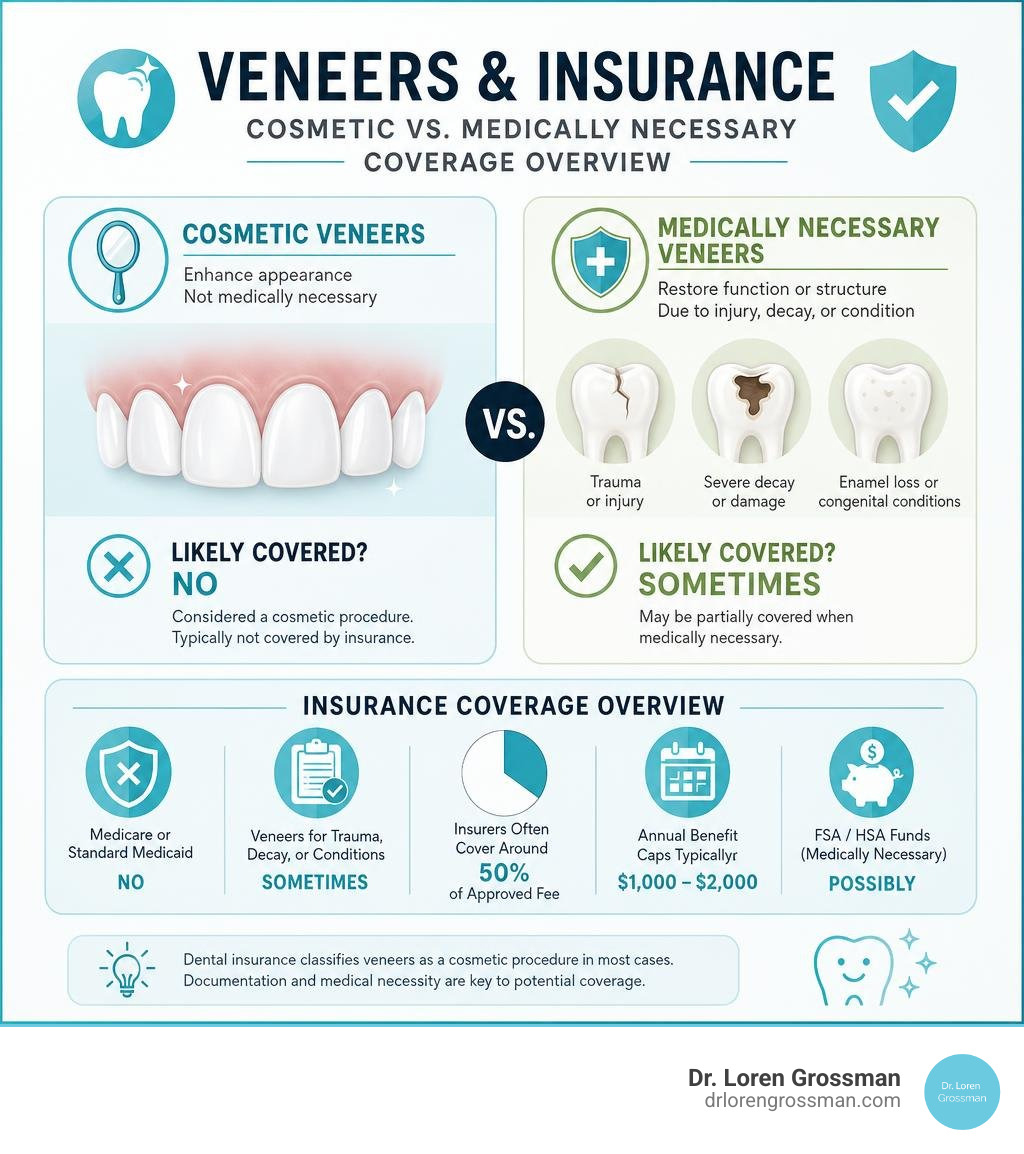
| Situation | Likely Covered? |
|---|---|
| Veneers for cosmetic reasons (whitening, gaps, minor chips) | No |
| Veneers to restore a tooth damaged by trauma or accident | Sometimes |
| Veneers for severe enamel loss or congenital conditions | Sometimes |
| Medicare or standard Medicaid | No |
| FSA/HSA funds for medically necessary veneers | Possibly |
The bottom line: Dental insurance classifies veneers as a cosmetic procedure in most cases. That means they fall outside what standard plans pay for. Even when insurers do contribute, they typically cover only around 50% of the approved fee — and most plans cap annual benefits at $1,000 to $2,000, which may not go far when a single porcelain veneer averages $1,765.
That said, there are real exceptions. If your veneer is needed to restore tooth structure damaged by injury, decay, or a medical condition, your plan may offer partial coverage. Knowing how to document and present your case makes all the difference.
I’m Dr. Loren Grossman, D.M.D., a cosmetic and family dentist serving the Wyoming Valley since 1984, with decades of experience helping patients navigate questions about whether veneers are covered by insurance while finding the best path to a confident, healthy smile. In this guide, I’ll walk you through exactly what affects coverage, how to give your claim the best possible chance, and what to do if insurance won’t help.
Are veneers covered by insurance terms made easy:
Introduction
At our practice in Kingston, Pennsylvania, we believe that everyone deserves a smile they are proud to show off. A smile makeover can do wonders for your self-esteem, but navigating the financial side of cosmetic dentistry can feel like trying to solve a complex puzzle. Many of our patients in Northeastern Pennsylvania ask us if they can use their dental benefits to offset the cost of their treatment.
While dental health and cosmetic aesthetics are deeply connected, insurance companies look at these two categories through very different lenses. To help you make an informed decision, we have put together this extensive guide to explain the fine print of dental plans, show you how to maximize your benefits, and outline alternative ways to make your dream smile highly affordable.
Are Veneers Covered by Insurance? The Short Answer

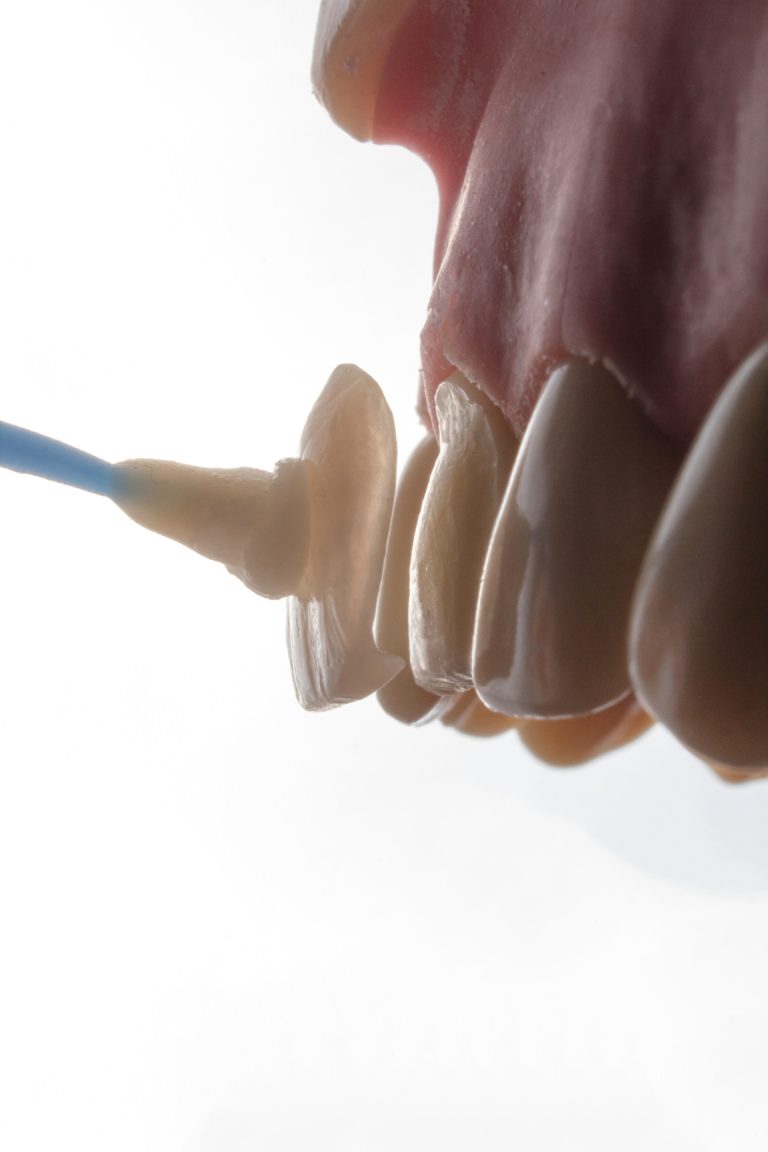
The short answer is almost always no when the procedure is performed purely for elective, cosmetic reasons. Standard dental insurance plans are built around preventive care (like cleanings and exams) and basic restorative care (like fillings). Because veneers are custom-made shells designed to cover the front surface of your teeth to hide stains, minor gaps, or slight alignment issues, insurers view them as elective luxury treatments.
According to the American Dental Association, cosmetic exclusions are standard across almost all employer-sponsored and individual dental plans. This means that if you are looking to get veneers simply to brighten your smile or make your teeth look more uniform, you will likely be responsible for the full out-of-pocket costs.
However, the fine print of your policy is where things get interesting. In certain circumstances where a tooth has suffered structural damage, some high-tier PPO plans may offer partial coverage. To get a deeper look at how dental plans categorize these treatments, you can read more about Does Insurance Cover Veneers? Understanding The Fine Print Of Dental Plans.
Cosmetic vs. Medically Necessary: The Key to Coverage
To understand how to get insurance to cover your dental veneers, you must understand the crucial distinction between cosmetic dentistry and restorative dentistry.
- Cosmetic Dentistry: Treatments performed solely to improve the appearance of your teeth without addressing an underlying disease, functional impairment, or structural defect.
- Restorative Dentistry (Medically Necessary): Treatments required to restore the function, integrity, and structure of a tooth that has been compromised by decay, trauma, infection, or developmental defects.
If we can demonstrate to your insurance provider that a veneer is serving a restorative purpose rather than a purely cosmetic one, we may be able to secure partial coverage. To understand what is physically involved in preparing and placing these custom shells, you can explore More info about the dental veneers procedure.
When are veneers covered by insurance for restorative needs?
There are a few specific scenarios where dental plans might provide partial coverage (typically around 50% of the approved restorative fee, subject to your yearly deductible and annual maximum):
- Accident or Dental Trauma: If you chipped, cracked, or fractured a tooth in an accident, a veneer may be deemed the most clinically appropriate way to restore the tooth’s structural integrity.
- Severe Decay or Failing Restorations: If a tooth has substantial front-surface enamel loss due to decay, or if an old filling has failed and a veneer is required to protect the remaining tooth structure, it may qualify.
- Congenital or Developmental Conditions: Genetic anomalies like Amelogenesis imperfecta (which causes thin, malformed enamel) or severe dental fluorosis that compromises the physical strength of the tooth can establish medical necessity.
In all of these restorative cases, thorough clinical documentation is the key to approval. For a deeper dive into how different insurance plans handle these exceptions, you can read Does Insurance Cover Veneers? Shocking Truths About Coverage.
When are veneers considered purely cosmetic?
Veneers are considered strictly cosmetic when they are used to address aesthetic concerns on healthy, structurally sound teeth. Examples include:
- Correcting minor gaps or spacing issues.
- Covering intrinsic stains or discoloration that teeth whitening cannot resolve.
- Reshaping slightly crooked or misshapen teeth to create a more symmetrical smile.
Because these issues do not affect your ability to chew, speak, or maintain basic oral health, insurers will classify the treatment as elective. If you are considering this path, it is helpful to know what to expect during the preparation and placement phases by reading More info about the veneers process.
How to Maximize Your Chances of Insurance Approval

If your case has a legitimate restorative component, we must take specific, proactive steps to build a compelling case for your insurance provider. You cannot simply submit a claim after the procedure and hope for the best.
To maximize your chances of approval, we utilize a process called a predetermination of benefits (also known as a pre-treatment estimate). Before we touch your teeth, we submit a comprehensive package of clinical evidence to your insurer, including:
- High-Resolution Intraoral Photographs: Clear visual proof of the structural damage, fracture, or decay.
- Digital X-Rays: Diagnostic imaging showing the health of the tooth’s root and surrounding bone structure.
- A Detailed Clinical Narrative: A written explanation from our team detailing why a veneer is the most conservative and durable restorative solution to protect your tooth.
By submitting this diagnostic package beforehand, the insurance company can review the medical necessity criteria under your specific plan. To learn more about the physical sensations and comfort levels associated with this preparation, take a look at More info about the painless truth of getting veneers.
How to check if your veneers are covered by insurance
We always advise our patient family in Kingston, PA, to verify their benefits before beginning any cosmetic or restorative journey. Here is a step-by-step checklist to help you check your coverage:
- Identify Your Plan Type: PPO plans offer the greatest flexibility and are the most likely to cover restorative veneers. HMO plans or discount plans rarely cover major cosmetic or restorative treatments.
- Locate the “Cosmetic Exclusion” Clause: Review your plan’s Summary of Benefits. Most plans explicitly state that they do not cover cosmetic procedures.
- Check Your Annual Maximum: Most dental plans limit their annual payout to between $1,000 and $2,000. If your veneers cost more than this limit, you will be responsible for the remaining balance even if the procedure is approved.
- Inquire About Waiting Periods: If you recently purchased an individual plan, there may be a 6-to-12-month waiting period for major restorative procedures.
To help you decide which material is best for your smile and your budget, explore More info about different types of veneers.
Comparing Veneer Types: Costs, Durability, and Insurance Impact
The material you choose for your smile transformation plays a massive role in the upfront cost, how long your results will last, and how insurance companies view the procedure. The two primary options are porcelain and composite resin.
| Feature | Porcelain Veneers | Composite Resin Veneers |
|---|---|---|
| Average Cost (Per Tooth) | $900 – $2,500 | $250 – $1,500 |
| Average Lifespan | 10 – 20 years | 5 – 7 years |
| Fabrication Method | Dental Laboratory (Requires 2-3 visits) | Chairside Bonding (Often 1 visit) |
| Stain Resistance | High (Highly resistant to coffee, tea, wine) | Moderate (Can stain over time) |
| Reversibility | Irreversible (Requires enamel removal) | Often reversible (Minimal to no prep) |
| Insurance Likelihood | Sometimes covered if used as a restorative crown alternative | Rarely covered by insurance |
When deciding on a material, many patients worry about the long-term health of their natural teeth. You can read a detailed analysis on this topic by visiting More info about whether veneers ruin your teeth.
Porcelain Veneers
Porcelain is the gold standard of cosmetic dentistry. These ultra-thin shells are custom-crafted in a professional dental laboratory to match the light-reflecting properties of natural enamel. They are incredibly durable, highly stain-resistant, and can last up to two decades with proper oral hygiene.
Because porcelain veneers require the removal of a very thin layer of enamel (usually about 0.5 mm) to fit flush against your gums, the procedure is permanent. If a porcelain veneer is approved by insurance for restorative reasons, the plan will typically cover up to 50% of the cost, though you will still be subject to your annual maximum. To see how porcelain can completely revitalize your smile, learn More info about porcelain veneers.
Composite Resin Veneers
Composite veneers are made from a tooth-colored composite resin (the same material used for dental fillings). They are sculpted directly onto your teeth by the dentist in a single visit. Because they do not require dental lab fabrication, they are significantly more affordable upfront.
However, composite resin is more porous than porcelain, meaning it is more susceptible to staining and chipping over time. They typically need to be replaced every 5 to 7 years. Because composite veneers are often viewed as a temporary or strictly aesthetic treatment, insurance companies are even less likely to cover them than porcelain restorations.
Alternative Financing and Payment Options
If your insurance provider denies your veneer claim, you do not have to put your dream of a beautiful smile on hold. We believe that financial constraints should never stand in the way of your confidence. There are several highly effective ways to finance your treatment:
- Flexible Spending Accounts (FSAs) & Health Savings Accounts (HSAs): These accounts allow you to use pre-tax dollars to pay for medical and dental procedures. While purely cosmetic treatments are generally excluded by the IRS, you can use FSA or HSA funds for veneers if we can document that the procedure is treating a structural or functional dental issue.
- Third-Party Financing (CareCredit): CareCredit works like a credit card specifically for healthcare expenses. Many participating dental practices offer promotional interest-free financing for 6 to 24 months, allowing you to break your treatment cost into manageable monthly payments.
- In-House Dental Savings Plans: Many modern dental practices offer custom savings plans for patients without traditional insurance. These plans typically provide discounts of 20% to 60% on major dental treatments, including cosmetic procedures, without yearly maximums or waiting periods.
Before committing to any cosmetic procedure, it is vital to understand the potential side effects and long-term care requirements. You can read More info about veneer side effects and risks to ensure you are fully prepared.
Frequently Asked Questions About Veneers and Insurance
What are the best alternatives to veneers that insurance is more likely to cover?
If you want to improve your smile but your insurance will not cover veneers, there are several alternatives that plans are much more likely to cover:
- Dental Crowns: A crown covers the entire tooth rather than just the front surface. Because crowns are used to strengthen weakened or severely decayed teeth, insurance plans typically cover them at 50% as a major restorative procedure.
- Dental Bonding: Using composite resin to repair minor chips or gaps is faster and cheaper than veneers. If the bonding is performed to repair a decayed or chipped tooth, it is often covered under “basic services” at 70% to 80%.
- Orthodontic Treatment: If you are seeking veneers to fix crooked teeth, traditional braces or clear aligners may be partially covered by orthodontic insurance riders, especially for younger patients.
How much do veneers typically cost without insurance in 2026?
In 2026, the national average cost for a single porcelain veneer ranges from $900 to $2,500 per tooth, with the national average sitting around $1,765. A full set of six to eight veneers across your visible smile line averages $15,486 in the United States.
These costs can vary based on geographic location, the complexity of your case, and the materials used. To learn more about customized treatment pricing and options in the Wyoming Valley, check out More info about veneers in Kingston, PA. You can also search for regional dental networks by visiting Veneer Near Me in Kingston, PA – Doctors Network.
What should I ask my dentist and insurance provider before the procedure?
Before moving forward, we highly recommend asking your dentist and your insurance representative the following questions:
- To your dentist: “What are the specific CDT (Current Dental Terminology) codes you will use for my treatment?”
- To your dentist: “Can you submit a predetermination of benefits to my insurer so I can see my exact out-of-pocket estimate?”
- To your insurance provider: “Do you offer any partial coverage for veneers if they are clinically necessary to restore a structurally damaged tooth?”
- To your insurance provider: “What is my remaining annual maximum benefit for this calendar year?”
Conclusion
At the practice of Dr. Loren Grossman, we are dedicated to helping our patients throughout Northeastern Pennsylvania achieve the beautiful, healthy smiles they deserve. Whether you are looking for a complete cosmetic transformation or need to restore teeth damaged by trauma or decay, our team in Kingston, PA, provides personalized care, advanced technology, and a warm, supportive environment.
We understand that navigating dental insurance can be stressful, and we are here to help you every step of the way—from submitting pre-treatment estimates to exploring flexible financing options. Ready to take the first step toward a brighter, more confident you? Transform your smile with dental veneers by scheduling your consultation with us today!
To learn more about planning your perfect smile, you can also explore: